
900 million people use ChatGPT every week. Google AI Overviews reach 1.5 billion monthly users. AI-referred traffic converts at 11.4% vs. 5.3% for organic search. And 93% of Google’s AI Mode sessions end without a single outbound click. AI search isn’t an emerging trend anymore.
AI search has stopped being theoretical.
The numbers are settled, user behavior shift is documented, and no one’s debating whether ‘it matters’ anymore. Because it matters.
The harder question, the one most trend pieces skip is what’s changing inside the system.
Which sources are AI models actually citing?
Where is the money moving?
What content formats are gaining ground and which ones are losing it?
We track AI visibility across platforms every day at Rankshift AI. Here are seven AI search trends that we believe are under-discussed, under-appreciated, or misunderstood, also backed by data and informed by what the sharpest practitioners in the industry are saying.
Some of them confirm what you’d expect (a few will probably surprise you!)
The 7 AI Search Trends That Are Quietly Rewriting Rules in 2026
The AI search trends that matter in 2026 aren’t the ones making headlines. They’re the ones quietly changing which brands AI decides to name and which ones it skips over entirely.
1. LinkedIn Became an AI Citation Engine (and Almost Nobody Saw It Coming)
This is the trend most people haven’t caught up to yet.
A Semrush study found that LinkedIn is the #2 most cited domains overall across ChatGPT Search, Google AI Mode, and Perplexity. On average, 11% of AI responses reference a LinkedIn URL, ahead of Wikipedia, YouTube, and every major news publisher.

(Source: Semrush)
Profound’s separate study of 1.4 million citations across six AI models found LinkedIn climbed from #11 to #5 on ChatGPT’s citation rankings between November 2025 and February 2026. For professional queries specifically, it’s #1 across every platform.
And here’s the split that makes this strategically interesting: on ChatGPT and Google AI Mode, 59% of LinkedIn citations come from individual creators, personal posts and articles. On Perplexity, it flips: 59% come from Company Pages.
So what does this actually mean for marketing teams?
It simply means:
- A CEO’s LinkedIn post about a product decision is now training material for the AI that potential customers consult before visiting a website.
- Employee advocacy programs, the kind most companies run half-heartedly, have graduated from “employer branding” to “AI citation acquisition.”
- And, the brands still treating LinkedIn as a job board while their competitors’ VPs are publishing twice a week are falling behind in a channel they can’t see in Google Analytics.
What this means: Your executives’ LinkedIn posts are now AI-discoverable content. Thought leadership isn’t a branding exercise anymore, it’s a citation strategy. Brands that invest in employee advocacy and executive publishing are building AI visibility in a channel most competitors are ignoring entirely.
2. The Content Funnel Inverted – Bottom-of-Funnel Now Wins AI Traffic
This one should trigger a serious content strategy conversation. Case studies and pricing pages are now the highest-performing content types for AI referral traffic. Top-funnel “what is” guides and generic how-tos? They’ve seen massive drops over the past two years.
Think about why.
When someone opens ChatGPT, the educational part of the journey happens inside the conversation. The user asks, “What’s the best LLM tracking tool for an enterprise?” and gets a synthesized answer covering features, pricing, tradeoffs. By the time they click through to a website, they’re not at the top of the funnel. They’re comparing. Evaluating. Deciding.
Eli Schwartz has been pushing this point: “I am encouraging my clients to think about where their search efforts might be best focused at the mid-funnel of the journey.” When companies take this approach, he’s seeing higher conversion rates from traditional search too, because AI-driven awareness qualifies users before they ever hit a Google result.
There’s a data point from Growth Memo that makes this concrete: the top 4.8% of URLs in ChatGPT answers, the ones cited 10+ times are in-depth pages that answer “what is it,” “who uses it,” “how to choose,” and “pricing” in a single URL.
Not four separate blog posts. One page doing the heavy lifting.
So, it’s pretty much clear: stop producing top-funnel content at volume and expecting it to drive AI traffic. Invest instead in comparison pages, transparent pricing breakdowns, case studies with real numbers, and comprehensive “how to choose” guides that collapse the funnel into one citable page.
3. Agentic Commerce Left the Lab – This Week
This one isn’t a forecast, it’s already LIVE.
Starting this week, Shopify merchants can sell directly inside ChatGPT, Google’s AI Mode, Microsoft Copilot, and the Gemini app through what Shopify calls “Agentic Storefronts.” Pricing, checkout, and inventory all sync from the Shopify admin. Brands that don’t use Shopify can join through a new Agentic plan and list products across those same channels.
Google’s Universal Checkout Protocol is live with Etsy and Wayfair. ChatGPT’s Agent Mode and Instant Checkout let users research, compare, and buy; all inside the conversation. McKinsey projects AI agents could mediate $3-5 trillion in consumer commerce by 2030. And 24% of consumers already say they’re comfortable with AI agents shopping on their behalf, rising to 32% among Gen Z.
But here’s the detail that doesn’t make the headlines: 92% of ChatGPT agent queries rely on the Bing Search API, and 63% of AI agents bounce immediately after landing on a page. The reasons? Slow load times, HTTP errors, CAPTCHAs, and bot blocking rules. Your site could be invisible to AI shoppers right now, and you’d have zero signal in your analytics.
Crystal Carter from Wix made the point sharply: “Focusing solely on being found is no longer enough… ignoring the agentic opportunity is a mistake.”
If your product data isn’t structured (Product schema, real-time pricing, machine-readable inventory) and your server can’t handle AI agent traffic cleanly, you’re losing sales that never show up as lost.
What this means: Your website needs to be agent-readable, not just human-friendly. Structured product data, real-time pricing, machine-readable availability, and fast server responses aren’t optional if you want AI agents to include you in their shopping recommendations.
Read our blog on how to optimize your ecommerce business for ChatGPT shopping.
4. ChatGPT Ads Arrived and the Organic Window Is Closing
OpenAI launched advertising inside ChatGPT in February 2026, starting with Free and Go tiers. Early placements are priced at roughly $60 CPM with a $200K minimum commitment. Reporting is limited to impressions and clicks, no sophisticated attribution yet. OpenAI’s COO described it as “an iterative process,” which is corporate for “we’re figuring it out as we go.”
Google, meanwhile, has been rolling shopping ads into AI Mode, which now serves 75 million daily active users. Perplexity has been testing sponsored answers since late 2024.
The pattern is one we’ve seen before.
A new channel emerges, organic reach is generous in the early days, ads arrive, and organic reach contracts.
Brands that built presence early get to defend it. Brands that waited get to pay for it. Google Search followed this arc in the 2000s. Facebook followed it in the 2010s. AI search is following it now, just compressed into months instead of years.
The organic AI visibility window isn’t closed. But every ad placement that enters the response pushes it a little further shut. The brands building citation authority now, before paid placements crowd the answer, are securing an advantage that gets more expensive to replicate with each passing quarter.
You need to understand how each AI platform discovers, ranks, and cites content, and optimize accordingly. Tools like Rankshift AI exist specifically for this: tracking your brand’s visibility, citations, and sentiment across ChatGPT, Perplexity, Gemini, and Google AI Overviews simultaneously.
5. Search Just Became a Camera and a Microphone, Globally
March 27, 2026, Google expanded Search Live globally to 200+ countries.
Users can now open the Google app, tap the Live icon, ask a question out loud, and get real-time audio responses. Turn on the camera, and Search can see what you’re looking at and respond accordingly.
This is live, powered by Gemini 3.1 Flash, and available to anyone with a Google app on Android or iOS.
Multimodal search stopped being “a 2027 thing” the moment Google made it available in 200 countries on the same day. The practical implication for content teams: text-only optimization is no longer sufficient.
AI systems are interpreting images, processing voice queries, and synthesizing video content, then citing the sources that provide the clearest, most structured information across all those formats.
Alt text, video transcripts, image metadata, descriptive captions; these have been on the “nice to have” list for years. They just moved to the “required for AI discoverability” list. If your content only exists as text on a page, you’re invisible to a search query that starts with a camera pointed at a product, a screenshot of an error message, or a voice question asked while driving.
6. Third-Party Mentions Now Outweigh Your Own Website
This is the single biggest strategic shift most marketing teams haven’t internalized.
Brands are 6.5x more likely to be cited through third-party sources than their own domains. 48% of AI citations come from community platforms. 85% of AI brand mentions are influenced by off-site sources.
Kevin Indig (former Shopify Head of SEO) framed the strategy clearly: “LLMs pull a lot of citations and mentions from third-party sites, especially as purchase intent gets stronger. So, the strategy is to publish thought leadership and research to improve brand mentions on other sites.”
Ethan Smith of Graphite offered the line that sticks: “Reciprocal mentions is the new reciprocal backlink.”
And Murat Yatağan (formerly Google, Microsoft) was direct about the implication: “Doubling down on on-site SEO while ignoring off-site partnerships is a losing game. If nobody else is talking about you, the AI won’t either.”
Read more: GEO vs SEO
This changes the job description for content teams. Digital PR, community engagement, expert roundups, podcast appearances, earned media placements, none of these are “nice to have” brand activities anymore. They’re direct inputs into whether AI cites your brand or your competitor’s.
The teams that understand this are restructuring their content operations around it. The teams that don’t are optimizing pages that AI isn’t even looking at.
7. Verified Expertise Is Beating Anonymous Content, Quietly but Clearly
This trend doesn’t generate LinkedIn hot takes because it sounds boring: Attach a real author to your content. Add Person schema. Build byline pages. Not exactly sexy.
But the data keeps pointing the same direction.
Lily Ray was blunt: “The days of writing a lot of upper-funnel content without providing unique insights, data, opinions or value, those days are over now.”
Murat Yatağan’s teams have seen measurable jumps in citation frequency when moving from anonymous “Staff” bylines to content backed by Person schema linked to credentialed authors. He calls it the “expertise trinity”: verified authors, accredited reviewers, credible references.
And there’s a structural reason this works. 44.2% of all LLM citations come from the first 30% of an article, the intro where authorship, credentials, and framing are established. The AI evaluates who wrote it before it decides whether to quote what was written. If it can’t determine who’s behind the content and why they’re qualified, citation probability drops.
Anonymous team posts are becoming invisible to generative engines. Not because AI has a policy against them; but because named, credentialed content provides the trust signals AI needs to justify a citation. The fix isn’t complicated. It just requires caring about authorship in a way most content operations haven’t had to before.
How Rankshift AI Helps You Track What’s Shifting
Reading about trends is one thing. Watching them play out across your brand in real time is another.
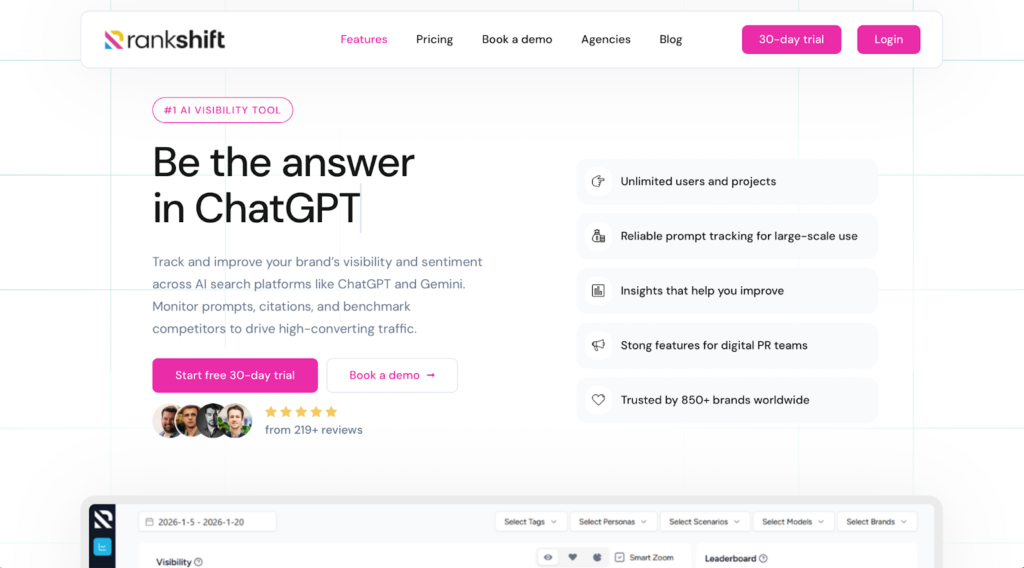
Rankshift AI tracks your brand’s visibility, citations, sentiment, and share of voice across ChatGPT, Perplexity, Gemini, Claude, and Google AI Overviews. It captures responses directly from the AI user interface, not API outputs, so you see exactly what your customers see.
The questions these seven trends raise are the questions Rankshift is built to answer.
- Which platforms are citing you and which are ignoring you?
- Where are competitors showing up that you aren’t?
- How is AI sentiment toward your brand shifting?
- Which third-party sources are shaping the narrative in your category?
- And are your citation patterns holding steady or decaying?
850+ brands use Rankshift to turn AI visibility from a blind spot into a measurable, optimizable channel. Setup takes three minutes. Start a free 30-day trial.
Where This Leaves Marketing Teams
If you’ve read this far, you’ve probably noticed something uncomfortable: the job just got harder.
Not because AI search is complicated to understand. The mechanics are fairly straightforward. It got harder because marketing teams now have two jobs running simultaneously.
Job one: keep winning in traditional search, where the fundamentals still drive the pipeline.
Job two: build visibility in a parallel discovery channel that cites differently, converts differently, changes monthly, and can’t be measured with any tool in your existing stack.
Most teams are still only doing job one. Some are dabbling in job two by running prompts manually and screenshotting the results. Very few are treating AI visibility as a managed, monitored channel with the same rigor they bring to organic search or paid media.
That gap between “aware of AI search” and “actually measuring and optimizing for it” is where the competitive advantage lives right now. Not in tactics. Not in content hacks. In the operational discipline of tracking what’s happening and responding to it before your competitors do.
Rankshift AI exists to close that gap. It monitors your brand’s visibility, citations, sentiment, and competitive position across ChatGPT, Perplexity, Gemini, Claude, and Google AI Overviews, in real time, from the actual user interface, not API approximations. 850+ brands already use it. Setup takes three minutes.
The trends in this piece will keep evolving. New platforms will emerge. Citation patterns will shift again. Agentic commerce will find its footing eventually.
The one constant is that the brands with visibility into what’s happening will outperform the ones flying blind.
Start there. Start a free 30-day trial
