
There’s a question your analytics can’t answer: “Does AI recommend my brand?”
You can track every Google click, every paid impression, every social share, but when a potential buyer asks ChatGPT which product to choose and ChatGPT doesn’t mention your brand, you simply lose a chance to compete.
The buyer simply never knew you existed; they picked a competitor the AI recommended, and moved on with their day. Because you were not there in the conversation to begin with.
This pattern is repeating across every industry. And the scary part is: most brands don’t know it’s happening. There’s no click to measure or no lost impression in analytics. The buyer asked AI for a recommendation, got an answer, and moved on, simple!
A study of 1 million non-branded queries across five major LLMs found that AI models mention brands in 26% to 39% of responses. ChatGPT Search alone includes brands in nearly 40% of answers. And early research from Seer Interactive shows this traffic converts at significantly higher rates than traditional Google organic.
This guide covers how AI decides which brands to mention, why Google rankings alone don’t guarantee AI visibility, and the eight specific tactics on how to improve brand mentions in AI. Let’s get started.
What Are Brand Mentions in AI?
Before going further, let’s get the terminology straight.
There are two ways your brand can appear in an AI response, and the distinction matters for your strategy.
- AI brand mention is when the model names your brand in its answer. For example, “For email marketing, tools like Mailchimp, Klaviyo, and ConvertKit are popular choices.”
That’s three mentions. No links, just brand names in the response.
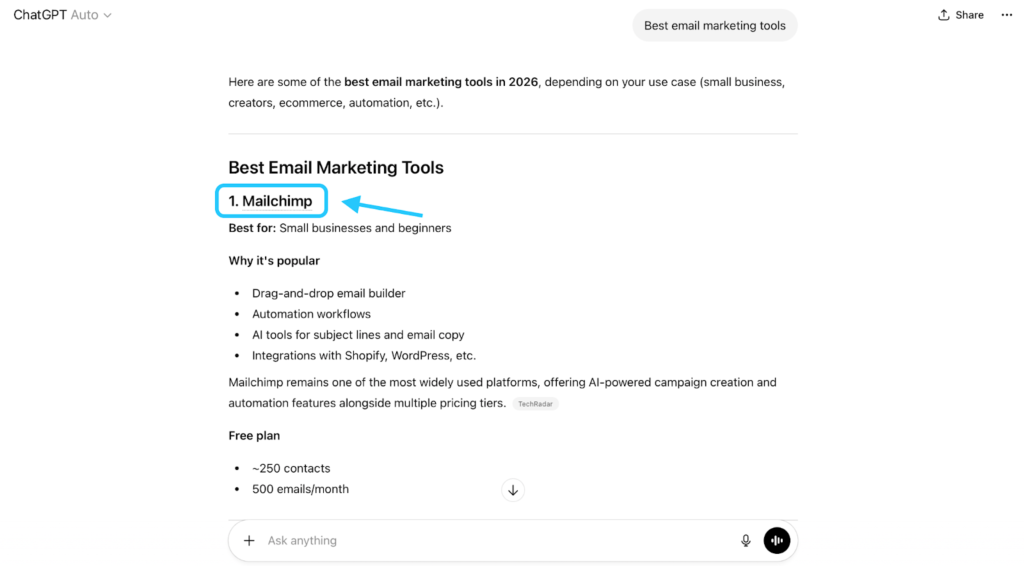
- AI citation is when the model links to a specific page on your site as a source. You might see your URL in the “Sources” section of a ChatGPT or Perplexity response, sometimes alongside the mention and sometimes without it.
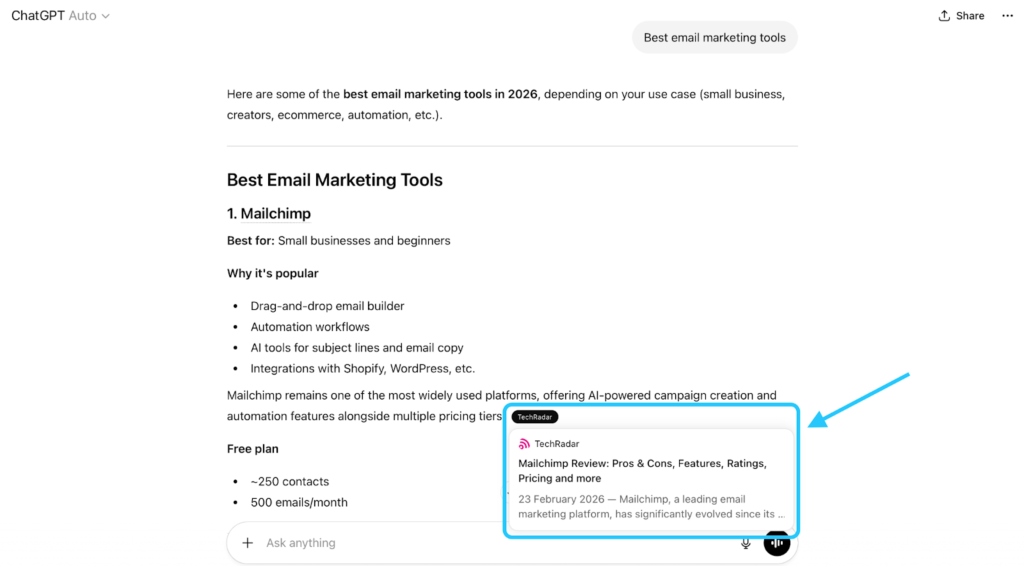
Here’s the part that trips people up: you can earn mentions without citations (the AI knows your brand but doesn’t link to your site), and you can be cited without being mentioned (the AI uses your page as a source but recommends a different brand in the answer text).
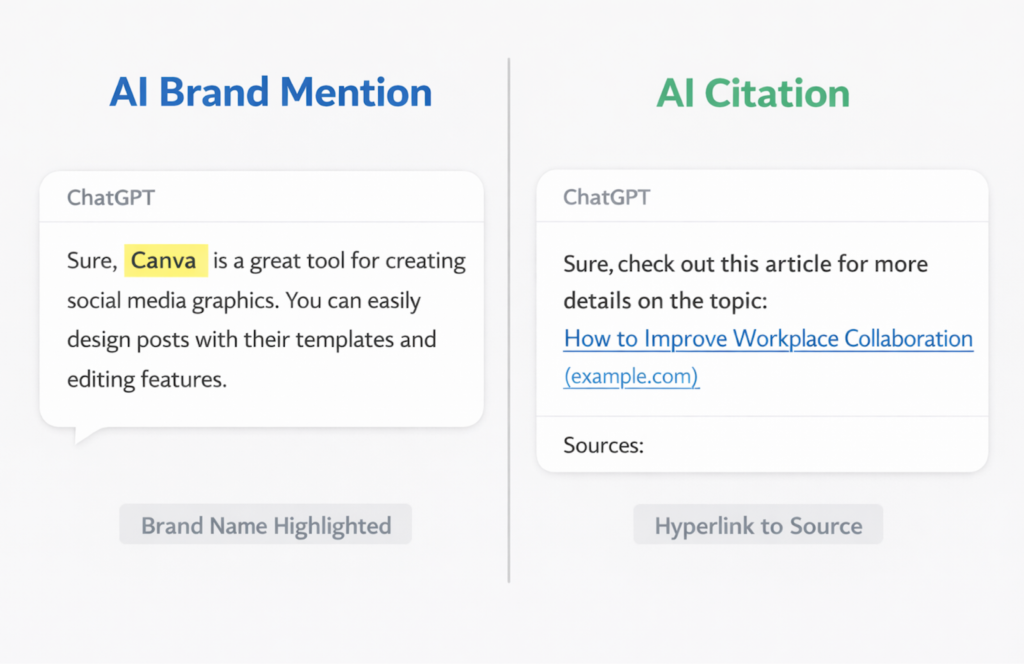
Ideally, you want both. But if you’re starting from zero, focus on brand mentions first. They put your brand in the conversation. Citations drive traffic.
How Do AI Models Decide Which Brands to Mention?
Before jumping into tactics, let’s understand how this actually works. Because it’s not the same as Google rankings, and the tactics that follow won’t make sense without this context.
LLMs Evaluate Your Brand’s Entire Web Footprint
Traditional SEO optimizes individual pages. AI visibility optimizes your brand as an entity. That one sentence will save you months of wasted effort if you internalize it.
Research on AI citation patterns consistently shows that the vast majority of brand mentions come from third-party pages: review sites, comparison articles, Reddit threads, news coverage, community forums, Wikipedia entries, YouTube transcripts. Not from brand-owned websites.
LLMs don’t just read your homepage and decide to recommend you. They’re scanning thousands of sources, looking for corroboration. If multiple credible, independent sources describe your brand in a consistent way, the model builds confidence. When that confidence crosses a threshold for a given prompt, your brand shows up in the answer.
SE Ranking’s research quantified part of this. They found that brands with active profiles on review platforms like Trustpilot, G2, and Capterra are roughly 3x more likely to be cited by ChatGPT than brands without that presence.
Your website is one input among many. If you’re only optimizing your own pages, you’re working on maybe 15-20% of the signal that determines whether AI mentions you.
What Makes Content “Citable” by AI
Beyond the “where,” there’s the “what.” Three qualities make content attractive to LLMs:
- Freshness: Pages not updated within 90 days are over 3x more likely to lose AI visibility compared to recently refreshed content. More than 70% of all pages cited by AI have been updated within the past year. (Source: AirOps)
- Structure: Clean heading hierarchies, FAQ sections, schema markup, and tables all make it easier for models to parse your content and extract usable statements. Vague marketing copy gets skipped. Specific, factual statements get cited.
- Corroboration: Every credible mention of your brand on a third-party site adds to the model’s confidence. It’s cumulative. A review on G2, a Reddit recommendation, a mention in a TechCrunch article, and a comparison on a niche blog all compound into a signal that’s stronger than any single mention alone.
Learn more about LLM Optimization.
Can SEO Rankings Alone Guarantee AI Mentions?
Short answer: NO.
Also, this is the most common misconception in AI visibility right now.
Of course, strong Google rankings help. Research shows the majority of URLs cited in AI responses also rank in Google’s top 10. But that means there are still URLs that don’t.
Plenty of brands rank well on Google and get zero AI mentions. And smaller brands with stronger distributed web presence consistently show up in AI answers despite weaker traditional rankings.
The gap comes down to a fundamental difference in how these systems work.
SEO rewards pages. AI rewards entities. You can have a technically perfect, beautifully optimized page and still be invisible to AI if your brand lacks the distributed web presence that LLMs need to feel confident recommending you.
I’ve seen this play out firsthand. A SaaS company with strong domain authority and solid rankings for competitive keywords was completely absent from ChatGPT’s recommendations in their category. Their competitors with half the DR showed up consistently. The only difference: those competitors had active G2 profiles with hundreds of reviews, regular Reddit mentions, YouTube tutorials, and guest posts on industry blogs. They’d built the entity-level presence that LLMs look for. The market leader had a great website and nothing else.
In short, SEO is necessary but not sufficient. It’s the foundation but then build the
Treat it as the foundation. Then build the entity layer on top.
8 Ways to Improve Brand Mentions in AI Search
Here are 8 strategies on how to improve brand mentions in AI search.
1. Find Pages LLMs Already Cites and Get Your Brand on Them
This is what I’d start with today if I were building an AI visibility strategy from scratch. It’s the fastest path to results because you’re working with the AI’s existing trust network rather than building a new one.
LLMs draw from a relatively stable set of sources for any given topic. If you get your brand mentioned on those specific pages, you’re inserting yourself directly into the answer pipeline.
How to do it:
- Run 15-20 prompts your ideal buyer would type into ChatGPT. Think conversational: “What’s the best CRM for small businesses?” not just “best CRM.”
Run each one across ChatGPT, Perplexity, and Google AI Overviews. For every response, note which URLs appear as sources. Those are your target pages.
- You’ll notice patterns. Most cited pages fall into a few categories: industry listicles (“best LLM tracking tools for enterprise”), comparison articles, review platforms, Reddit threads, and media coverage.
For each target page, figure out your path in. Can you pitch the author for inclusion in the roundup? Can you get listed on that review site? Can you contribute a helpful answer in that Reddit thread?
The quickest wins are pages that mention your competitors but not you. They’re already trusted by the AI. You just need to get added.
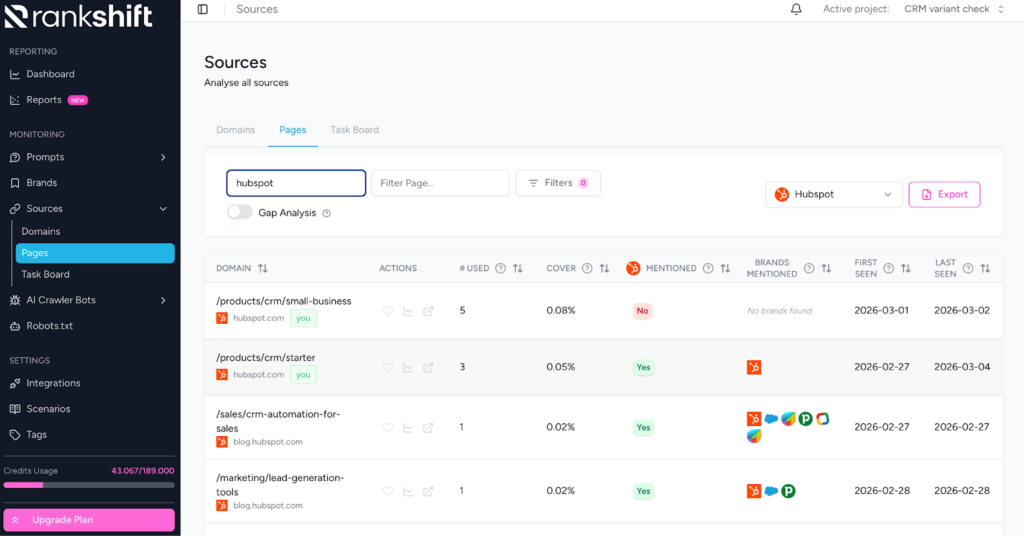
Rankshift automates most of this discovery. Its citation source analysis shows which pages and domains AI platforms rely on for your tracked prompts, and flags gaps where competitors appear but you don’t.
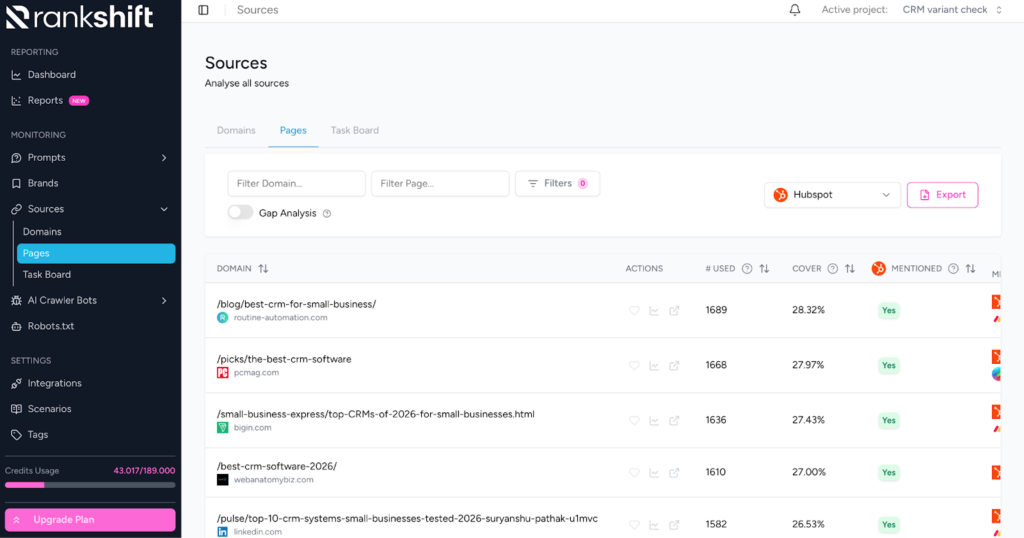
Instead of manually running dozens of prompts and logging URLs in a spreadsheet, you get a prioritized list of outreach targets sorted by how frequently each page gets cited across models.
For example: When someone asks ChatGPT “best email marketing tools,” the AI often pulls brand recommendations directly from specific roundup articles on G2. Getting your product featured in that exact article puts you in the AI’s answer.
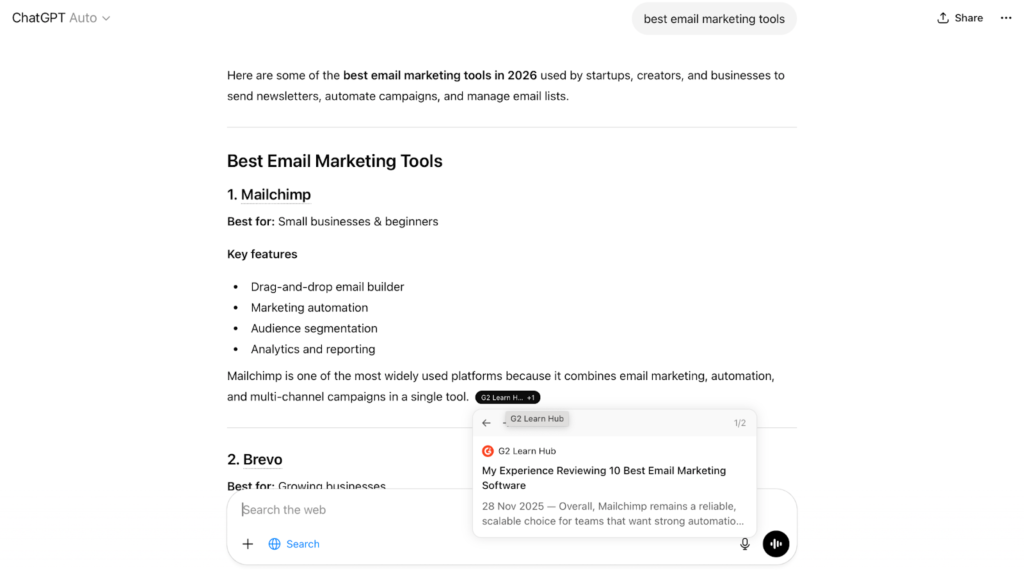
One successful outreach to a high-authority listicle can move the needle more than ten blog posts on your own site.
2. Build Brand Presence on Review Sites and Community Platforms
This is the unglamorous work that most marketing teams deprioritize. And it’s one of the most effective things you can do for AI visibility.
Community and user-generated platforms drive a disproportionate share of AI citations across every major model. Reddit, YouTube, LinkedIn, Wikipedia, and review sites like G2 appear as sources far more frequently than most brand-owned content.
SE Ranking found that brands active on Trustpilot, G2, Capterra, and Yelp are roughly 3x more likely to be cited by ChatGPT.
What this means practically:
- Review platforms are the lowest-hanging fruit. Claim and optimize your profiles on G2, Capterra, Trustpilot, and any industry-specific review platform. Fill them out completely. Then actively ask customers for reviews. The data suggests that simply having an active, populated profile makes a measurable difference in citation likelihood.
- Participate genuinely on Reddit in subreddits relevant to your industry (not as a brand billboard, but as a knowledgeable contributor.) When your product is a genuinely good answer to someone’s question, mention it naturally. Don’t pitch. Reddit users can smell marketing from a mile away, and they’ll bury you.
Here’s a subtle mention by a Reddit user that helped us gain visibility in AI.
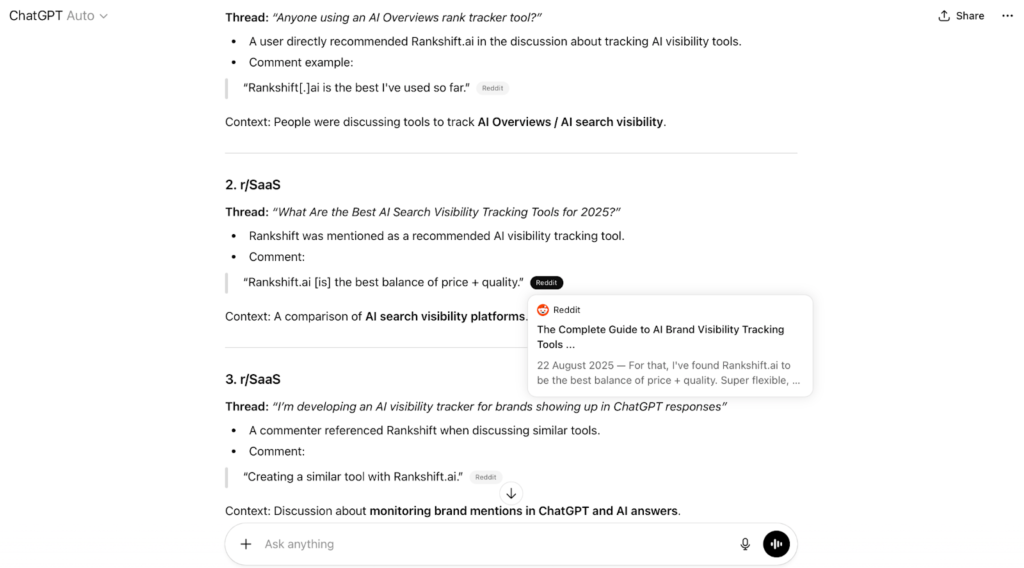
Reddit mention:
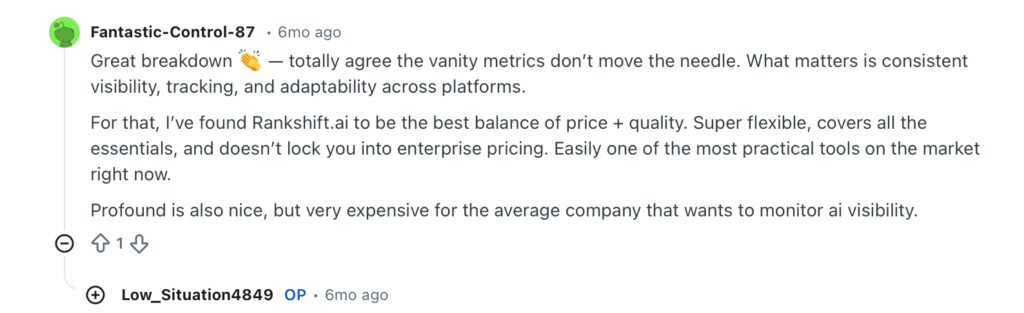
[Source: https://www.reddit.com/r/SaaS/comments/1mx1roc/the_complete_guide_to_ai_brand_visibility/]
Another amazing mention:

[Source: https://www.reddit.com/r/seogrowth/comments/1r6wila/you_can_call_me_a_professional_ai_visibility/]
- YouTube is consistently among the top three cited platforms across all major AI models. Create and maintain a YouTube channel with product demos, tutorials, and thought leadership. These don’t need to be polished productions. A clear screen recording with decent audio explaining how to solve a specific problem can be cited by AI and watched by real buyers at the same time.
- Wikipedia matters if your brand is notable enough for an entry. Make sure it exists, and check the facts periodically. Don’t try to write a promotional copy (it’ll be reverted within hours), but correct any errors and ensure the basic information is current.
Track which platforms are generating the most mentions using Rankshift’s citation source analysis. It shows which domains AI models cite most frequently in your category, so you can prioritize platform-building effort where it matters most.
3. Keep Your Content Updated (90 Days Is the Baseline)
LLMs treat freshness as a signal of reliability. And the data on this is hard to ignore. Research found that pages not updated in 90 days are over 3x more likely to lose AI visibility. More than 70% of pages cited by AI have been updated within the past year. (Source: AirOps)
If a competitor’s comparison page was refreshed last week and yours still says “updated 2023,” the model will choose the fresher source every time. This happens silently, you don’t get a notification that you’ve been dropped from AI answers, and your Google rankings may not change at all.
Pick your top 20 pages and put them on a quarterly refresh schedule. Product pages, comparison content, feature docs, pricing pages, and any blog post targeting high-intent queries. When you update, don’t just change the date. Add new data points, refresh screenshots, swap in current examples, remove anything outdated. LLMs can tell the difference between a meaningful update and a fake ‘just change the date’ one.
Add a visible “Last updated: [date]” timestamp to your key pages. This signals freshness to readers and crawlers alike. And prioritize refreshing pages that already rank well on Google, since there’s significant overlap between Google’s top results and AI-cited pages.
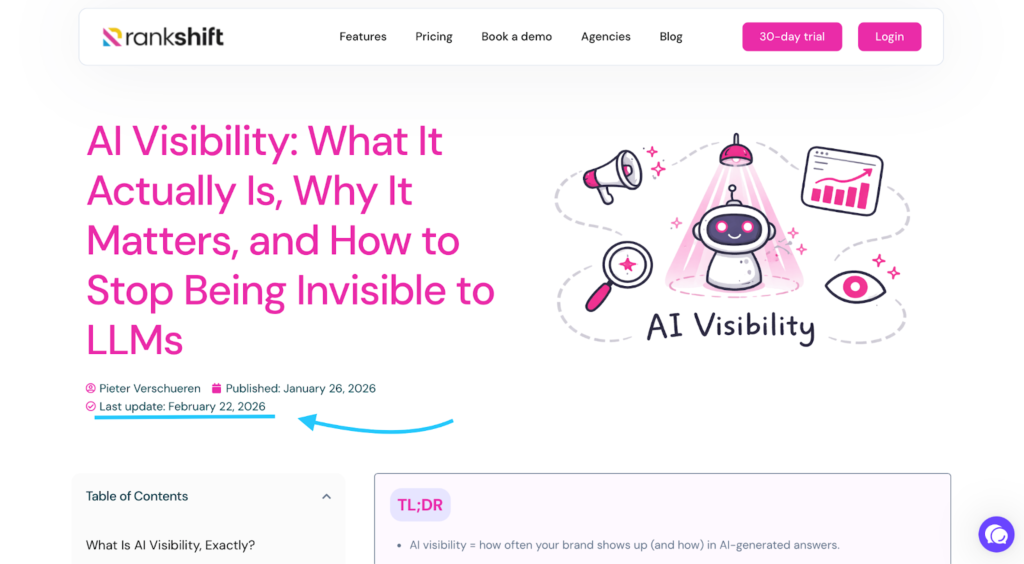
Use Rankshift to identify which of your pages are currently being cited by AI models and which have dropped off. If a page that was getting cited three months ago has gone silent, a content refresh is usually the fix.
Why not explore it yourself?
4. Structure Content So AI Can Extract and Cite It
AI models don’t read your content like a human reader does. They scan it, parse the structure, and look for clear, self-contained statements they can drop into an answer.
If your writing is vague or wrapped in marketing language, the model will skip you and cite someone who writes more plainly.
Write extractable statements. Compare these two approaches:
Vague: “Our platform helps companies streamline their workflows and achieve better outcomes across the organization.”
Extractable: “Acme is a workflow automation platform used by 2,000+ companies that reduces average task completion time by 40%.”
The second version gives the LLM a specific, quotable fact. The first gives it nothing to work with.
Structure matters at the technical level too. Use clear H2/H3 heading hierarchies that mirror how someone would ask a question. Put your strongest answer in the first one or two sentences under each heading. LLMs often extract from the opening of a section, so don’t bury the useful part under three paragraphs of context-setting.
Add FAQ sections with short, direct answers. Include tables and structured comparisons wherever you’d normally write list-heavy paragraphs. Implement Organization, Product, and FAQ schema markup.
And one practical detail that’s easy to miss: when you cite sources in your own content, spell out the name in the text (“According to Gartner…”) rather than only adding a hyperlink. LLMs don’t always follow links, but they read explicit source mentions in copy.
5. Optimize for Prompts, Not Just Keywords
People don’t type two-word queries into ChatGPT. They ask full questions in natural language. “What’s the best project management tool for a remote team of 15 people?” That’s a prompt, not a keyword. And your content needs to match how people actually phrase these questions.
Where to find the prompts your audience uses:
- Google Search Console is the starting point. Look for long-tail queries with 8+ words.
- GSC now captures AI Mode queries too, which tend to be more conversational than traditional searches.
- Reddit and forums are another goldmine because the way people ask questions in subreddits mirrors how they prompt AI tools almost exactly.
- Your own customer support tickets are pure gold too. The questions your customers already ask you are the same ones they’ll type into ChatGPT.
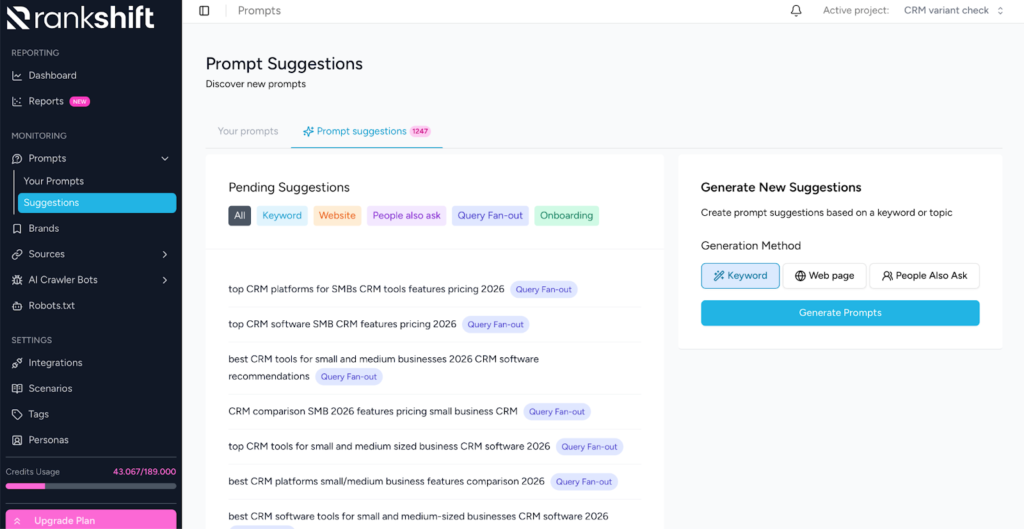
Rankshift’s Prompt Suggestions bridges the gap between your existing keyword list and AI-style queries. It converts traditional SEO keywords into the kind of conversational prompts people actually use in ChatGPT and Perplexity, and estimates search volume per platform so you can prioritize.
Moreover, it allows you to generate using 3 ways: Keywords, web page, and People Also Ask (PAA).
Build content around these prompts:
- Frame headings as natural questions: “What’s the best CRM for startups?” not “Best CRM Tools.”
- Answer the question directly in the first sentence or two after the heading.
- Cover prompt variations, because “Best CRM for freelancers” and “Affordable CRM for solo founders” will trigger separate AI answers even though they’re about the same topic.
6. Publish Original Research and Data Others Will Cite
This is the long game. But it’s one of the most durable ways to build AI visibility because it turns your brand into a source that other content references, rather than just another mention in someone else’s article.
When your brand comes up with a specific statistic that gets picked up across your industry, you become part of the AI’s knowledge graph. Every article, blog post, or social thread that writes “According to [your brand] data…” reinforces your authority in the model’s understanding. That citation trail is exactly what LLMs follow when deciding which brands to mention.
Search Engine Land highlighted original research as one of the most effective content types for LLM visibility. They specifically called out mini research drops, annual reports, and proprietary benchmarks as formats that stand out from generic web content. (Source: Search Engine Land)
You don’t need a dedicated research team. Survey 200 customers and publish the findings with clear visualizations. Analyze your own product data for trends your industry would care about (“We analyzed 10,000 email campaigns and found that subject lines under 6 words had 23% higher open rates”).
Publish annual benchmarks for your niche. Create a free tool or calculator that generates unique data for each user, which naturally attracts links and citations from writers covering your space.
Even a small dataset, if it’s original, useful, and clearly presented, will get referenced by other writers. And those references compound into the kind of distributed brand signal that LLMs rely on.
7. Earn Mentions in Editorial and Analyst Coverage
LLMs can distinguish between what a brand says about itself and what independent sources say.
A mention in a trade publication or analyst report carries more weight in the model’s trust calculation than the same claim on your own blog. Independent editorial validation is one of the strongest entity signals you can build.
Respond to journalist requests on platforms like HARO, Qwoted, or Help a B2B Writer.
When your CEO gets quoted by name and title in a published article that discusses your product category, that creates an entity signal the AI can connect: this person leads this brand, which is an authority in this space. The quote doesn’t even need to mention your product directly. The association between the expert, the brand, and the topic is what matters.
Pitch exclusive data to publications. Journalists always need numbers for their stories. If you’ve created original research (see #6), offer it exclusively to a publication that your target audience reads. The publication gets a scoop. You get a high-authority mention tied to specific data. And the AI learns that credible editorial sources associate your brand with the topic.
Build expert profile pages for your leadership team on your site. Include their name, title, credentials, areas of expertise, and links to their published commentary. This helps LLMs create clear entity associations between specific people and your brand.
And don’t overlook Bing optimization. ChatGPT and several other AI tools pull real-time information from Bing’s index. If you’re only optimizing for Google, you’re missing a significant AI citation pathway. Set up Bing Webmaster Tools, verify your site, and make sure your key pages are indexed there.
8. Allow AI Crawlers and Fix Technical Access
Before any other tactic on this list can work, AI crawlers need to actually reach your content.
This is table stakes. But a surprising number of brands have it wrong, often because they blocked AI crawlers in 2023-2024 during the initial panic about training data.
Checklist:
- robots.txt: Make sure GPTBot, ClaudeBot, PerplexityBot, and Bingbot aren’t blocked. If you blocked AI crawlers during the initial training data concerns, reconsider.
- Server-side rendering: LLMs process raw HTML, not JS-rendered content. If product info only appears after JavaScript runs, AI crawlers may miss it.
- No paywalls on key content: Gated content is invisible to AI. If your best material is behind a login, competitors’ open content gets cited instead.
- Consider llms.txt: This proposed standard gives AI crawlers explicit guidance about your content. Still early, but worth setting up.
Ensure that the AI crawlers are not blocked.
How to Track AI Brand Mentions and Measure Progress
AI visibility is volatile. The same prompt can surface different brands from one day to the next.
Research shows that only 30% of brands stay visible from one AI answer to the next, and just 20% remain present across five consecutive runs of the same prompt. (Source: AirOps)
That volatility makes consistent monitoring essential. You can’t just check once and assume you’re set. Track these metrics weekly:
- AI Share of Voice: What percentage of your target prompts mention your brand? This is your core KPI.
- Citation sources: Which third-party pages mention you, and are those pages being cited by AI models?
- Competitor gaps: Which prompts surface competitors but not you? These are your immediate outreach targets.
- LLM referral traffic in GA4: Set up tracking to identify visitors arriving from ChatGPT, Perplexity, and other AI platforms.
Learn more about how to track AI traffic in GA4. - Branded search volume: Users often discover brands through AI, then Google the name to validate. A rise in branded searches is often the first signal that AI visibility is growing.
Read more: How to track brand mentions in AI.
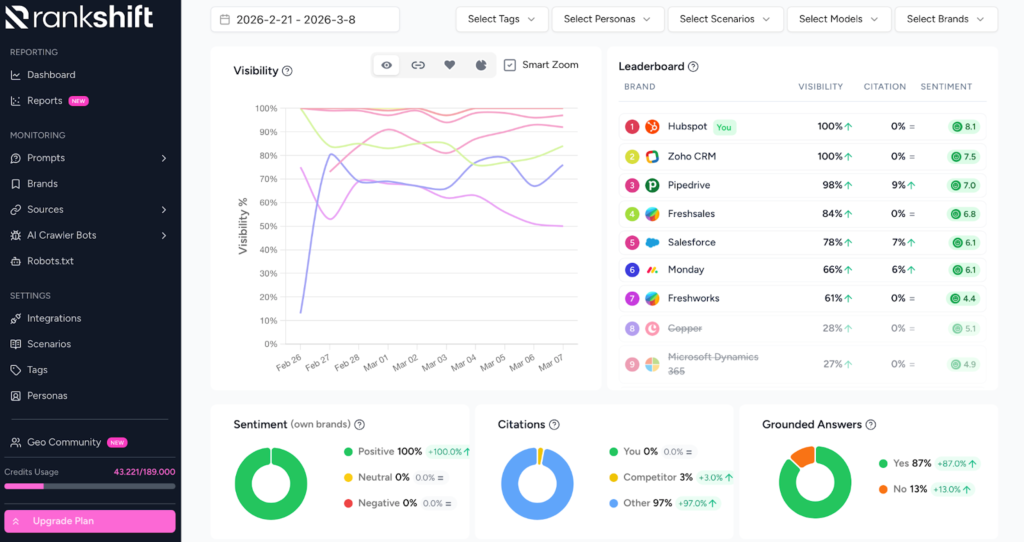
Rankshift tracks all of this across ChatGPT, Perplexity, Claude, and Gemini. You get visibility scores and share of voice over time, sentiment tracking that catches how AI describes your brand (not just whether it mentions you), citation source analysis showing which domains the AI trusts most in your niche, and competitive gap reports that flag exactly which prompts your competitors are winning and you’re not.
The citation source feature connects directly to tactic #1. It tells you which specific pages to target for outreach, turning monitoring data into an action plan.
You can start with a 30-day free trial and track your first prompts without a credit card.
Where This Is Heading
Paid AI placement is coming. Perplexity and OpenAI are both experimenting with sponsored results inside AI responses. When that happens, organic AI visibility will sit alongside paid AI visibility the same way organic and paid search coexist today.
The brands that built organic AI presence before the paid layer arrives will have the same structural advantage that early SEO adopters had over late movers a decade ago.
The window to build that advantage is right now. Not because AI search is new. Because most of your competitors haven’t started yet.
If you want to know where you stand, Rankshift gives you the picture in minutes: your AI share of voice, competitor gaps, citation sources, and sentiment across every major model.
Free 30-day trial, no credit card. Start with your top 10 prompts and see what comes back.
