
A growing share of buyers no longer start with a Google search or scroll through a category page. They open ChatGPT and type something like: “What is the best standing desk for a small home office?” or “Which protein powder has the cleanest ingredients?” And within seconds, they get a confident, specific answer with product names attached.
For ecommerce businesses, this is not a small shift. It is a new discovery channel with its own rules, its own ranking signals, and its own optimization logic. The good news: the playbook is not completely different from what you already know. The better news: most of your competitors have not figured it out yet.
This guide explains exactly how ChatGPT sources and surfaces products, and what you can do right now to improve your visibility inside it. We’ll cover various LLM optimization strategies and best practices.
How ChatGPT Actually Finds Products
Before you can optimize for ChatGPT, you need to understand what is happening under the hood when someone asks it a product question. There are two separate but connected systems at work.
The base model: brand reputation in training data
ChatGPT was trained on a vast corpus of text from across the internet: review sites, forums, editorial articles, comparison pieces, Reddit threads, and more. Brands that appear frequently and positively in that data have a built-in advantage. When someone asks a broad question like “what are the best running shoes?”, the model leans on this embedded knowledge to generate a response. This is why established brands with strong editorial presence tend to dominate early ChatGPT recommendations.
The implication for newer or smaller brands: you cannot win on training data alone, but you can build the kind of third-party presence that influences future model updates.
The real-time layer: shopping query fan-outs
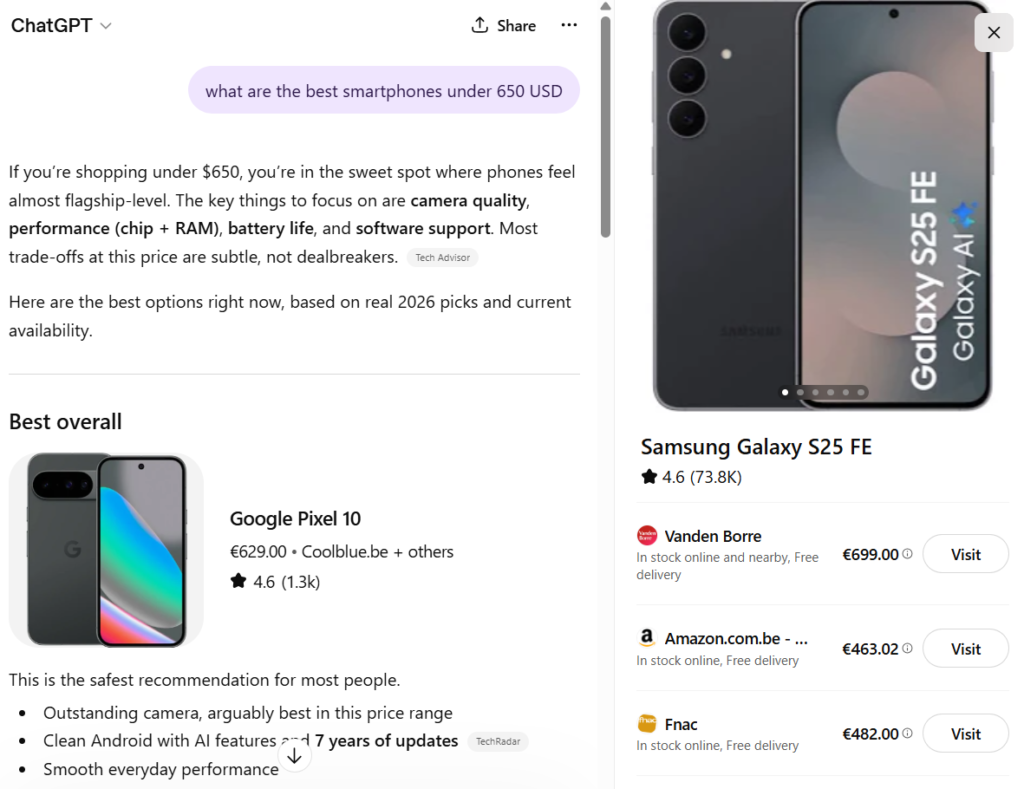
Here is where it gets interesting, and where most optimization guides stop short. Research has uncovered a mechanism called the shopping query fan-out. When a user asks ChatGPT a product-related question, the model does not simply answer from memory. It generates multiple derived search queries in the background and sends them to search engines to pull live product data.
The finding that has reshuffled thinking in this space: roughly 83% of the products appearing in ChatGPT shopping carousels are sourced from Google Shopping, not Bing. This is surprising given that ChatGPT is a Microsoft product and Bing Merchant Center is the expected feed source. But the data tells a different story: Google Shopping feeds are the dominant real-time input.

What this means practically: optimizing your Google Shopping feed is not just an advertising task anymore. It is core ChatGPT visibility work.
Step 1: Treat Your Product Feed as Your ChatGPT Listing
If ChatGPT pulls the majority of its real-time product data from Google Shopping, then your product feed is effectively your listing inside ChatGPT. Every field matters. Here is what to prioritize.
Write titles that answer questions, not just describe products
Standard SEO wisdom says to front-load your product title with the brand name and primary keyword. That logic still applies, but for ChatGPT you also need to think about the kind of natural language questions the model is processing. A title like “Ergonomic Office Chair with Lumbar Support, Adjustable Armrests, for Home Office” maps much better to conversational queries than “Office Chair Model X400 Black”.
Think about the user intent behind the query, not just the product specification. What problem is this product solving? Who is it for? Build those answers into your title structure.
Descriptions: features to benefits to use case
Product descriptions in your feed should follow a clear structure: start with the core feature, explain the benefit it delivers, and anchor it to a specific use case. This structure aligns with how ChatGPT synthesizes product information into recommendations. Example:
- Feature: “Carbon steel blade with full tang construction.”
- Benefit: “Maintains edge sharpness through heavy use.”
- Use case: “Ideal for professional chefs and home cooks who cook daily.”
Feed hygiene: the silent killer of AI visibility
Feed errors do not just hurt your Shopping ads. They suppress your visibility in AI-generated recommendations too. Before anything else, audit and fix:
- Missing or incorrect GTINs (Global Trade Item Numbers)
- Price mismatches between your feed and your product page
- Out-of-stock products that remain active in the feed
- Low-resolution or non-compliant product images
A clean, policy-compliant feed is the baseline. ChatGPT cannot recommend what the feed pipeline cannot reliably surface.
Step 2: Build Your Structured Data Foundation
Schema markup is the language search engines and AI systems use to understand what is on your page without having to infer it. For ecommerce, three schema types are essential for ChatGPT visibility.
Product schema
Every product page should have complete Product schema, including:
- name and description
- brand
- sku and gtin (whichever is applicable)
- offers (with price, priceCurrency, availability, and url)
Incomplete Product schema sends a weak signal. If ChatGPT is parsing your page to verify or enrich product data, missing fields make that harder and reduce your chances of appearing.
AggregateRating schema
Reviews are a major trust and ranking signal in AI product recommendations. But the signal only travels if it is machine-readable. Implement AggregateRating schema on every product with reviews, including the ratingValue, reviewCount, and bestRating fields. ChatGPT factors social proof into its recommendations, and structured review data is how that proof gets registered.
FAQ schema on category and landing pages
Category pages and buying guides are where FAQ schema pays off most. Structure questions the way buyers ask them to ChatGPT, for example “What should I look for when buying a mattress for back pain?” and answer them directly and specifically. This format maps naturally to the conversational query patterns that trigger ChatGPT shopping responses.
Step 3: Build Review Volume Across the Right Channels
ChatGPT draws on both structured data and unstructured text when forming product recommendations. Reviews and user-generated content on third-party platforms feed directly into the model’s base knowledge, and continue to influence it as training data is updated.
Focus your review strategy across three layers:
On-site reviews
Volume matters, but so does specificity. Generic five-star reviews contribute less signal than detailed reviews that mention specific use cases, compare the product to alternatives, or address common buyer concerns. Prompt your customers to write reviews that go beyond “great product” and into “I bought this for X purpose and it solved Y problem better than Z alternative.” That kind of language is exactly what ChatGPT draws on.
Third-party review platforms
Trustpilot, Google Reviews, and niche industry review sites all contribute to the web-wide signal that informs ChatGPT recommendations. Prioritize the platforms most relevant to your category. A kitchenware brand benefits more from presence on Wirecutter-style editorial sites than from generic business directories.
Reddit and community forums
Reddit is heavily indexed in AI training data and is one of the platforms where real product opinions live in an unfiltered form. Monitor the subreddits relevant to your product category. Engage authentically where appropriate. If your product gets recommended organically in community discussions, that is meaningful signal. If it never appears, that is worth understanding and addressing through content, PR, or community engagement strategies.
Step 4: Create Content That Matches How People Ask ChatGPT
Traditional SEO content targets keyword phrases. ChatGPT optimization targets questions and intent. The difference sounds subtle but it reshapes what you should be writing and how.
When someone asks ChatGPT a product question, the model generates multiple backend search queries to find supporting information. This is the fan-out mechanism mentioned earlier. A single question like “What is the best air purifier for allergies?” might fan out into queries like “best air purifier allergies review”, “HEPA air purifier allergy relief comparison”, “top-rated air purifiers for asthma 2026”, and more.
Your content needs to be visible across this range of derived queries, not just the head term. We recently researched the impact of prompt phrasing on AI brand visibility, and even the smallest wording change can trigger different results.
Buying guides and comparison content
Long-form buying guides that address specific buyer personas and use cases perform well in ChatGPT sourcing. Write a guide for “the best air purifier for a small bedroom” and a separate one for “the best air purifier for a large open-plan living space”. This specificity mirrors the way people phrase questions to AI assistants and increases the surface area of queries your content can appear for.
FAQ sections on product and category pages
Add a structured FAQ section to every major product and category page. Write questions exactly as buyers would type them into ChatGPT. Then answer them in two to three sentences: directly, specifically, and without fluff. Concise and useful answers perform better than long ones here because they are easier for the model to extract and synthesize.
Conversational product copy
Revisit your product page copy with a conversational lens. Does it answer the question a buyer might have asked to land there? If someone found your page through a ChatGPT recommendation for “lightweight laptop bag for daily commuters”, does your page copy speak directly to that use case? If not, it is worth updating. Aligning your on-page language with the intent behind the recommendation increases both conversion and the likelihood of being recommended again.
Step 5: Build Your Brand Footprint Across the Web
The longer-term lever for ChatGPT visibility is your brand’s presence in the kind of content that ends up in AI training data. This is slower to influence than feed optimization or structured data, but it is the difference between brands that get recommended as a default and brands that only appear when searchers already know their name.
Editorial mentions and press coverage
Coverage in publications that carry authority in your category, whether trade press, national media, or respected niche blogs, creates the kind of brand signal that AI models pick up on.
A product mentioned in a “best of” list on a high-authority site is more likely to surface in ChatGPT recommendations than one that exists only in your own product descriptions. PR and digital outreach (we also call it citation building) are, in this context, an extension of your AI optimization strategy.
Consistent brand naming across all channels
ChatGPT aggregates signals from many sources. If your brand name is inconsistent across your website, your feeds, your review profiles, and your social channels, the model has a harder time building a coherent understanding of who you are and what you sell. Standardize your brand name, product names, and category language everywhere. Consistency is not just a branding best practice; it is a machine-readability issue.
Comparison content that includes your brand
One underused tactic: create comparison content that honestly positions your product against named alternatives. “How our product compares to [Competitor]” pages do three things at once. They give buyers the information they would have searched for anyway. They create content that matches a specific and high-intent query pattern. And they establish your product as a named participant in the category conversation, which is exactly the signal AI models use when generating “best X vs Y” recommendations.
Step 6: Keep Your Merchant Center Accounts Healthy
Because ChatGPT pulls product data from Google Shopping in real time, your Merchant Center account health directly affects your AI visibility. This is a connection most ecommerce managers are not yet making, because Merchant Center has historically been treated as an advertising tool. It is now also a content distribution tool for AI.
Key account health areas to maintain:
- Zero product disapprovals related to policy violations, misrepresentation, or restricted content
- Price accuracy: the price in your feed must match the price on your page at all times
- Availability accuracy: products flagged as in stock but actually unavailable destroy trust signals
- Shipping and return information correctly populated in your feed
A healthy Merchant Center account does not guarantee ChatGPT visibility. But an unhealthy one is a reliable ceiling on how far your visibility can go.
Where to Start: A Prioritization Framework
If you are starting from scratch, here is a suggested sequence based on impact and effort:
| # | Action | Impact | Effort |
|---|---|---|---|
| 1 | Fix feed errors and Merchant Center disapprovals | High (immediate) | Low |
| 2 | Implement Product and AggregateRating schema | High | Medium |
| 3 | Rewrite product titles and descriptions for intent | High | Medium |
| 4 | Add FAQ sections to category and product pages | Medium | Low |
| 5 | Build review volume on-site and on third-party platforms | High | Medium |
| 6 | Create buying guides and comparison content | Medium | High |
| 7 | PR and editorial coverage in your category | High (long-term) | High |
Don’t forget to monitor your visibility with a ChatGPT tracking tool like Rankshift AI.
The Bigger Picture
ChatGPT optimization, and Generative Engine Optimization in general, is not a separate discipline that sits alongside SEO. It is a natural extension of it, applied to a new distribution channel with its own mechanics. The fundamentals are the same: make your products easy to find, easy to understand, and credible through third-party evidence. The execution details shift, but the underlying logic does not.
The businesses that will get brand mentions in AI are not the ones chasing the latest prompt trick or exploiting a temporary loophole. They are the ones that have invested in feed quality, structured data, genuine review volume, and authoritative content. That investment compounds over time, across every channel that uses similar signals, including traditional search, Shopping ads, and the AI layer sitting on top of both.
Start with your feed. Fix what is broken. Build what is missing. Then think about content. The window where early movers have a meaningful advantage is open right now, but it will not stay open forever.
