
“SEO is dead.”
“GEO is the new SEO.”
“If you’re not optimizing for ChatGPT, you’re already invisible.”
Scroll through LinkedIn for five minutes and you’ll see a dozen posts like these.
Every week there’s a new hot take, a new acronym, a new “the sky is falling” post from someone who discovered AI search last Tuesday.
Let’s skip the panic and look at what’s actually happening.
900 million people use ChatGPT every week. 60% of searches end without a click. Google’s AI Overviews appear in over half of all search volume. People aren’t abandoning search, they’re getting answers from a different kind of engine; one that doesn’t rank pages but cites them.
And the brands getting cited? They’re mostly the same ones with strong organic authority. So, no, SEO isn’t dead. But it’s no longer enough on its own either.
In simple terms, that gap between ranking and getting cited is what Generative Engine Optimization (GEO) addresses, it’s the practice of optimizing your content so AI platforms like ChatGPT, Perplexity, Google AI Overviews can find and cite your content in AI answers.
This guide is everything you need to understand GEO: what it actually is, why it matters right now (not eventually, right now), and what you should do about it.
What Is Generative Engine Optimization (GEO)?
Every marketer understands SEO: optimize content, rank higher, earn clicks. GEO applies the same logic to a different arena: AI engines instead of search engines.
Generative Engine Optimization is how you get your brand cited, mentioned, or recommended inside AI-generated answers across ChatGPT, Perplexity, Gemini, Google AI Overviews, and Claude.
The term “GEO” comes from a Princeton research paper, where researchers studied 10,000 queries and found that targeted optimizations like adding statistics, citing authoritative sources, and improving content structure, improved visibility in AI responses by up to 40%.
Since then, the discipline has matured rapidly. The acronym wars continue (AEO, LLMO, AIO – pick your fighter), but the core idea is settled: SEO gets you ranked. GEO gets you quoted.
When ChatGPT tells someone “the best Promptwatch alternatives are…” and your product is in that list, that’s GEO working. When Perplexity cites your blog post as a source in a comparison answer, that’s GEO working.
The goal isn’t to abandon SEO. It’s to extend your visibility into the places where discovery is increasingly happening.
Why Does GEO Matter Right Now?
The skeptic’s response is predictable: “AI search is still small. Google isn’t going anywhere.”
Fair instinct. Wrong conclusion. The numbers have moved well past the “interesting experiment” phase.
The Scale Is No Longer Debatable
ChatGPT crossed 900 million weekly active users in February 2026, more than doubled in twelve months. Google’s Gemini app has surpassed 750 million monthly users. Google’s own AI Overviews now appear in over 54% of all searches by volume.
And here’s the figure that reframes the entire conversation: monthly AI sessions are now 56% the size of traditional search worldwide. That’s not a niche but a parallel channel running at more than half the scale of the one marketers spent two decades mastering.
The Click Is Disappearing and AI Answer Is Replacing It
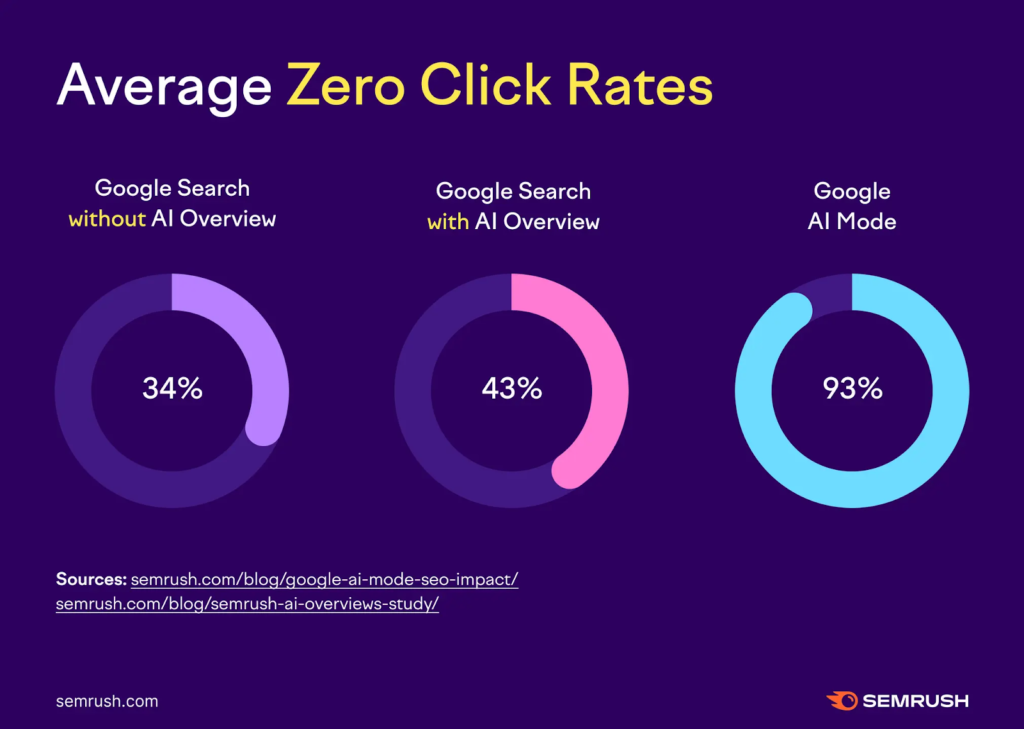
Roughly 60% of searches now end without a click and on mobile, it’s 75%.
As per Semrush, with more AI-driven responses, the likelihood of users clicking through to external sites declines.
(Source: Semrush)
Moreover, the CTR for position #1 when an AI Overview is present? Just 2.6%.
Position one. The spot entire SEO teams are built to capture, just delivering 2.6% when an AI summary sits above it.
The traffic didn’t vanish, the AI answer absorbed it. Users get what they need inside the AI response. And that response names specific brands, cites specific sources, recommends specific products. If you’re not inside it, you’re not in the consideration set.
This Isn’t Just Awareness But Revenue
ChatGPT-referred traffic to U.S. retail sites converts at 11.4%, compared to 5.3% for organic search. AI-referred visitors convert 86% higher than social media and 13% higher than organic.
And with OpenAI rolling out shopping features inside ChatGPT, users can now browse, compare, and purchase without leaving the conversation. Perplexity is testing sponsored answers. Google is embedding ads into AI Overviews. AI-native commerce infrastructure is being built in real time.
When an AI recommends your product by name with context, comparison, and a purchase link, that’s the most qualified referral channel to emerge in a decade.
The Early-Mover Window Is Closing
GEO today is where SEO was around 2010. The fundamentals are solidifying, measurement tools are maturing, and most brands haven’t even audited their AI visibility yet.
That’s the opportunity, and the clock is moving fast. ChatGPT went from zero to 900 million weekly users in three years. Google took a decade to reach a comparable scale.
The brands that built SEO early locked in compounding advantages that took competitors years to close. GEO is presenting the same window. It just won’t stay open as long.
GEO vs SEO: Complementary, Not Competing
This is the single most misunderstood aspect of GEO, and it’s where the loudest voices in the industry often get things wrong.
GEO doesn’t replace SEO. It never did. The two operate on the same foundation, i.e., quality content, topical authority, credible backlinks, clean technical structure. Strip away the acronym debate and you will see the similarities.
The divergence is in what happens after the content is discovered.
Search engines rank pages. Generative engines cite them. Google serves a list and lets the user choose. ChatGPT reads the sources, extracts the most relevant claims, and assembles a single synthesized answer, deciding for the user which brands deserve to be named.
That editorial step is the whole ballgame. And it’s why optimizing for generative engines requires a different lens, even if the raw material is the same.
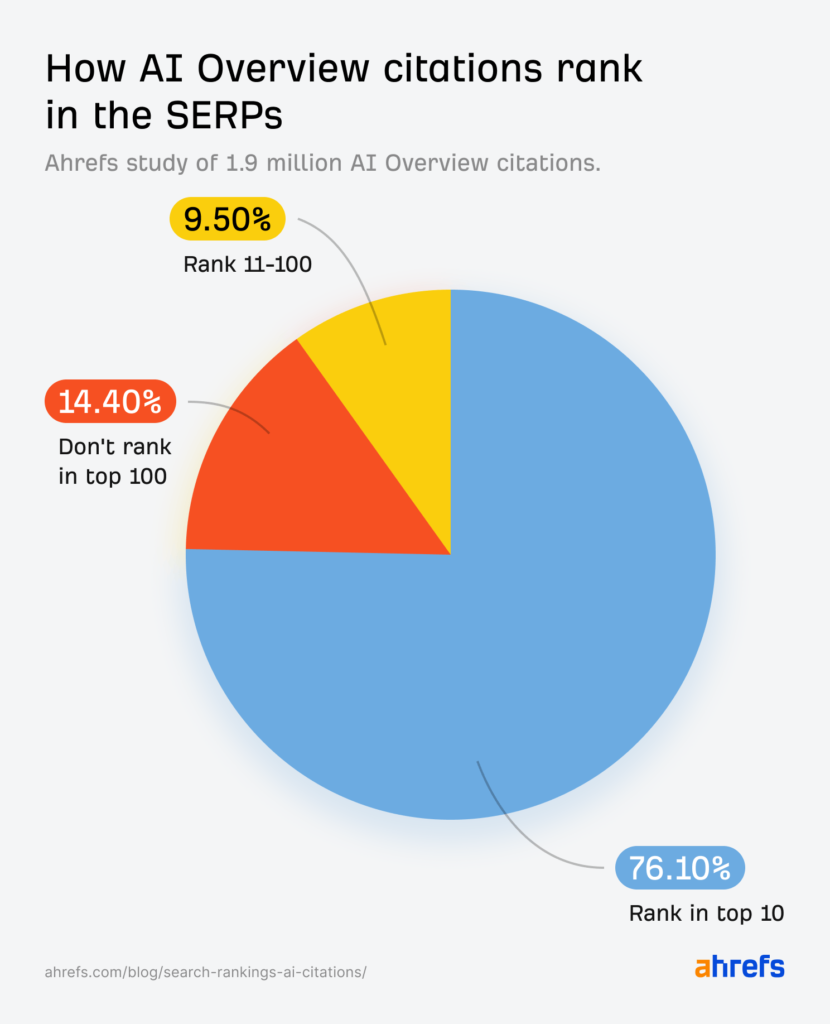
The data confirms the overlap. Ahrefs found that 76% of AI-cited pages rank in Google’s top 10. A Writesonic study of 1M+ AI Overviews showed 40.58% of citations come from the organic top 10. Strong SEO clearly feeds GEO performance.
(Source: Ahrefs)
But flip those numbers: 24% to 60% of AI citations come from pages that aren’t in the top 10. Some from outside the top 100 entirely. Organic ranking helps, but it doesn’t guarantee a seat inside the AI’s answer.
As Seer Interactive’s Wil Reynolds and team put it nicely: “You optimize for search engines, you influence AI.”
Here’s how the two disciplines compare:
| SEO | GEO | |
| Objective | Rank higher in search results | Get cited inside AI-generated answers |
| Target | Search engine algorithms (Google, Bing) | Generative AI models (ChatGPT, Perplexity, Gemini, AI Overviews) |
| Core signals | Keywords, backlinks, domain authority, technical health | Entity clarity, factual density, citation-worthiness, brand consistency |
| Content structure | Comprehensive depth, keyword relevance | Answer-first, extractable, short paragraphs, comparison tables |
| Success metrics | Rankings, organic traffic, CTR, conversions | AI visibility score, citation frequency, share of voice, sentiment |
| Discovery model | User clicks through to your site | Your brand appears inside the answer (click optional) |
The relationship between SEO and GEO isn’t either/or. It’s sequential. SEO builds authority and then GEO makes that authority legible to the machines assembling the answers.
Ignore SEO, and generative engines have nothing credible to cite. Ignore GEO, and your hard-earned authority stays locked inside search results that fewer users are clicking on.
For a deeper breakdown of how these two disciplines interact, and where the tactical differences actually matter, here’s a comprehensive GEO vs SEO comparison.
How Generative Engines Actually Work (And Why It Matters for GEO)
To optimize for generative engines, you need to understand at least broadly how they work. The mechanics are different from traditional search, and those differences explain why certain GEO tactics work.
Retrieval-Augmented Generation (RAG)
Most AI search experiences today use a process called Retrieval-Augmented Generation (RAG), or RAG. Here’s the simplified version:
1. Query decomposition: When a user types a complex question into ChatGPT or Perplexity, the system doesn’t paste the full prompt into a search engine. It breaks the question into smaller sub-queries, sometimes called “fan-out queries” and searches for each one separately.
If someone asks “What’s the best email marketing platform for a small e-commerce business with fewer than 10,000 subscribers?” the AI might separately search for “best email marketing platforms 2026,” “email marketing e-commerce features,” and “email platforms pricing under 10K subscribers.”
2. Information retrieval: The AI searches the web (and sometimes its own training data) for relevant sources. This is where crawlability matters, if AI bots can’t access your content, you’re out of the running before the competition even starts.
3. Source ranking and selection: The retrieved sources get ranked by relevance, authority, and factual density. The highest-scoring content becomes a candidate for citation. This is the step where GEO optimization has the most direct impact.
4. Response generation: The AI reads the selected sources and synthesizes a coherent answer. It doesn’t copy text verbatim, it understands concepts and rewrites them in natural language, pulling from multiple sources.
5. Citation attribution: Finally, the AI attributes information to specific sources by adding inline citations or links. Citation decisions depend on how directly a source contributed to specific facts in the generated answer.
Now, why does this matter for your strategy? Because it tells you what generative engines are actually looking for:
- Semantic clarity: Concepts explained without unnecessary jargon
- Structural organization: Clear headings, logical flow, scannable format
- Factual density: Statistics, data points, cited research
- Answer-first structure: The key information up front, not buried under paragraphs of context
Traditional SEO often rewards comprehensive, long-form coverage. GEO places more emphasis on content that’s easy to extract and reassemble, individual facts and claims that can stand on their own.
Training Data vs. Real-Time Retrieval
There’s another layer worth understanding. Generative AI systems surface information in two fundamentally different ways:
- Training data: The massive dataset the model was trained on. When a model answers from training data, it’s drawing on information that could be months or even over a year old. There’s no citation, no link, no way to trace where the information came from.
- Real-time retrieval: When the model searches the live web to augment its response. This is where citations appear, and it’s the layer that most closely resembles traditional search dynamics.
Most AI platforms today blend both approaches. And the balance varies by query. Some prompts get answers purely from training data (no citations). Others trigger live web searches with full source attribution.
Seer Interactive’s analysis highlights the training data cutoff dates for major models, which matters because if a model isn’t searching the web for a given query, the information it has might be a full year old:
- ChatGPT (GPT-5.2): August 2025
- Google Gemini (Gemini 3): January 2025
- Anthropic Claude (Claude 4.6): August 2025
For GEO practitioners, this creates a dual challenge. You need to influence training data (a longer-term brand-building play) and optimize for real-time retrieval (which functions more like traditional SEO). Monitoring which prompts trigger citations versus training-data answers will help you understand where GEO can have the most immediate impact for your brand.
A Practical GEO Framework: Six Steps to Get Started
Okay, so enough theory. Here’s a quick practical framework for building a GEO strategy that actually works.
Step 1: Make Sure AI Crawlers Can Actually Read Your Content
This sounds obvious, but it’s the most common problem. Before optimizing anything, you need to verify that AI bots can access your site.
- Check your robots.txt file: Many sites inadvertently block AI crawlers. Cloudflare recently changed its default configuration to block AI bots, if you use Cloudflare, your AI bot traffic may have been shut off automatically without you realizing it.
- Check your server logs: Look for user agents like “ChatGPT-User,” “PerplexityBot,” “Googlebot” (for AI Overviews), and “ClaudeBot.” If they’re not showing up, something is blocking them.
- Avoid client-side rendering for important content: AI crawlers generally can’t execute JavaScript the way a browser does. If your key content is rendered client-side, it might be completely invisible to AI systems. Server-side rendering is strongly preferred.
- Consider an llms.txt file: This is an emerging convention; a simple text file that helps AI systems understand your site structure and content hierarchy. It’s not universally adopted yet, but it’s a low-effort way to signal AI-friendliness.
Step 2: Map Your High-Value Prompts
Just as SEO starts with keyword research, GEO starts with prompt research. But instead of asking “What are people searching for?” you’re asking “What are people asking about AI?”
The prompts that matter most are the ones tied to buying decisions and brand evaluation things like:
- “What are the best [product category] tools for [use case]?”
- “Compare [your brand] vs. [competitor]”
- “Is [your brand] good for [specific need]?”
Run these queries yourself across ChatGPT, Perplexity, Gemini, and Google AI Overviews. Note which brands get mentioned, which sources get cited, and where the gaps are. If your competitor is showing up and you’re not, that’s your opportunity.
Build a list of 50-100 high-value prompts. Prioritize the ones with clear commercial intent, these are the moments where AI visibility translates directly into business impact.
Step 3: Structure Content for AI Extraction
Here’s where GEO diverges most from traditional content strategy. AI systems don’t read your content the way a human does, they extract specific facts, definitions, and claims to assemble into answers.
The Princeton GEO research found that content with statistics, citations, and structured information had 30-40% higher visibility in AI responses. The practical implications:
- Lead with the answer: Put the most important information at the beginning of each section. Don’t bury it under paragraphs of context. AI systems reward content that gets to the point.
- Use clear, hierarchical headings: H1 → H2 → H3 structure isn’t just good for SEO, research suggests that content with clear H1-H2-H3 structure gets cited 2.8x more often in AI responses.
- Write in scannable formats: Target short paragraphs as in two to three sentences maximum per paragraph. Long text blocks are harder for AI to parse and less likely to be extracted as a citation.
- Add statistics and data points: Every substantive claim should ideally be backed by a number. Content with specific statistics is up to 40% more likely to be cited by AI engines.
- Include comparison tables: AI models strongly prefer tabular data for multi-entity queries. If you’re writing about a category with multiple options, a structured comparison table gives AI systems exactly the format they need.
- Add an FAQ section: This might feel formulaic, but FAQ sections are disproportionately powerful for GEO. Each Q&A pair is a self-contained, extractable answer, exactly the format AI systems are looking for.
Step 4: Build Entity Clarity and Brand Consistency
AI engines don’t think in keywords. They map entities like people, products, companies, concepts, and their relationships to build an internal model of which sources are authoritative on which topics.
This is where GEO gets into territory that traditional SEO rarely touches.
- Implement schema markup: Organization, Product, Person, Article, and FAQ schema types give generative engines explicit, machine-readable context about your content and brand. This isn’t optional for serious GEO.
- Ensure brand consistency across the web: Your brand description on your website should match what appears on LinkedIn, Crunchbase, review platforms, and industry directories. When these signals are consistent, AI systems can categorize and reference your brand with higher confidence. When they conflict, you’re less likely to be mentioned.
- Build your Wikipedia presence: Wikipedia content makes up a significant portion of AI training data. Having an accurate, well-sourced Wikipedia entry for your brand can meaningfully increase the likelihood of being mentioned in AI responses. It’s not a guarantee, and it’s not something you can game, but if your brand is notable enough, a Wikipedia page is worth pursuing.
- Earn third-party mentions: This is where GEO and digital PR intersect. AI systems heavily weight third-party signals when deciding which brands to cite. According to one analysis, 85% of AI brand mentions are influenced by off-site sources. Getting mentioned on Reddit, industry publications, expert roundups, and community platforms like YouTube; these all feed the signals that AI models use.
Step 5: Prioritize Content Freshness
AI engines weigh recency heavily when selecting sources. A guide published in 2024 with no updates will consistently lose ground to a 2026 article covering the same topic.
This creates a GEO-specific challenge: AI citation decay. Content that ChatGPT cited last month can get replaced by fresher sources this month. Unlike Google rankings, which can persist for years, AI visibility shifts in weeks.
The practical response:
- Add clear “Last updated” timestamps to all content
- Refresh cornerstone content quarterly at minimum like update statistics, add new insights, revise outdated claims
- Maintain version history signals (e.g., “Version 2.1 – Updated March 2026”)
- Monitor your AI visibility continuously and prioritize refreshes for content where citations are decaying
Step 6: Create Original, Citable Research
This is the highest-leverage GEO tactic, and it’s the one most brands underinvest in.
If you publish something no one else has, as in, a benchmark study, a proprietary dataset, an original analysis, a unique framework, AI engines have a reason to cite you over dozens of lookalike alternatives. Original research, proprietary data, and expert commentary are citation magnets.
By publishing original data, you can create a resource that other publications reference, which reinforces their authority in AI training data, making you more likely to be cited in future AI answers. It’s a compounding cycle.
If you can invest in one thing for GEO, make it original research. Nothing else compounds quite the same way.
Now, you know how to improve AI visibility, let’s jump to how to measure GEO performance.
If you’re looking for a more detailed one, have a look at our GEO checklist.
How to Measure GEO Performance
This is where things get tricky. Traditional SEO has mature, well-understood metrics like rankings, organic traffic, click-through rates, conversions. GEO metrics are still evolving, and the measurement infrastructure is younger.
But the core metrics are becoming clearer:
AI Visibility Score: How often your brand appears in AI-generated responses for your target prompts. This is the GEO equivalent of “ranking.”
Brand Mentions: The raw count of how frequently your brand is named in AI answers, with or without a citation link. Learn more about how to improve brand mentions in AI.
Citation Frequency: How often AI engines link back to your specific pages as sources. Not all mentions include citations, so this is a more precise measure of content-level GEO performance.
Share of AI Voice: Your brand’s visibility relative to competitors for the same set of prompts. This is arguably the most strategic GEO metric as it tells you whether you’re gaining or losing ground.
Sentiment and Context: Not just whether you’re mentioned, but how you’re mentioned. Is the AI positioning your brand positively? Recommending you? Or citing you in a negative comparison?
AI Referral Traffic: Traffic coming to your site directly from AI platforms. Look for user agents like “ChatGPT-User” and “PerplexityBot” in your analytics.
Tools like Rankshift AI, Semrush Enterprise AIO, and others are building the dashboards and tracking infrastructure to make these metrics actionable. The space is maturing fast.
Read more: Key AI search metrics
Common GEO Misconceptions (Let’s Clear These Up)
“GEO is just SEO with a new name.”
Well, not quite.
The foundation is the same; quality content, authority, structure. But GEO introduces genuinely new optimization surfaces (prompt research, entity consistency, AI crawlability, citation decay management) and new success metrics (AI visibility, share of voice, sentiment). The tactics overlap significantly, but the measurement and monitoring are distinct enough that treating them as identical will leave real value on the table.
“You can’t influence what AI cites.”
This one has more truth to it than the GEO hype merchants would like to admit, you can’t control AI citations the way you can control on-page SEO elements. But you absolutely can influence them.
The Princeton research proved that specific content optimizations can improve visibility by up to 40%. Structured data, entity clarity, factual density, freshness signals, third-party mentions; these all demonstrably affect citation probability.
“It’s too early to invest in GEO.”
With 900 million weekly active users on ChatGPT alone and AI Overviews appearing in the majority of high-volume searches, the “too early” window has closed.
The question isn’t whether AI search is relevant to your brand. It’s whether you’re building visibility now while the competitive field is still relatively open, or waiting until your competitors have already established their positions.
As Foundation Inc.’s James Scherer put it well: “SEO is your space; your website, blog, technical optimization. GEO is all that stuff plus external influences. We don’t really optimize for generative engines; we influence them.”
“SEO is dead because of GEO.”
No. Full stop. The data consistently shows that strong organic search performance is one of the strongest predictors of AI citation. You need SEO as the foundation and GEO builds on top of it.
The Common Debate: Is GEO Even a Real Thing?
Worth acknowledging: there’s legitimate skepticism in the SEO community about GEO as a distinct discipline.
Rand Fishkin has argued that the proliferation of new acronyms (GEO, AEO, LLMO, AIO) is more confusing than helpful, and that the underlying work is simply “search optimization” applied to new surfaces.
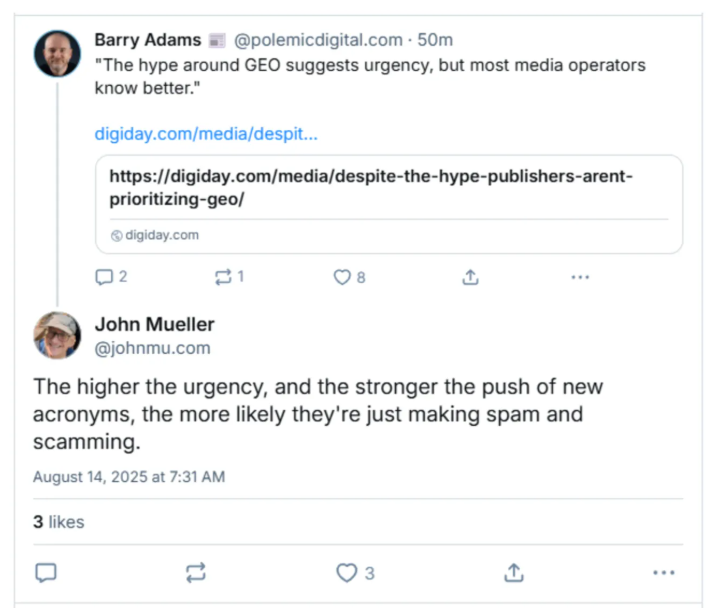
Google’s John Mueller has gone further, suggesting that aggressive promotion of AI SEO acronyms may signal spam tactics rather than genuine expertise.
These are fair critiques. The naming chaos is real, and there are absolutely bad actors selling fake “GEO services” that amount to nothing more than monitoring dashboards and vague recommendations.
But here’s where the skeptics and the practitioners agree: the behavior change is real. People are discovering brands through AI platforms. The optimization tactics for AI citation are related to but distinct from traditional SEO. And measurement requires new tools and new metrics.
Whether you call it GEO, AI SEO, or “the expanded scope of modern search optimization,” the work needs to happen. The name matters less than the strategy.
I’ve done a lot of research on what top players in the market are doing and here are 18 GEO agencies in 2026 that you can try working with.
Where GEO Goes From Here
GEO in 2026 is where SEO was around 2010. The fundamentals are becoming clear, the measurement tools are emerging, and early movers are building advantages that will compound over time.
A few things we expect to see in the next 12-18 months:
- Multimodal optimization will matter more. As AI platforms increasingly process images, video, and audio alongside text, not just text, brands will need to think about GEO across content formats. The global multimodal AI market surpassed $1.6 billion in 2024 and is growing fast.
- AI citation will become a conversion channel, not just an awareness metric. With shopping features rolling into AI platforms, the line between “getting cited” and “generating revenue” will blur significantly.
- Consolidation in GEO tooling. Right now the market is fragmented; dozens of tools tracking different aspects of AI visibility. Expect consolidation, with the strongest platforms (like Rankshift AI) offering end-to-end visibility, optimization recommendations, and competitive intelligence in a single dashboard.
- GEO will become a cross-functional discipline. It’s not just the content team’s job. GEO lives at the intersection of content marketing, SEO, digital PR, and product marketing. Brands that treat it as a siloed initiative will underperform those that integrate it across functions.
Track, Measure, and Improve Your AI Visibility with Rankshift AI
Everything we’ve covered in this guide boils down to one operational reality: you can’t optimize what you can’t measure.
And until recently, measuring AI visibility meant manually typing prompts into ChatGPT, screenshotting the responses, and maintaining a spreadsheet that went stale within a week.
Well, switch to real LLM tracking tools like Rankshift AI.
Rankshift AI helps to track your brand’s visibility across every major generative engine like ChatGPT, Perplexity, Gemini, Claude, and Google AI Overviews, and turns raw AI responses into actionable data.
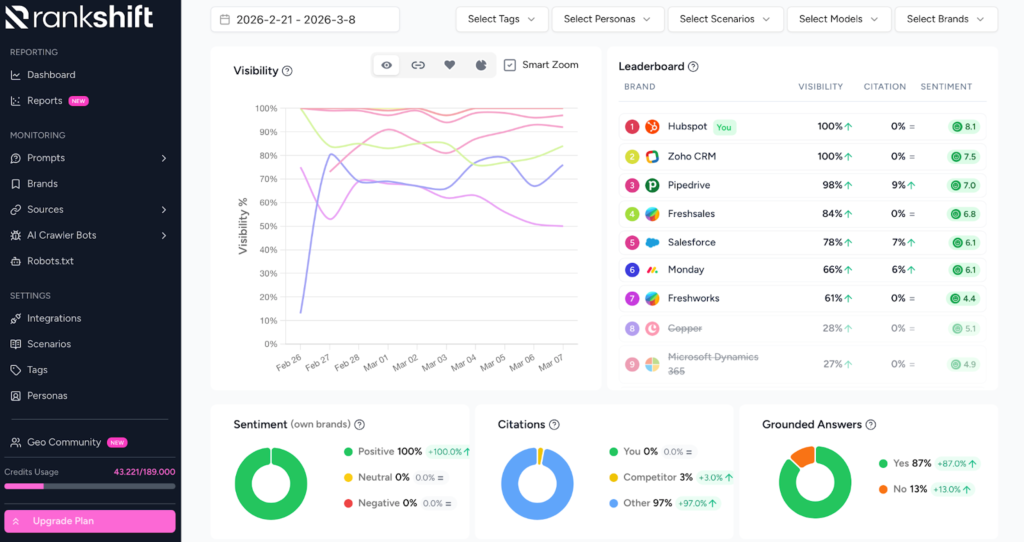
What it actually does:
- Prompt monitoring at scale: Track how your brand appears across hundreds of prompts, across multiple AI platforms, without the manual labor. Rankshift captures responses directly from the AI user interface, not API outputs, so you see exactly what your customers see.
- Visibility score and share of voice: Know where you stand relative to competitors for the prompts that matter to your business. Not vanity metrics, the same competitive benchmarking logic that made SEO tools indispensable, applied to AI search.
- Sentiment analysis: It’s not enough to know whether AI mentions you. You need to know how. Rankshift surfaces the themes, strengths, and weak spots that AI associates with your brand, so you can shape the narrative, not just observe it.
- Citation source intelligence: Discover which sources AI engines trust in your niche. See whether your content is being cited, or whether competitors and third-party publications are shaping the conversation without you.
- AI crawler logs: Track when AI models crawl your site, which pages get cited most, and where the gaps are. The kind of technical visibility that most teams don’t even know they’re missing.
850+ brands already use Rankshift to monitor and improve their AI search performance. Setup takes three minutes.
Final Thought
GEO isn’t a trend. It isn’t a fad. And it isn’t replacing SEO.
It’s the second chapter of the same story, how brands get discovered online. Chapter one was about ranking in a list. Chapter two is about being woven into an answer. Both chapters matter. But only one of them is still being written.
The fundamentals haven’t changed: build authority, publish substance, earn trust. What’s changed is that a new audience ‘generative AI’ is now reading your work and deciding in real time whether you’re worth quoting. That audience is growing faster than any search engine ever did, and the brands it cites today will compound that advantage tomorrow.
So start. Audit where your brand appears across ChatGPT, Perplexity, Gemini, and AI Overviews. Identify the gaps. Fix the technical blockers. Structure your best content for citation. Publish research worth referencing. And track all of it with Rankshift AI or whatever gives you the data to move from instinct to strategy.
The AI already has opinions about your brand. Time to find out what they are, and start shaping them.
Ready to win in AI search?
