
Two years ago, the question every marketing team asked was “where do we rank on Google?” Now it’s “does ChatGPT even know we exist?”
That shift created a whole new software category, and it filled up fast. Generative Engine Optimization, AI visibility, answer engine optimization, whatever you want to call it, there are now dozens of tools promising to get your brand mentioned inside AI answers. Two of them get compared a lot: The Prompting Company and Rankshift.
They sound like competitors. They’re really not. They solve the same problem from opposite ends, and picking the wrong one is an expensive mistake.
Full disclosure before we go further: we build Rankshift. So read this the way you’d read any vendor comparison, with one eyebrow raised. What we’ve tried to do is be specific and checkable rather than vague and flattering. Where The Prompting Company does something we don’t, we say so plainly. You’ll find that section below, and it’s not padding.
The Prompting Company vs. Rankshift at a glance
| The Prompting Company | Rankshift | |
|---|---|---|
| Best for | Enterprise teams who want AI-optimized pages built and hosted for them | Marketers and agencies who need to measure AI visibility and act on it |
| Core approach | Generate and host AI-friendly pages on a subdomain so LLM crawlers find them | Track what AI engines actually say about you, then close the gaps |
| How data is collected | Prompt probing plus crawler traffic on hosted pages | Responses captured from the real AI user interface, not the API |
| Engines covered | Tiered. ChatGPT, Perplexity, and Gemini on Basic. Google AI from $299/mo. Claude and DeepSeek from $2,500/mo | ChatGPT, Gemini, Claude, Perplexity, Google AI Overviews, Google AI Mode, and more, on every plan |
| Prompts included | 25 (Basic plan) | 150 (Starter plan) |
| Seats and projects | Tied to your plan tier | Unlimited seats, unlimited projects, unlimited websites on every plan |
| Content generation | Metered. 0 articles on Basic, 8 on Pro, 100 on White glove | AI-ready articles built from real LLM responses and top cited sources, published on your own domain |
| Content optimization | Not on the Basic plan | Included |
| Standout feature | AI agent usability testing | AI crawler logs and citation gap analysis |
| Free trial | Yes, on Basic and Pro | 30 days, no credit card |
| Pricing | $99, $299, or $2,500/mo, plus custom Enterprise | From €69/month |
What The Prompting Company does
The Prompting Company is a Y Combinator-backed startup that raised a $6.5M seed round in late 2025 from Peak XV, Base10, Kearny Jackson, and YC. The founders previously built Typedream (acquired by beehiiv) and Cotter (acquired by Stytch), which is a genuinely strong pedigree, and they’ve picked up recognizable customers including Rippling, Rho, Motion, and Vapi.
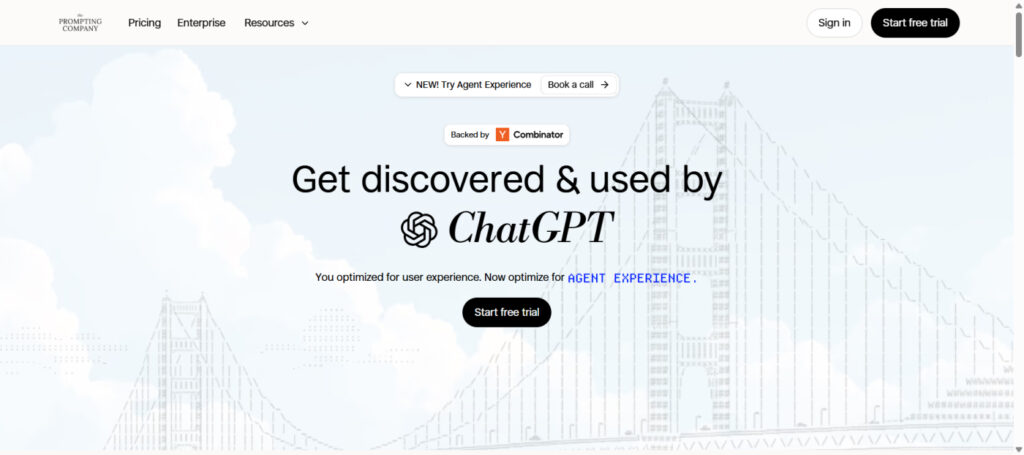
Their thesis is blunt: your website is built for humans, and AI crawlers hate it. Navigation bars, cookie banners, marketing fluff, JavaScript. So The Prompting Company builds a second version of your site, stripped-down markdown pages designed purely for machines to parse, and hosts it on a subdomain (typically something like ai.yourdomain.com). Then it routes AI crawler traffic there.
Around that core, they’ve built:
- Prompt discovery. Surfaces the commercial-intent questions people actually ask AI in your category, with daily suggestions.
- Automated content creation. Generates AI-optimized pages, though the number you get is metered by plan: none at all on Basic, 8 articles a month on Pro, 100 on White glove. The half-a-million-page deployments you read about are custom Enterprise arrangements, not something you buy off the pricing page.
- AI traffic dashboard. Shows crawler hits on those hosted pages, and distinguishes training crawlers from live inference bots (the ones fetching your page mid-conversation because a user just asked about you).
- Agent usability testing. Can an AI agent read your docs, call your API, and complete a real workflow on your product? Almost nobody else is doing this.
The Prompting Company pros:
- Genuinely end-to-end. It doesn’t just tell you that you’re invisible, it goes and does something about it.
- Agent usability testing is a real, differentiated feature.
- There is a free trial on the Basic and Pro plans, so you can look before you commit.
- Serious funding and a founding team with two exits behind them.
The Prompting Company cons:
- The pricing page is where it gets uncomfortable. See below.
- Your visibility lives on their infrastructure. Cancel, and the pages go with it.
- Core engines are paywalled. You cannot track Claude or DeepSeek at all until you’re paying $2,500 a month.
- Almost no independent reviews. Zero on G2 at the time of writing.
- Thin on analytics. There’s very little public evidence of citation analysis, sentiment tracking, share of voice, or historical trends.
The Prompting Company pricing: Four tiers. Basic at $99/month covers ChatGPT, Perplexity, and Gemini, generates zero articles, and has no content optimization. Pro at $299/month adds Google AI and gives you 8 generated articles a month. White glove at $2,500/month is the tier they recommend, and it’s the first one that includes Claude and DeepSeek, with 100 articles. Enterprise is custom. Free trial available on Basic and Pro.
Read that again, because it’s the whole story. The $99 plan is a tracker with no content generation at all. To generate a meaningful volume of content, or to see what Claude says about you, you’re at $2,500 a month.
What Rankshift does
Rankshift starts from the other end. Before you spend a cent producing content, you should know what the AI engines are already saying about you, who they’re recommending instead, and which sources they trust when they do it.
So Rankshift tracks your prompts across ChatGPT, Gemini, Claude, Perplexity, Google AI Overviews, and Google AI Mode, and reports back on:
- Visibility score and share of voice. How often you appear, and how much of the conversation you own versus each competitor.
- Citation and source analysis. Which exact URLs the models pull from when they answer. This is the single most actionable data point in GEO, because it tells you which sites to get on.
- Sentiment. Not just whether you’re mentioned, but how you’re described.
- Historical snapshots. AI answers change constantly. Rankshift stores previous responses so when you drop out of an answer, you can see exactly when it happened and who replaced you.
- AI crawler logs. Which AI bots hit your site, which pages they took, and how often.
- Content briefs and citation gap analysis. The bridge from “here’s the problem” to “here’s what to publish.”
- AI content writer. Rankshift analyses the actual AI responses for your prompts and the sources those answers cite, works out which concepts, entities, and structures keep showing up in the content that wins, and then drafts AI-ready articles on that basis. You can produce at scale, and every piece is built on evidence from the engines you’re trying to appear in rather than a keyword guess.
Rankshift pros:
- Responses are captured from the actual AI user interface, not the API. This matters more than it sounds: API output routinely differs from what a real person sees in the ChatGPT window, and if you’re reporting on API data, you’re reporting on something your customers never saw.
- Unlimited seats, unlimited projects, unlimited websites on every plan. No per-user tax for adding a colleague or a client.
- Credit-based, so you decide how to spend your tracking across engines, markets, languages, and refresh frequency. No geographic tier locks.
- Pipes straight into Looker Studio, BigQuery, and Power BI, plus API and MCP access. Your AI visibility data can sit next to the rest of your marketing reporting instead of in another dashboard nobody opens.
- 30-day free trial, no credit card.
Rankshift cons:
- We don’t host your pages for you. Rankshift writes the articles, but they go live on your own site, which means someone on your side has to press publish. That’s deliberate, and we think it’s the right trade, but it is a trade.
- The data is deep, which means there’s a short setup phase where you have to think about which prompts actually matter. Bad prompt selection produces bad signal, and no tool fixes that for you.
- No agent usability testing. See below.
Rankshift pricing: From €69/month on the Starter plan, credit-based, with unlimited seats and projects on every tier. 30-day free trial with no credit card required.
Where The Prompting Company genuinely beats us
Two things, and we’re not going to pretend otherwise.
Agent usability testing. Their product asks a question ours doesn’t: can an AI agent actually use your product? Can it find your docs, understand your API, and complete a task on a user’s behalf? If you sell developer tools or anything an agent might operate, that’s a real and growing concern, and The Prompting Company is one of the very few companies taking it seriously.
Hosting and publishing at enterprise volume. Both tools generate content. The difference is what happens next. At the custom Enterprise tier, The Prompting Company hosts it for you, on their subdomain, at a scale most companies could never manage in-house. Half a million pages is not something you spin up in a CMS on a Friday afternoon. If your strategy genuinely depends on blanketing every possible query variation and you have the budget to have someone else own that infrastructure, they’ve built the machine for it. Rankshift hands you finished, AI-ready articles and you publish them yourself.
Worth being precise, though, since a lot of write-ups get this wrong: that page-farm capability is not what you’re buying on the self-serve plans. On Basic you get zero articles. On Pro you get eight a month.
Where Rankshift wins
You can prove it worked. This is the core of it. The Prompting Company’s model is generate, publish, hope. Rankshift’s model is measure, diagnose, fix, measure again. If you can’t see your visibility score move on a specific prompt against a specific competitor on a specific engine, you have no idea whether any of your GEO spend did anything. That’s an uncomfortable position to be in when the CFO asks.
You get content at scale too, just built on better evidence. This is the part people get wrong about Rankshift, so let’s be direct: we generate content. The AI content writer analyses hundreds of real AI responses and the sources those answers actually cite, extracts the concepts and structures that keep winning citations, and drafts articles from that. Mass-producing pages against a keyword guess is a volume play. Producing them against observed engine behaviour is a targeting play. Same output, far better aim.
You own the outcome. Their pages live on their subdomain. Ours go live on your domain, on the site you already own and already have authority on. One of those assets survives a cancelled subscription.
Agencies aren’t punished for growing. Per-brand subscriptions and per-seat limits are fine when you have one brand and three people. They’re brutal when you have eleven clients and a team of six. Unlimited projects and seats is not a feature we bolted on, it’s the reason a lot of Belgian and Dutch agencies moved to us in the first place.
Nothing important is behind a higher tier. This is the one that should decide it for most people. On The Prompting Company’s Basic plan, you don’t get Claude, you don’t get DeepSeek, you don’t get content optimization, and you generate zero articles. Claude alone costs you a jump from $99 to $2,500 a month. On Rankshift, every engine is available on every plan, from €69. Credits decide how much you track, not which engines you’re allowed to look at. Paywalling an entire AI model is a pricing decision, not a technical one.
You see what your customers see. UI capture, not API output. Worth repeating, because a lot of tools in this category quietly don’t do it.
You can start today. Thirty days, no card, no sales call.
Which one should you pick?
Pick The Prompting Company if: you’re an enterprise dev-tool or fintech company, you can sign off $2,500 a month or more, your strategy depends on hosting an enormous volume of machine-readable pages you don’t want to manage yourself, and you specifically care about whether AI agents can operate your product. Below that budget, the plans get thin fast.
Pick Rankshift if: you want to know where you stand before you spend, you want content that’s written against what the engines are demonstrably citing rather than against a hunch, you manage more than one brand or client, you need reporting your leadership will actually look at, or you’d rather build authority on your own domain than rent visibility on someone else’s subdomain.
For most teams, the honest advice is to start with measurement. You cannot optimize what you cannot see, and you cannot justify the invoice for something you cannot prove. Then write against what you found, not against what you assumed. Rankshift does both, and it gives you 30 days to test that claim for free, without a credit card and without a sales call.
