
A few years ago, getting found online meant one thing: ranking as a blue link in Google. That world is quietly ending. A growing share of people never click a link at all — they type a question into ChatGPT, ask Perplexity for a recommendation, or let Google’s AI Overview hand them the answer before the results even load.
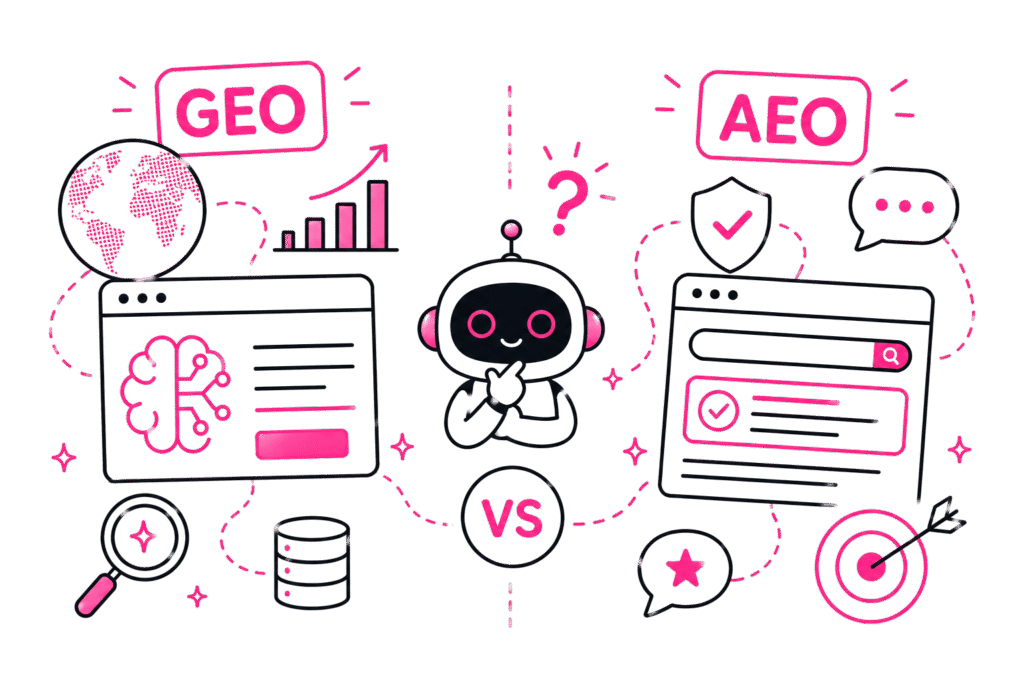
I’ve spent years in search optimization, and the last two watching generative engines rewrite the rules in real time. Two new layers have shown up to deal with the shift: AEO (Answer Engine Optimization) and GEO (Generative Engine Optimization). People use the terms interchangeably constantly. They shouldn’t — the two target different outcomes, reward different signals, and if you conflate them, you’ll pour effort into the wrong one.
Here’s the difference, with examples, and a straight answer on which to prioritize.
What is AEO (Answer Engine Optimization)?
AEO is the practice of structuring content so an AI-powered system can extract it and surface it as a direct, concise answer to a query. The output is short, factual, and usually shown without the user needing to click anything.
It shows up on surfaces you already know: Google Featured Snippets (the old “position zero”), People Also Ask boxes, Knowledge Panels, voice assistants like Siri and Alexa, and Google’s AI Overviews. AEO has its roots in the featured-snippet era, when SEOs first started optimizing to be the answer instead of just ranking near it. The goal is simple and brutal — become the single definitive response for a specific, closed-ended question.
A concrete example: someone searches “How many calories are in an avocado?” The answer box pulls one short factual sentence straight from a well-structured page. No synthesis, no context, no brand story. Just the number. AEO is about winning that moment, and only one page wins it.
What is GEO (Generative Engine Optimization)?
GEO is the practice of optimizing your content and your wider digital presence so that generative AI systems — ChatGPT, Gemini, Perplexity, Claude — include or cite your brand when they build a synthesized response. The output isn’t a snippet. It’s a multi-paragraph, conversational answer stitched together from many sources, and GEO is about being one of those sources.
GEO is newer, broader, and honestly a lot messier than AEO. It’s less about formatting tricks and more about building genuine authority across the web: expert authorship, cited statistics, brand mentions in high-authority publications, topical depth, and consistent entity clarity. For a full breakdown of the mechanics, see our guide on LLM optimization.
A concrete example: someone asks ChatGPT, “What are the best project management tools for remote teams?” The model doesn’t paste a single snippet. It writes a comparison, names specific tools, weighs opinions, and in some interfaces links the guides it leaned on. GEO is what puts your brand inside that answer — not as the answer, but as a trusted, referenced source.
AEO vs GEO at a glance
Here’s the whole thing in a table you can scan in ten seconds.
| Dimension | AEO (Answer Engine Optimization) | GEO (Generative Engine Optimization) |
|---|---|---|
| Primary goal | Be the direct answer | Be cited as a trusted source |
| Mechanism | Extraction of a short passage | Synthesis across multiple sources |
| Query type | Closed-ended, specific questions | Open-ended, exploratory questions |
| Output format | Short snippet or voice response | Multi-paragraph synthesized answer |
| Target platforms | Google Snippets, People Also Ask, Siri, Alexa, AI Overviews | ChatGPT, Perplexity, Gemini, Claude, Bing Copilot |
| Content style | Concise, structured, extractable | Comprehensive, authoritative, data-rich |
| Key tactics | FAQ schema, structured data, direct answers | Brand mentions, original data, topical authority |
| Success metric | Snippet ownership, voice-answer share | Citation frequency, AI visibility share |
| Relationship to SEO | Extension of on-page and technical SEO | Extension of authority and off-page SEO |
Put simply: AEO rewards short structured answers and flat factual clarity. GEO rewards authoritative depth, original insight, and consistency an AI can triangulate against other trusted sources.
The core differences that actually matter
The table covers the map. These four differences are the terrain.
1. Query type. AEO is built for closed-ended, high-intent questions with one right answer — “What is the capital of Belgium?” or “What time does the stock market close?” Brevity is the whole point. GEO is built for open-ended, comparative, or advisory questions that need synthesis — “Should I use React or Vue for my next project?” or “What are the pros and cons of freelancing?” These have no single correct answer. They force the AI to gather context, weigh perspectives, and construct something new.
2. Output format. AEO targets a self-contained output: a snippet, a sentence, a voice-read line, a PAA answer. The AI isn’t building anything — it’s lifting. GEO targets a generated output: a chatbot response, an AI Overview, a Perplexity summary. The AI is constructing something fresh from your content and everyone else’s. You’re not trying to be quoted verbatim. You’re trying to be referenced.
3. Platform. AEO mostly targets traditional search with AI bolted on — Featured Snippets, AI Overviews in classic Google, voice assistants, People Also Ask. These still run on a document-retrieval model; they just surface answers more loudly. GEO targets pure generative platforms — ChatGPT, Perplexity, Gemini, Claude — which don’t return a ranked list at all. They synthesize from scratch, and your brand mention happens inside that synthesis, not next to it.
4. What you actually optimize. For AEO, the levers are on-page and technical: FAQ sections with clear question headings, Schema.org markup, declarative opening sentences, and clean 40-to-60-word definitions that stand alone. For GEO, the levers are off-page as much as on: brand mentions in third-party publications (see how to improve brand mentions in AI), original research worth citing, named experts with verifiable credentials, topical authority across a subject, and consistent entity signals everywhere your brand appears.
Same query, different optimization
Abstractions are easy to nod along to and hard to act on. So here are four real queries and how each engine handles them.
AEO — “How long to boil eggs?” Google returns an answer box: 6 minutes for soft, 9 for medium, 12 for hard. A page with a clear heading, a short opening answer, and a numbered list has the best shot at that snippet.
GEO — “What’s the best way to meal prep eggs for the week?” ChatGPT writes a synthesized guide covering boiling, frittatas, egg bites, storage times, and reheating. It references named cooking guides. The query’s too nuanced for one snippet, so depth and authority win.
AEO — “What temperature to bake chicken?” Someone asks Alexa hands-free in the kitchen. Alexa reads one short factual answer — 375°F for about 25 to 30 minutes. Only one page wins that spoken slot.
GEO — “Best CRM for startups.” Perplexity returns a ranked comparison of named tools with linked citations to the articles it judged authoritative. The brands inside that synthesis benefit even when the user never visits their sites.
The pattern is clear. Short factual queries favor AEO. Complex, comparative, or recommendation queries favor GEO. A complete strategy plans for both.
Where AEO and GEO overlap
For all their differences, these two share a lot of ground. Both reward trustworthiness, authority, and well-structured content. Both benefit from clear human-readable writing that a machine can parse. And both punish thin, keyword-stuffed pages that offer no real value.
Plenty of tactics serve both at once. A well-built FAQ section feeds AEO with extractable answers and signals topical depth for GEO. Original research gives generative models something worth citing, and lands in Featured Snippets when the key finding is stated as one clean sentence. Answer-first structuring — lead with the core response, then add nuance — works for a snippet and for AI synthesis alike.
So you don’t need two separate content strategies. You need content built well enough that both machines can use it.
Is AEO a subset of GEO, or the other way around?
This is a live argument in the industry, and it’s worth taking a position on. Some practitioners treat GEO as the umbrella term covering all AI-search optimization, with AEO as one tactic inside it. Others treat AEO as the older, established discipline (born from featured snippets and voice) and GEO as the newer extension into pure generative systems.
My take: they’re siblings, not parent and child. They answer the same shift — from retrieval to generation — from different angles. AEO asks “How do I become the direct answer?” GEO asks “How do I become the trusted source an AI draws from?” Both are valid, and both are load-bearing.
The reason the framing matters isn’t academic. The moment you label one as a subset of the other, teams underinvest in whichever they’ve filed as secondary — and then wonder why they’re invisible on half the surfaces that matter.
How AEO and GEO fit with traditional SEO
SEO, AEO, and GEO aren’t competing strategies. They’re layered, and the order matters.
SEO is the foundation — crawlability, indexability, topical relevance, internal linking, page speed, backlinks. A site that can’t be crawled or indexed can’t be extracted or cited, full stop. AEO is the layer that turns strong rankings into direct-answer placements: snippets, PAA boxes, voice answers. GEO is the layer that turns authoritative content into citations and brand mentions inside generative responses.
The pressure to add the top two layers is real, not theoretical. AI Overviews and generative summaries have measurably cut click-through rates on informational queries, with some publishers reporting steep drops. That doesn’t mean traffic vanishes. It means visibility moves into new surfaces — and you have to optimize for those surfaces too.
How to optimize for AEO
If you want snippets, People Also Ask placements, and voice answers, this is the work.
- Use a Q&A structure. Match your H2s and H3s to real questions people ask, and mirror the phrasing they type or speak.
- Lead with a concise answer. Put a clear 40-to-60-word response directly under each question heading, before the deeper context. That length is the sweet spot — short enough for a voice assistant to read aloud, complete enough to stand alone.
- Format for extraction. Ordered lists for steps, tables for comparisons, short paragraphs for definitions. Answer engines pull these formats reliably.
- Implement schema. Add FAQPage schema for Q&A pages and HowTo schema for tutorials. Structured data tells the engine exactly what it’s looking at.
- Target weak snippets. Find queries where a snippet exists but is thin, then write a cleaner, tighter answer.
- Cover natural-language phrasing. Voice queries run long and conversational — “how do I,” “what’s the best,” “how long does it take.” Cover those.
How to optimize for GEO
If you want to be cited by ChatGPT, Perplexity, Gemini, Claude, and AI Overviews, your job is to earn authority a machine can verify.
- Publish deep, authoritative content. Generative engines lean on comprehensive guides over thin pages when they synthesize.
- Back claims with original data and expert quotes. Unique research, surveys, named experts, clearly attributed statements — that’s the raw material LLMs surface in citations.
- Demonstrate E-E-A-T. Experience, Expertise, Authoritativeness, Trustworthiness, shown through author bios, credentials, sourcing, and editorial transparency.
- Keep entities consistent. Same brand name, same product names, same descriptors across your site, socials, review platforms, and PR. Inconsistent signals confuse models.
- Write quotable insights. Self-contained statements and stats an AI can lift cleanly without rearranging.
- Reinforce claims across reputable sources. Models triangulate. When several trusted sites repeat the same fact about you, the model adopts it as true.
- Keep content fresh. Update guides and show a visible last-updated date. Stale pages get discounted.
Common mistakes to avoid
Even strong teams trip on the same few things.
- Treating AEO and GEO as either/or. They overlap heavily, and building one usually strengthens the other.
- Optimizing for machines instead of readers. Keyword stuffing and robotic phrasing get filtered out by ranking systems and LLMs.
- Neglecting freshness. A guide untouched for two years rarely gets cited by a modern generative engine.
- Skipping schema. Missing structured data is the easiest preventable mistake there is. It quietly limits your eligibility for everything.
- Inconsistent entity references. Mismatched product spellings and out-of-date bios across the web all drag down citation accuracy.
How to measure AEO and GEO success
Different goals, different KPIs. Don’t measure one with the other’s yardstick.
AEO metrics: featured-snippet ownership and how many queries you hold, voice-answer appearances, snippet impressions and CTR from answer boxes, and People Also Ask presence on target queries.
GEO metrics: brand-citation frequency inside LLM outputs (how often ChatGPT, Perplexity, or Gemini name you), AI referral traffic, share of AI visibility versus named competitors on key prompts, and the quality of leads coming from AI-influenced discovery.
A few tools have shown up to track this. Rankshift focuses on AI search rankings and citations across engines. The HubSpot AI Search Grader scores how often a brand appears in generative results. Meltwater’s Gen AI Lens monitors brand presence inside AI conversations. Pick one, set a baseline, and watch the trend. For the full picture of what to track and why, see our guide to AI search metrics.
And don’t stop at visibility. Tie AI-influenced discovery to pipeline — which deals were sourced or shaped by AI surfaces — and feed that into attribution. Revenue is still the benchmark that outranks all the others.
Which should you prioritize?
Most businesses should run both. But the sequencing depends on where your buyers actually ask their first question.
Start with AEO if you depend heavily on Google traffic today, your audience uses voice for quick lookups, you need fast measurable wins, or your content already ranks but doesn’t own its snippets.
Start with GEO if your buyers research in ChatGPT, Perplexity, or Claude before they ever touch Google, you sell B2B or SaaS with a complex evaluation cycle, your topic is comparative or advisory, or you compete in a category where AI Overviews already dominate.
For most teams the honest answer is both, in parallel, on top of healthy SEO. Ask three questions to break the tie: which funnel stage matters most right now, where does your ideal customer ask their first question, and which AI surfaces already mention your competitors? Start where the gap is widest, then expand.
What comes after AEO and GEO
Search is moving fast, and the next layer is already forming.
AI discovery is becoming the new top of funnel. Buyers ask a generative assistant before they open a search engine at all, which makes visibility in AI outputs a prerequisite for even entering the consideration set. Up to 47% of searches now feature an AI-generated overview — meaning a large share of queries get answered before anyone sees a link.
The next discipline on the horizon is AI Agent Optimization (AAO). As autonomous agents start booking meetings, comparing vendors, and making purchases on a user’s behalf, your brand data needs to be machine-readable, current, and reachable through structured channels — clean APIs, maintained knowledge graphs, accurate product feeds, one source of truth about your brand that any machine can verify. The teams building durable visibility today are the ones already treating AEO and GEO as core channels, not experiments. That’s the move: start reporting on them now, before the agents arrive and start deciding for your customers.
