
How to Select an AI Visibility Tool
AI search is no longer experimental.
ChatGPT, Google AI Overviews, Gemini, Claude, Perplexity AI, and Microsoft Copilot are shaping brand discovery in real time. Buyers are making decisions before they ever click a blue link.
That shift created a new category: AI visibility tools.
But based on combined evaluations across enterprise reviews, agency testing, independent trials, and SEO platform comparisons, selecting a platform is not just about tracking mentions. The strongest recurring themes fall into eight evaluation categories.
1. Coverage: Are You Actually Seeing the Full Picture?
Most tools look impressive. Until you realize they only track two or three engines.
Coverage is the first filter.
Evaluate:
- Does it track ChatGPT, Google AI Overviews,AI Mode, Gemini, Claude and Perplexity?
- Are certain engines locked behind enterprise tiers?
- Does the platform rely on UI-based scraping or API-based pulls?
- Can you track by region and language?
Why this matters:
LLM answers vary significantly by platform, geography, and even interface version. A brand may appear in ChatGPT but disappear in Google AI Overviews. Visibility in the US may differ from Belgium. API access often provides partial results, while UI scraping tends to reflect what users actually see.
Limited coverage equals distorted data.
2. Prompt Methodology: Garbage In Equals Garbage Out
Every serious review highlights the same structural limitation:
These tools only track the prompts you tell them to track.
So the real question becomes: how strong is your prompt framework?
Evaluate:
- Does the tool help generate prompts?
- Can you import keyword lists and convert them into AI-ready prompts?
- Can you segment by branded vs unbranded queries?
- By funnel stage?
- By persona?
- By intent type?
- Does it support repeated runs for statistical reliability?
Advanced platforms allow:
- Bulk uploads
- Negative framing prompts
- Multi-language segmentation
- Confidence scoring based on repeated testing
Why this matters:
Weak prompt design produces misleading visibility data. If your prompt set is narrow or biased, your insights will be too.
Tracking multiple markets? Your prompts need to reflect how buyers ask questions in each language. Use Lara Translate to prepare translated versions of your core prompts, then have a native speaker check the phrasing against real customer questions. A translated prompt is a starting point; local buyer language is the benchmark.
3. Data Depth: Insights or Just Mentions?
“You were mentioned” is not a strategy.
Many platforms stop there.
Look for depth:
- Share of Voice scoring
- Sentiment analysis
- Citation tracking, including which domains influence answers
- Quote-level visibility, meaning position inside the response
- Topic clustering and tagging
- Trend visualization over time
- Source domain breakdown
Red flag:
If you are manually interpreting exports in spreadsheets to understand what happened, the tool is not doing enough analytical work.
Data should translate into signal, not manual effort.
4. Actionability: Does It Tell You What To Do?
This is where platforms diverge sharply.
Strong tools provide:
- Content optimization suggestions
- GEO or AEO audits
- Technical crawler analysis
- AI bot indexation checks
- Prompt gap analysis
- Competitor gap recommendations
- Source improvement suggestions
5. Enterprise Readiness and Scale
Tracking ten prompts is easy.
Tracking one thousand across multiple markets is not.
If AI search matters to your organization, evaluate:
- Can it handle hundreds or thousands of prompts?
- Multi-brand environments?
- API access?
- Dashboard integrations?
- Historical data retention?
- User seat pricing?
- Statistical repeat testing?
Some platforms work well for freelancers but struggle at scale. Others are clearly built for enterprise environments.
Choose based on where you are headed, not just where you are today.
6. Reliability and Transparency
This category is young and unstable.
Some tools are well funded, with experienced SEO or AI teams. Others are solo founder experiments built quickly to ride momentum.
Ask:
- Is the data collection methodology transparent?
- Do they publish research?
- Are updates frequent?
- Is the team experienced in search?
- Is the product infrastructure credible?
Durability matters. If the platform disappears in twelve months, your historical data disappears with it.
7. Pricing Model: The Hidden Complexity
Headline pricing is rarely the full story.
Evaluate:
- Cost per prompt
- Cost per engine
- Add-on fees
- User seat charges
- Overage costs
- Enterprise-only features
- Annual commitments
Some affordable tools become expensive once scaled across multiple engines and repeated testing.
Model your real usage before committing.
8. Technical AI Monitoring: Where the Market Is Heading
More advanced buyers are already moving beyond surface-level visibility.
They are asking for:
- AI crawler log analysis
- Referral tracking from AI chatbots
- Weighted position scoring
- Model-specific performance breakdown
- Persona-level tracking
- Brand risk alerts
This is where the category is evolving. Not just visibility, but observability.
9. Data Residency: Infrastructure Is a Strategic Decision
Server location is often treated as a technical footnote.
It is not.
Where your data is stored and processed affects
- Compliance and regulatory exposure
- Jurisdictional risk
- Procurement and customer requirements
- Performance and latency
- Strategic independence
- Internal governance friction
For AI visibility tools that process prompts, analytics data, user behavior, and sometimes customer information, infrastructure decisions carry strategic weight. In particular, this is a question we often get from European enterprise customers. They really want their data stored and processed in Europe.
The Strategic Reality
There is no perfect tool.
This market is:
- Early stage
- Rapidly evolving
- Non-deterministic, because LLM outputs change constantly
- Lacking standardized metrics
So selection should be based on your maturity level, scale, budget, and internal capabilities.
A Simplified Decision Framework
If you are:
Freelancer or SMB
Prioritize affordability and ease of setup. You need signal quickly, not infrastructure complexity.
Agency
Prioritize prompt flexibility, reporting, competitor tracking, and client-friendly exports. Think of unlimited users and projects.
Enterprise
Prioritize coverage depth, statistical validity, integrations, and scale.
Here is an overview about the best AI visibility tools:
Rankshift
Rankshift is an AI visibility and brand monitoring platform built specifically for tracking how brands appear inside large language model (LLM) outputs.
Rather than focusing on traditional search rankings, it measures presence, citations, and competitive positioning inside AI-generated answers from systems like ChatGPT, Gemini, Claude, Perplexity, Mistral, Copilot, and Llama.
Rankshift is designed for SEO teams, growth marketers, and brand strategists working on Generative Engine Optimization (GEO) and AI search visibility. Its core value proposition is narrow but clear: give brands direct visibility into how AI systems describe, cite, and position them.
Rankshift does not attempt to be a full SEO suite. It concentrates on AI answer monitoring and related analytics, including prompt tracking and crawler-level insights.
Founded: 2025
Founders: Pieter Verschueren & Denis Debacker
Headquarters: Deerlijk, Belgium
Key features
- Multi-model AI visibility tracking: Tracks brand mentions and positioning across major LLMs including ChatGPT, Gemini, AI Mode, AI Overviews, Claude, Perplexity, Mistral, Copilot, and Llama. This enables cross-model comparisons rather than relying on a single engine.
- Prompt-based monitoring system: Users define prompts that reflect real-world user questions. Rankshift runs these prompts across selected AI systems and records outputs, mentions, and citations.
- Smart prompt suggestions: Provides prebuilt or recommended prompts aligned with category-level queries, helping teams avoid starting from a blank slate.
- Competitor benchmarking inside AI answers: Identifies which competitors appear in the same responses and highlights where they are mentioned instead of (or ahead of) your brand.
- Source and citation tracking: Captures which domains and URLs AI models cite when answering prompts related to your brand or industry.
- Advanced citation gap analysis: Shows where AI systems consistently cite third-party sources over your own content for the same prompts, surfacing structural authority gaps.
- Actionable GEO insights: Goes beyond raw visibility data by pointing to breakdown areas in prompts, models, or citation sources where improvements are needed.
- Built-in AI content writer: Rankshift analyzes LLM responses and your citations, connects key concepts to relevant entities, and drafts optimized content designed to perform in answer engines.
- AI crawler analytics: Tracks how AI bots interact with your website. This adds a technical observability layer that many AI visibility tools do not address.
- Flexible prompt frequency control: Prompts can be scheduled daily, weekly, or monthly instead of being forced into fixed daily runs, allowing budget optimization.
- Unlimited users and projects: Designed to scale from small teams to enterprise use cases without per-seat restrictions.
- Unlimited pitch projects for agencies: Agencies can spin up AI visibility reports for every prospect without worrying about project limits or burning through credits.
Pros
- Strong multi-LLM coverage across major generative platforms rather than focusing on one ecosystem.
- Direct insight into AI answer positioning, not just traditional SEO metrics.
- Competitor visibility benchmarking within the same AI-generated responses.
- Granular citation tracking and gap analysis, useful for GEO strategy development.
- AI crawler analytics, providing log-level insight into how generative engines discover and process site content.
- Flexible credit-based pricing, allowing prompt scheduling control and cost optimization.
- Unlimited users and projects, making it viable for agencies and larger teams.
- Focused product scope, avoiding feature bloat common in broader SEO platforms.
Cons
- Requires thoughtful prompt setup: As with most LLM tracking tools, results depend heavily on the quality and coverage of chosen prompts. Poor prompt strategy limits signal quality.
- Credit-based system requires management: While flexible, improper scheduling or excessive prompt runs could deplete credits quickly if not planned strategically.
Pricing
Rankshift uses a credit-based pricing model.
- 30-day free trial available
- Paid plans start at €77 per month
- Unlimited users and unlimited projects included
- Flexible scheduling (daily, weekly, monthly prompt runs)
Unlike tools that force daily checks for every tracked prompt, Rankshift allows control over frequency, which can significantly improve cost efficiency.
| Plan | Cost / Month | Prompts Included | Users Included | Websites / Projects |
| Starter | ~€77 (monthly) | 150 prompts | Unlimited | Unlimited |
| Professional | €177 | 350 prompts | Unlimited | Unlimited |
| Business | €399 | 850 prompts | Unlimited | Unlimited |
| Enterprise | Custom | Custom | Unlimited | Unlimited |
Verdict
Rankshift is a focused, purpose-built AI visibility monitoring platform for teams serious about LLM Optimization.
It is particularly well-suited for:
- SEO teams expanding into AI search monitoring
- Brands needing cross-model visibility reporting
- Agencies managing multiple AI visibility campaigns
- Technical teams wanting crawler-level AI observability
It is less suitable for:
- Teams looking for a traditional all-in-one SEO suite
- Organizations that want a simplified, high-level visibility score without deeper diagnostics
Its strongest differentiator is the combination of multi-model tracking and AI crawler analytics. That pairing provides both surface-level answer visibility and backend discovery insight.
Rankshift does not try to compete on breadth. It competes on clarity of AI answer visibility and for GEO-focused teams, that specialization is its primary strength.
HubSpot AEO
HubSpot AEO is an AI search visibility and brand monitoring solution designed for both small business owners and enterprise-level marketing teams. The platform is available as a standalone product or as part of HubSpot’s Marketing Hub, which includes access to cross-channel marketing automation features covering websites, emails, social media, and more.
HubSpot AEO focuses on prompt-level monitoring, citation tracking, and sentiment analysis across ChatGPT, Perplexity, and Gemini. One of the platform’s key standouts is its prompt discovery features: HubSpot AEO integrates with the software provider’s native CRM solution. As such, users can leverage CRM prospect database information to identify high-intent prompts tied directly to their target audiences.
Key Features:
- Multi-engine coverage: Tracks brand mentions across ChatGPT, Gemini, and Perplexity within consolidated dashboards.
- Prompt discovery: Filters through prompts based on ideal customer profiles and buyer journey stages.
- Competitor landscape: Provides high-level overviews of competitor share of voice across all supported AI search engines.
- Prompt analytics: Gauges brand visibility across specific prompts and compares performance against competitors side-by-side.
- Citation tracking: Displays the exact sources AIs use to generate answers and breaks down citations by content type, channel, and domain.
- Sentiment analysis: Measures brand sentiment and compares it against competitors across all supported engines.
- AI optimization recommendations: Offers personalized AI optimization suggestions and highlights their potential impact for faster decision-making.
Pros
- Affordable entry point: The standalone AEO tool starts at $45/month, which makes the platform accessible to budget-conscious teams.
- Scalable: Teams can start with the standalone AI optimization tool and gradually upgrade to HubSpot Marketing Hub to measure and manage their entire online presence.
- Clear competitive benchmarking: Includes easy access to competitor performance metrics and comparison charts.
- Intuitive interface: Does a good job at highlighting complex information in a digestible format.
- Advanced prompt research tools: The CRM-based prompt research features make HubSpot AEO stand out in the AI optimization tool space.
Cons
- Limited search engine support: The platform currently lacks Google AI Mode, AI Overview, Claude, and Microsoft Copilot tracking.
- Steep gaps between pricing plans: The HubSpot Marketing Hub and AEO bundle is available starting at $800 per month, which may make this option out of reach for smaller businesses.
- Lacks AI crawlability checks: Doesn’t include features similar to Otterly’s GEO audits.
Pricing
HubSpot AEO is either available as a standalone solution or integrated within the Marketing Hub. Pricing plans are as follows:
- HubSpot AEO Standalone: from $45/month (annual billing) with 25 daily prompts.
- HubSpot Marketing Hub Professional: from $800/month (annual billing) with 25 daily prompts + access to omnichannel marketing tools.
- HubSpot Marketing Hub Enterprise: from $3,600/month (annual billing) with 50 daily prompts + access to omnichannel marketing tools.
- 28-day free trial avaialbe (for standalone AEO).
| Plan | Cost / Month | Prompts Included | Users Included | Websites / Projects |
| HubSpot AEO Standalone | $45/month | 25 | Not specified | Not specified |
| HubSpot Marketing Hub Professional | $800/month | 25 | 3 | Not specified |
| HubSpot Marketing Hub Enterprise | $3,600/month | 50 | 5 | Not specified |
Verdict
HubSpot AEO is a scalable solution designed to satisfy the needs of both small businesses and enterprise-level marketing teams. More specifically, the platform is best suited for:
- Freelancers and consultants
- Small businesses looking to get started with AEO
- Large marketing teams looking to integrate AEO into their existing workflows
- Companies looking for a scalable solution
It may not be the best fit for:
- Teams looking to track brand mentions across Google AI Mode, AI Overviews, and Microsoft Copilot
- Teams looking for AI crawlability analytics features
Otterly.AI
Otterly.AI is an AI search visibility and brand monitoring platform designed to track how brands appear across major generative search engines such as Google AI Overviews, ChatGPT, Perplexity, and Microsoft Copilot. It focuses on prompt-level monitoring, citation tracking, and brand mention analysis to help businesses understand and improve their presence in AI-generated answers.
Positioned as an affordable, self-serve solution, Otterly.AI is particularly aimed at freelancers, small businesses, startups, and SEO professionals who want visibility into AI search without enterprise-level costs. It emphasizes ease of setup and automated tracking, though it trades off some depth and scalability compared to more advanced Otterly AI alternatives.
Founded: 2024
Founders: Thomas Peham, Josef Trauner and Klaus-M. Schremser
Headquarters: Persenbeug, Austria
Key Features
- Brand Monitoring Across AI Engines: Tracks brand mentions and visibility across Google AI Overviews, ChatGPT, Perplexity, and Microsoft Copilot. Add-ons are available for Google AI Mode and Gemini.
- Prompt-Level Tracking: Allows users to monitor specific prompts and see how their brand appears in AI-generated answers. However, prompts must be entered one at a time, which limits scalability.
- Link Citation Analysis: Audits which URLs are cited by AI platforms and tracks citation performance over time. Includes reporting on citation frequency and history.
- Brand Visibility Index & KPIs: Provides visibility metrics and performance indicators to quantify AI presence.
- GEO Audit Feature: Offers a generative engine optimization (GEO) audit to identify opportunities to optimize content for better LLM inclusion.
- AI Prompt Generator: Suggests AI search prompts based on entered keywords or a website (up to 10 inputs), helping users discover prompts to track.
- Automated Weekly Reports: Generates recurring reports summarizing AI visibility performance.
- Keyword-to-Prompt Conversion: Converts traditional SEO target keywords into related LLM prompts, bridging SEO and GEO workflows.
- Search Volume Estimation (AI Prompts): Estimates search volume for AI prompts per platform, though accuracy is uncertain.
- Exportable Reports: Allows data export for reporting and client sharing.
Pros
- Affordable Entry Point: Among the lowest-cost tools in the AI visibility space, with plans starting around $25–$29 per month.
- Accessible for Small Teams: Specifically recommended for small businesses, freelance SEOs, and startups exploring AI search monitoring.
- Straightforward Setup: Simple onboarding process and easy keyword-to-prompt conversion for SEO users.
- Clear Focus on Core AI Tracking: Delivers prompt tracking, citation audits, and brand mention monitoring without unnecessary enterprise complexity.
- Positive Early User Feedback: Reports of strong user satisfaction, including high ratings on Product Hunt and OMR Reviews.
- Time Savings Over Manual Checks: Designed to replace manual AI answer checking, with reported time savings.
- Case Study Evidence: A case study reports a client achieving #1 positioning in ChatGPT for specific queries.
Cons
- Limited Prompt Scalability: Prompts must be added one at a time, which makes large-scale tracking inefficient. Given LLM variability, meaningful tracking often requires hundreds of queries.
- Clunky User Interface: Described as not very intuitive and somewhat arcane in design.
- Lacks Advanced Insights: Missing deeper, data-driven actionable insights and trend analysis.
- No AI Crawler Visibility Analysis: Does not provide technical insights into how AI bots crawl or index your site.
- Limited Engine Coverage in Base Plans: Some AI engines require add-ons, and coverage may not match more enterprise-focused competitors.
- Uncertain Data Methodology: The presence of screenshots suggests scraping rather than direct API integrations, which may raise questions about consistency and methodology transparency.
- Search Volume Estimates May Be Unreliable: AI prompt search volume is estimated, with unclear methodology.
- Brand Confusion Risk: Similarity in name to Otter.ai may complicate research and brand differentiation.
- No AI crawler analytics
Pricing
Otterly.AI uses tiered pricing based primarily on the number of tracked prompts.
- Lite plan starts at $25/month (annual billing) with daily tracking of 15 prompts.
- Starter tiers are listed from $29/month for 10 tracked prompts.
- Standard plan at $160/month includes tracking for 100 prompts, with additional prompt bundles available.
- Higher tiers scale up to $989/month for 1,000 prompts.
- Free trial available.
| Plan | Cost / Month | Prompts Included | Users Included | Websites / Projects |
| Lite | ~$25 (annual) | 15 prompts | Not specified | 1 domain (implied) |
| Starter | $29 | 10 prompts | Not specified | Not specified |
| Standard | $160 | 100 prompts | Not specified | Not specified |
| Enterprise | Up to $989 | 1,000 prompts | Not specified | Not specified |
(Seat limits and multi-domain details are not clearly specified in available documentation.)
Verdict
Otterly.AI is best described as an entry-level to mid-tier AI search visibility tool.
It performs well for:
- Freelancers and small agencies
- Startups testing AI visibility
- SEO teams wanting to bridge keyword tracking and LLM monitoring
- Businesses needing basic citation and mention tracking without enterprise pricing
It is less suited for:
- Enterprises requiring large-scale, statistically robust prompt sampling
- Brands needing AI crawler diagnostics and deep technical audits
- Teams demanding advanced trend modeling, longitudinal analytics, or broad multi-model coverage
- Agencies managing hundreds or thousands of prompts per client
The platform’s affordability and straightforward workflow are its biggest strengths. However, limitations in prompt scalability, advanced analytics, and technical transparency mean it functions more as a practical starting point than a comprehensive AI observability system.
For small teams exploring generative engine optimization (GEO), Otterly.AI is a rational first step. For large brands treating AI search as a mission-critical channel, it will likely need to be supplemented—or replaced—by more robust platforms.
Omnia
Omnia is an AI visibility platform built for marketing and growth teams that want both data and execution. It tracks how brands appear across the major AI engines (ChatGPT, Google AI Overviews, Google AI Mode, Perplexity, Claude, Gemini, and Copilot) and turns that data into a prioritized action backlog of what to create, where to publish, and which gaps to fix.
The defining product choice is that monitoring and improvement live in the same workflow: insights feed into agents that act on them, with human review before anything ships.
Positioned for scale-up marketing teams (Series A to C) that already have a content motion, Omnia covers the full GEO loop in one place: brand presence, share of voice, sentiment, citation patterns, and AI-native search prompt discovery.
Omnia includes competitor benchmarking and unlimited countries and brands across all plans, and pricing is metered by the number of prompts monitored rather than by seats or projects.
Founded: 2025
Founders: Daniel Espejo & Miguel Fernández
Headquarters: Madrid
Key features
- Multi-engine AI visibility tracking: Monitors brand presence, share of voice, and competitive positioning inside answers from ChatGPT, Google AI Overviews, Google AI Mode, and Perplexity, refreshed daily.
- Citation-driven action backlog: Each citation is parsed and converted into a prioritized list of next actions: which page to create, which existing page to update, which third-party publication to target, and which technical or brand gap to close.
- Agentic execution layer: Where most platforms stop at reporting, Omnia layers AI agents on top of the citation data to draft and stage the recommended changes, with human review before they go live. Monitoring and acting belong in one workflow rather than across two products.
- Feature-level sentiment analysis: Goes beyond mention counts to track how AI models describe the brand at the feature level (pricing, integrations, reliability, support, and so on) versus competitors.
- Unlimited brands and countries: A single workspace can track multiple brands across any number of geographies without separate licenses, useful for agencies, multi-brand companies, and international teams.
Pros
- Action layer is the differentiator: The combination of citation analysis and agentic execution in the same workspace is rare in this category, where most platforms stop at reporting.
- Real browser data: Captures AI answers as users actually see them, including AI Overviews surface conditions that API-based tools miss.
- Unlimited countries and brands: Useful for international teams and agencies without per-domain license inflation.
Cons
- Action features assume a team with capacity to execute: Omnia generates a prioritized backlog and drafts changes, but improving AI visibility still requires content publication, technical fixes, and brand work. Teams without execution capacity get less value from the action layer.
- Pricing is in EUR: Plans are billed in euros, which can introduce minor FX variance for teams budgeting in USD or GBP.
- European-first market focus: The product, customer base, and case studies skew toward Europe (UK, Nordics, Spain, with expansion into Germany, France, and the US in progress). North American teams find the product fully usable, but local case studies are still building out.
- Prompt-dependent like all tools in this category: Even with built-in prompt discovery, results still depend on the quality and relevance of the tracked prompt set.
Pricing
Omnia uses prompt-based pricing with unlimited countries and brands across all plans, and a 14-day free trial.
- Growth plan starts at €79 per month (€63 per month billed annually), 25 prompts, daily monitoring across all four AI engines.
- Pro plan at €279 per month (€223 per month billed annually), 100 prompts. Marked as the recommended tier.
- Enterprise plan from €499 per month (€399 per month billed annually), 200+ prompts, with a dedicated account manager and a 24-hour SLA.
| Plan | Cost / Month | Prompts Included | Users included | Websites / projects |
|---|---|---|---|---|
| Growth | €79 (€63 annual) | 25 prompts | Unlimited | Unlimited |
| Pro | €279 (€223 annual) | 100 prompts | Unlimited | Unlimited |
| Enterprise | €499+ (€399+ annual) | 200+ prompts | Unlimited | Unlimited |
Verdict
Omnia sits at the intersection of AI visibility tracking and AI execution. It tracks the same surface area as Profound, Peec AI, Otterly, Scrunch AI, and Rankshift across major AI engines, but routes the resulting citation data into a prioritized action backlog that an agentic layer can help work through, with human review.
It is best suited for:
- Marketing and growth teams at scale-ups (Series A to C) treating AI visibility as a measurable acquisition channel
- SEO and content leads who want citation-level data on what AI engines actually pull, plus a workflow to act on it
- Agencies serving multi-brand or multi-country accounts that benefit from flat per-prompt pricing
- CMOs and Heads of Growth who want execution baked in rather than a separate content workflow bolted onto a reporting product
It is less suited for:
- Solo operators or very small teams without bandwidth to act on the backlog
- Brands that only need a top-line visibility score without execution support
- Teams whose customers do not yet use AI to research the category
Its strongest differentiator is the combination of citation-grade tracking and agentic execution in the same workspace. For teams treating GEO as a budgeted channel rather than an experiment, that pairing closes the gap between reporting and action that most tools in this category leave open.
Peec AI
Peec AI is an AI search visibility and brand monitoring platform built to help marketing, SEO, and growth teams understand how their brand appears inside AI-generated answers. As generative engines like ChatGPT, Gemini, Claude, and Perplexity increasingly shape buyer research, Peec AI focuses on tracking prompt-level visibility, citations, and competitive presence across these platforms.
Positioned as a cost-effective alternative to higher-priced enterprise tools, Peec AI aims to give teams practical visibility into AI search performance without requiring enterprise-level budgets.
Founded: 2025
Founders: Marius Meiners, Tobias Siwona & Daniel Drabo
Headquarters: Berlin
Key features
- Prompt-based visibility tracking: Peec AI runs selected prompts across major AI engines and tracks whether and how your brand appears in responses. This includes branded, commercial, and informational prompts.
- Multi-engine coverage: Tracks brand visibility across platforms such as ChatGPT, Gemini, Claude, and Perplexity, giving a cross-LLM view rather than single-engine monitoring.
- Citation tracking: Identifies when your website or specific URLs are cited in AI-generated answers, helping teams understand which pages influence LLM responses.
- Competitor benchmarking: Compares your visibility against competitors to measure share of voice and identify gaps where competitors are being recommended more often.
- Visibility scoring and performance metrics: Provides quantifiable metrics (e.g., share of voice, mention frequency) to track performance trends over time rather than relying on isolated snapshots.
- Actionable insights and smart suggestions: Offers recommendations to improve brand presence in AI responses, including guidance on content gaps and prompt coverage.
- Prompt management interface: Allows teams to define and manage tracked prompts directly within the UI, similar to traditional rank tracking tools for SEO.
Pros
- Strong price-to-value ratio: Frequently highlighted as one of the most cost-effective AI search visibility tools, especially compared to high-end enterprise platforms.
- Mid-market accessibility: Positioned below the industry’s higher pricing tiers while still offering broad LLM coverage and competitive analysis.
- Clear competitive benchmarking: Makes it easy to see when competitors are outperforming you in AI-generated recommendations.
- Cross-platform tracking: Covers major AI engines instead of focusing on a single chatbot environment.
- Structured, focused interface: Designed specifically for AI search tracking rather than being a bolt-on feature inside a broader SEO suite.
Cons
- Prompt-dependent tracking model: Like most tools in this category, Peec AI primarily tracks prompts you define. If you don’t know which prompts matter, you risk missing visibility opportunities.
- Limited AI model coverage in plans: Plans typically include tracking for ChatGPT, Perplexity, and Google AI Overviews. Access to additional engines such as Gemini, AI Mode, and potentially other emerging LLM environments requires an additional fee. This can increase total cost if broad multi-engine coverage is essential.
- Limited transparency into methodology details: Compared to some enterprise-grade platforms, public information on scraping vs. API usage, refresh cadence, and sampling methodology is less detailed.
- Less enterprise depth than premium competitors: While cost-effective, it may not match the reporting complexity or advanced analytics offered by higher-priced enterprise platforms.
- Dependent on LLM variability: Since AI responses can change based on timing and prompt phrasing, results may vary even under controlled testing conditions.
- No AI crawler analytics
Pricing
- Commonly listed at $99 per month in comparative analyses.
- Positioned below the reported industry average of $337/month for AI visibility tracking tools.
| Plan | Cost / Month | Prompts Included | Users Included | Websites / Projects |
| Starter | ~€89 (~$95–$103) | ~25 prompts | Unlimited | Not clearly specified |
| Pro | ~€199 (~$217–$230) | ~100 prompts | Unlimited | Not clearly specified |
| Enterprise | ~€499+ (~$545+) | ~300+ prompts | Custom | Custom |
This pricing places Peec AI firmly in the mid-tier category: more affordable than enterprise platforms like Profound or Semrush’s AI toolkits, while offering broader functionality than entry-level tools.
Verdict
Peec AI is a strong mid-market AI visibility tracking platform that balances affordability with meaningful functionality. It is best suited for:
- SEO teams expanding into Generative Engine Optimization (GEO)
- Growth and marketing teams needing visibility into AI brand mentions
- Agencies looking for scalable but cost-conscious AI search tracking
- Brands that want competitive benchmarking across multiple LLMs
It may not be the best fit for:
- Large enterprises requiring deep enterprise integrations, advanced API-level customization, or extensive reporting infrastructure
- Teams that need automated prompt discovery rather than manual prompt definition
- Organizations demanding complete methodological transparency and granular sampling controls
Profound
Profound, founded in 2024, is an enterprise-focused AI visibility and brand monitoring platform designed to help companies understand how they appear inside AI-generated answers. As AI search engines and large language models (LLMs) like ChatGPT, Gemini, Claude, and Perplexity increasingly shape brand perception, Profound positions itself as a solution for tracking, analyzing, and optimizing brand presence within these systems.
The platform is primarily aimed at enterprise brands, large marketing teams, and organizations that require deep observability into AI-driven search environments.
Founded: 2024
Founders: James Cadwallader & Dylan Babbs
Headquarters: New York City, United States
Key Features
- AI Visibility Tracking Across Multiple LLMs: Profound monitors brand mentions and responses across major AI systems, including ChatGPT, Gemini, Claude, Perplexity, and AI-enhanced search environments. It runs large volumes of synthetic prompts to replicate real-world AI interactions.
- Visibility Scoring & Share of Voice Metrics: The platform quantifies how often a brand appears in AI-generated responses compared to competitors, translating raw mention data into structured visibility metrics.
- Sentiment & Brand Positioning Analysis: Profound analyzes the tone and context in which brands are discussed by AI models, helping teams understand whether they are framed positively, neutrally, or negatively.
- Competitive Benchmarking: Users can compare AI visibility performance against competitors, identifying where rivals are gaining share within AI responses and which prompts drive that advantage.
- Prompt-Level Testing & Monitoring: The tool allows structured tracking of predefined prompts across different models, enabling organizations to test specific commercial or branded queries systematically.
- Citation & Source Analysis: Profound identifies which domains and URLs AI systems rely on when generating responses about a brand, supporting content strategy adjustments.
- Advanced Reporting & Deep Analysis: The platform supports detailed breakdowns by model, topic, sentiment, and prompt cluster. It is built to serve reporting needs for large teams and executive stakeholders.
Pros
- Strong enterprise positioning: Frequently identified as an enterprise-grade solution, particularly suitable for large organizations requiring comprehensive monitoring.
- Robust multi-engine coverage: Tracks visibility across a broad ecosystem of AI platforms, not just a single LLM.
- Advanced sentiment and contextual analysis: Goes beyond mention counting by evaluating tone and positioning within AI-generated outputs.
- Comprehensive share-of-voice measurement: Offers structured metrics to quantify brand presence relative to competitors.
- Competitive intelligence capabilities: Enables benchmarking against rivals to identify prompt-level gaps and positioning opportunities.
- High prompt volume capability: Designed to run synthetic queries at scale, supporting broad coverage across industries and use cases.
Cons
- High pricing compared to competitors: Frequently cited as one of the most expensive AI visibility platforms on the market, making it less accessible to smaller teams.
- Overkill for smaller brands: Many features and scale capabilities may exceed the needs of startups or small marketing teams.
- Prompt dependency limitation: Like most AI visibility tools, it relies heavily on predefined prompts. Without strong prompt strategy, coverage may miss relevant queries.
- Market immaturity risk: The AI visibility category is still evolving, and measurement variability exists due to the non-deterministic nature of LLM outputs.
- Synthetic query model limitations: Even with advanced simulation methods, LLM outputs can fluctuate, meaning reported visibility may vary over time.
Pricing
Profound uses tiered pricing based on AI engine coverage and monthly response volume.
- Starter plan starts at $99/month, only includes ChatGPT tracking, 50 prompts, and 1,500 responses per month (1 language, 1 region).
- Growth plan at $399/month expands to ChatGPT, Perplexity, and Google AI Overviews, with 100 unique prompts and 9,000 responses per month (1 language, 1 region).
- Enterprise plan offers custom pricing, with expanded engine coverage (including Gemini, Copilot, Claude, Grok, Meta AI, DeepSeek, and more), plus custom prompt limits, languages, and regions.
| Plan | Cost / Month | Prompts Included | Users Included | Websites / Projects |
| Starter | $99 | 50 prompts | 1 | 1 |
| Growth | $399 | 100 prompts | 3 | 1 |
| Enterprise | Custom pricing | Custom | Custom | Custom |
Overall, the Starter plan is quite limited compared to most AI search tools on the market. With tracking restricted to ChatGPT, just 50 prompts, and 1,500 monthly responses, it offers relatively shallow visibility coverage. Many competing platforms provide multi-engine tracking or higher prompt allowances at similar or lower entry-level pricing.
Verdict
Profound is a serious, enterprise-focused AI visibility platform built for organizations that treat AI search monitoring as a strategic priority rather than an experimental initiative.
It is best suited for:
- Enterprise brands with significant brand equity at risk in AI environments
- Large SEO, PR, and brand marketing teams
- Organizations needing structured reporting and competitor intelligence at scale
- Companies seeking share-of-voice measurement across multiple AI platforms
It is likely not ideal for:
- Small businesses with limited budgets
- Teams experimenting casually with AI search tracking
- Marketers who only need lightweight prompt monitoring
OpenLens
OpenLens is platform that tracks how brands are mentioned, ranked, and cited across seven AI platforms: ChatGPT, Google AI, Perplexity, Gemini, Claude, Grok, and DeepSeek. It is built by Bread Technologies, a team of AI researchers from Caltech, Georgia Tech, and the University of Toronto who study language models.
Aimed primarily at agencies managing multiple client brands, though in-house teams can use it for a single brand, OpenLens stands out for a free plan that needs no credit card, trial period, or sales call, plus built-in GEO audit tools and MCP and API access.
Launched: 2026
Founders: Cameron Witkowski & Aman Bhargava
Headquarters: San Francisco, United States
Key features
- Multi-platform AI visibility tracking: Monitors brand mentions and positions across ChatGPT, Google AI, Perplexity, Gemini, Claude, Grok, and DeepSeek from a single dashboard, with per-topic visibility and position-by-platform breakdowns. Platform access scales with plan tier.
- Competitive share of voice: Benchmarks your brand against tracked competitors inside the same AI answers, showing which rivals are recommended instead, broken down by platform and attribute.
- Source and citation tracking: Records the URLs AI models cite in the industries you track, helping teams identify which third-party sources shape AI recommendations.
- GEO audits: Gives a heuristic score for how discoverable a site is to AI agents and crawlers, checks whether AI retrieval can reach its pages, and returns guided recommendations to make content more citable, with monthly page allowances by plan and AI rewrite drafts on paid plans.
- Iris, an in-app AI agent: Runs tasks and builds deliverables from your visibility data when you ask in plain language.
- MCP server and REST API: Connects OpenLens to Claude Desktop or any MCP client, and exposes REST endpoints for programmatic access, so agencies can pull visibility data into their own workflows and AI agents.
- Google Search Console and GA4 integrations: Brings traditional search and analytics data alongside AI visibility metrics.
- Client reporting: Unlimited read-only client logins on every plan, including Free, plus white-label reports on the Agency plan.
Pros
- Free plan with 2 seats, 3 projects, and tracking on ChatGPT, Perplexity, and Google AI, making it one of the lowest-risk entry points in the category.
- Broad platform coverage on higher tiers, with DeepSeek on Starter and Gemini, Claude, and Grok on Agency.
- Built-in GEO audit tooling (readiness scoring, AI indexing checks, and guided content recommendations) alongside visibility tracking, reducing the need for separate diagnostic tools.
- MCP and API access on every plan, which suits teams building agent-driven reporting or automations.
- Agency-friendly structure, with unlimited projects (up to 100 per seat) and white-label reporting on the Agency plan, and unlimited client logins on every plan.
- Research-led team of AI researchers who study language models.
Cons
- Relatively new product: OpenLens launched in 2026, so expect some features and workflows to still be maturing.
- Key platforms are gated to the Agency plan: Gemini, Claude, Grok, and daily tracking are only available on Agency ($299.99/month) and Enterprise, with Free and Starter limited to weekly and monthly runs.
- Credit weighting can surprise: Each Claude output draws 100 credits and each Grok output 50, versus 1 credit on standard platforms, so tracking those models heavily can drain the pool quickly.
- Per-seat costs add up: Each paid plan includes one editor seat; additional seats cost $31.99/month on Starter and $239.99/month on Agency, which matters for larger teams.
Pricing
OpenLens uses a credit-based pricing model, where credits are allocated monthly and most AI platform outputs cost 1 credit.
- Free plan available, no credit card required
- Paid plans start at $39.99 per month ($33.99/month billed annually)
- 7-day free trial on Starter and Agency
- 15% discount on annual billing for Starter and Agency
- Unlimited read-only viewers and client logins on every plan
| Plan | Cost / Month | Credits Included | Users Included | Websites / Projects |
| Free | $0 | 1,000 pooled + 75 per project | 2 seats | 3 |
| Starter | $39.99 | 8,000 per seat + 200 per project | 1 editor seat (+$31.99/mo each, up to 5 total) | 5 |
| Agency | $299.99 | 50,000 per seat + 500 per project | 1 editor seat (unlimited at +$239.99/mo each) | Unlimited (100 per seat max) |
| Enterprise | Custom | Custom | Custom | Custom |
Pricing as of September 2026.
The Free plan is unusually capable for a zero-cost tier, but it covers only three platforms and weekly or monthly tracking. Teams that need Gemini, Claude, Grok, or daily runs will need to budget for the Agency plan, which is a significant jump from Starter.
Verdict
OpenLens is a strong option for agencies and teams that want to start tracking AI visibility without upfront cost, then scale into broader platform coverage and client reporting as needs grow.
It is particularly well-suited for:
- Agencies managing AI visibility across multiple client brands
- Teams wanting to test AI visibility tracking before committing budget
- Technical teams building MCP or API-driven workflows around AI search data
- Brands that want visibility tracking and GEO audit tools in one platform
It is less suitable for:
- Teams that need daily tracking on Gemini or Claude on a small budget
- Organizations wanting a long-established vendor with a proven track record
Its strongest differentiator is the combination of a free tier with built-in GEO audits and MCP access. That pairing lowers the barrier to entry while still giving technical and agency teams room to scale.
Scrunch AI
Scrunch AI, founded in 2023, is an AI search rank tracking and visibility tool designed to help companies understand how they appear across large language models (LLMs) and AI-powered search environments. It focuses on tracking brand mentions, citations, and competitive positioning within platforms such as ChatGPT, Gemini, Claude, and Perplexity.
Positioned primarily for enterprise and growth-stage companies, Scrunch AI aims to give marketing, SEO, and brand teams visibility into how AI systems recommend, describe, and cite their brand.
Founded: 2023
Founders: Chris Andrew & Robert MacCloy
Headquarters: Salt Lake City, Utah.
Key features
- Multi-LLM Visibility Tracking: Scrunch AI monitors brand presence across major AI answer engines and chatbots, including ChatGPT, Gemini, Claude, and Perplexity. This enables teams to compare visibility across platforms rather than relying on a single source of data.
- Prompt-Based Monitoring: Like most AI visibility tools, Scrunch AI allows users to input specific prompts (e.g., “best CRM for accounting firms”) and track whether and how their brand appears in responses. This mirrors traditional rank tracking but in AI environments .
- Citation and Mention Tracking: The platform identifies when a brand is directly recommended and when it is cited as a source. This distinction is critical in AI environments where being mentioned is different from being referenced as authoritative.
- Competitive Benchmarking: Scrunch AI compares brand visibility against competitors across tracked prompts, helping teams quantify share of voice and identify gaps in AI recommendations.
- Enterprise-Focused Analytics: Scrunch AI is positioned as a high-tier solution with robust analytics capabilities, likely designed to support larger teams and reporting needs .
Pros
- Strong enterprise positioning: Scrunch AI is frequently grouped with top-tier, well-funded AI visibility platforms, suggesting product maturity and stability .
- Broad AI engine coverage: It tracks visibility across multiple LLM platforms rather than focusing on a single AI source .
- Clear competitive benchmarking focus: Designed to help brands understand not just their presence, but how they compare against competitors in AI-generated responses.
Cons
- High price point: Scrunch AI is listed at approximately $250/month, placing it well above many entry-level alternatives . This may limit accessibility for small businesses or solo operators.
- Prompt discovery limitations: Like most tools in this category, it relies heavily on user-defined prompts. This means users must already know which queries to track, creating potential blind spots .
- Category immaturity risks: AI visibility tracking remains an emerging market. Data variability, LLM response fluctuation, and evolving APIs affect all tools in this space, including Scrunch AI .
- Less transparent methodology (in comparison to some competitors): Some industry analyses emphasize evaluating data collection transparency (API vs. UI simulation, sampling frequency, etc.). Publicly available descriptions of Scrunch AI do not deeply outline these technical details .
Pricing
- Approximate pricing: $250 per month
- Custom enterprise pricing
Scrunch AI is positioned in the upper pricing tier of AI visibility tools. It is significantly more expensive than lower-cost competitors such as Rankshift (€77/month), and sits closer to enterprise-oriented platforms in terms of cost structure .
| Plan | Cost / Month | Prompts Included | Users Included | Websites / Projects |
| Core | $250 | 125 unique prompts | 5 user licenses | 1 brand workspace |
| Enterprise | Custom | Custom # of unique prompts | Custom # of licenses | Custom # of brand workspaces |
There is no clear public breakdown in the available material regarding prompt limits, seat limits, or tier differentiation. Prospective buyers would likely need to request a demo for detailed pricing structure.
Verdict
Scrunch AI is a serious, enterprise-grade AI visibility platform designed for brands that want structured monitoring of their presence across major LLMs. It combines multi-platform coverage, competitive benchmarking, and citation tracking into a centralized monitoring system.
However, its high price point makes it best suited for:
- Mid-size to enterprise brands
- SEO and growth teams managing multiple competitive prompts
- Companies that view AI visibility as strategically critical
It is less suitable for:
- Early-stage startups with limited budgets
- Solo operators experimenting with AI tracking
- Teams that need advanced prompt discovery automation (unless Scrunch AI offers this behind closed demos)
Allmond
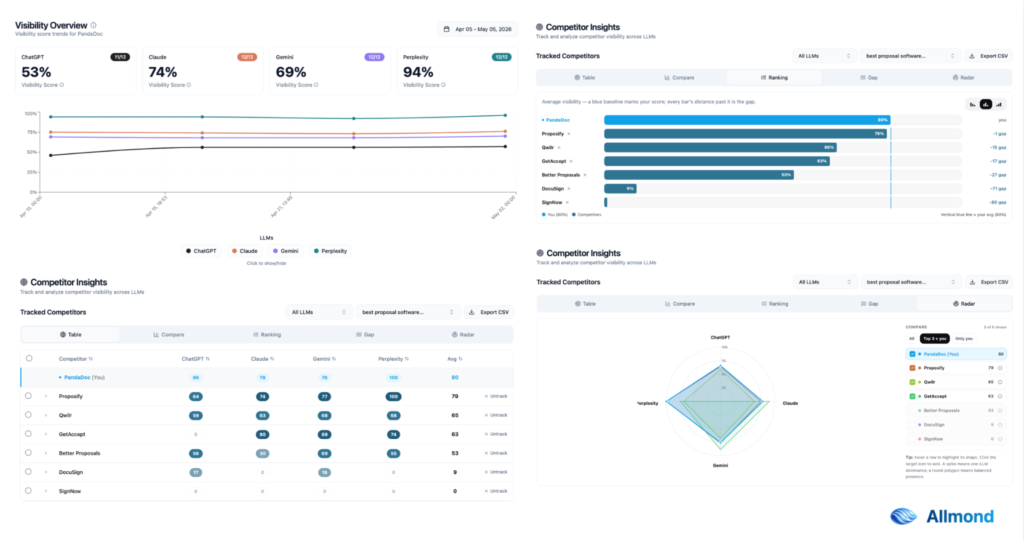
Allmond is an AI search visibility and brand monitoring platform designed to help businesses understand how they appear across major generative engines such as ChatGPT, Claude, Gemini, and Perplexity. It focuses on prompt-level visibility tracking, citation analysis, and competitor benchmarking to give teams a clear view of their presence in AI-generated answers.
Allmond targets agencies, SaaS companies, e-commerce brands, and startups that need reliable AI visibility insights without the complexity of enterprise-level platforms. It emphasizes fast setup, high-confidence data, and flexible usage across multiple projects and clients.
Founded: 2025
Founder: Olga Mykhoparkina
Headquarters: Estonia
Key Features
- Multi-LLM visibility tracking: Tracks brand presence across ChatGPT, Claude, Gemini, and Perplexity, with coverage in 60+ countries.
- Prompt-level monitoring: Evaluates how brands appear across selected prompts, enabling structured tracking similar to traditional SEO rank monitoring.
- Citation analysis: Identifies whether your brand or competitors appear in cited sources used by LLMs to generate answers.
- Competitor benchmarking: Highlights which competitors are being recommended in AI responses and compares visibility across the same prompts.
- Visibility scoring & trend tracking: Provides a clear 0–100 visibility score with weekly scans to monitor performance over time.
- Scalable agency workflows: Supports multiple clients, projects, and prompts with shareable dashboards and white-label reporting.
Pros
- High data reliability based on real AI-generated responses rather than modeled estimates
- Fast onboarding with no technical setup required
- Strong scalability with support for multiple projects, prompts, and clients
- Clear and actionable visibility insights for GEO-focused teams
- Cost-effective compared to enterprise-level AI visibility platforms
Cons
- Focused specifically on AI visibility, with limited broader SEO or marketing analytics features
- Weekly scan frequency may not suit teams needing real-time or daily tracking
- Reporting is streamlined, with less customization than some enterprise tools
- May be less suitable for highly technical teams requiring deep methodological controls
- Only monitors ChatGPT, Claude, Gemini, and Perplexity
- Price is 6.3 times higher compared to Rankshift: $0.12 per scan compared to $0.019 per scan
Pricing
Allmond uses a transparent pricing model based on scan volume, with all features included across plans.
- Starter: $29/month (up to 240 scans)
- Growth: $99/month (up to 825 scans)
- Pro: $199/month (up to 1660 scans)
A 7-day free trial is available. Additional scans can be purchased or upgraded mid-cycle.
Verdict
Allmond is best described as a mid-market AI visibility platform that balances usability, scalability, and cost.
It performs well for:
- Agencies managing multiple clients
- SaaS and e-commerce teams expanding into GEO
- Growth teams needing clear visibility into AI brand mentions
- Businesses looking for scalable tracking without enterprise complexity
It is less suited for:
- Enterprises requiring real-time monitoring or deep technical analytics
- Teams needing full SEO suite integrations or advanced customization
