
Background and goals
Student Verhuis Service had dominated traditional SEO for years through its long partnership with Doublesmart. Strong rankings, solid CRO and successful Digital PR were already in place.
Instead of defending a Google-first position, the ambition shifted toward the next search layer: AI-driven discovery.
The objectives were:
- Become the first moving company in the Netherlands generating measurable revenue via AI search
- Build structural visibility in tools such as ChatGPT, Perplexity and Google AI Overviews
- Drive scalable, trackable revenue from AI traffic
- Increase national visibility beyond a strong Amsterdam base
- Improve conversion performance while expanding reach
GEO Strategy
To compete in AI search, Doublesmart and Student Verhuis Service needed a focused Generative Engine Optimization strategy.The strategy combined technical crawlability, AI-structured content, authority signals and functional usability inside LLM environments.
1. Technical foundation for AI crawlability
The first step was structural cleanup:
- Core conversion tools were rebuilt to function without JavaScript, allowing AI systems to interpret them
- Site speed and stability were improved
- Technical architecture was simplified
This ensured AI systems could access and understand core service logic, not just static content.
2. Answer Engine Optimization and content restructuring
A full AEO strategy was implemented:
- Pages were rewritten to match how AI systems extract and summarize information
- Unique brand data and USPs were made explicit and structured
- Low-value pages were removed
- Underperforming blogs were rewritten with stronger informational clarity
Content moved from keyword targeting to answer clarity and extractability.
3. Authority and credibility signals
Original research and proprietary data were integrated into campaigns to strengthen trust signals.
Actions included:
- Digital PR campaigns built around proprietary insights
- Structured deployment of reviews and recognition badges
- Active review acquisition strategy
- Clear display of certifications and trust markers
These signals improved recognition inside LLM outputs as a reliable source.
4. AI-compatible pricing tool
A new AI-readable pricing tool was developed.
Unlike traditional form-based calculators, this version allowed LLM systems to interpret pricing logic. AI users could receive price indications directly within AI search environments.
This made the service not only discoverable, but functionally usable inside AI tools.
Execution
Execution took place over two years within a structured SEO for AI experiment.
Phase 1: Technical restructuring
Phase 2: Content rewriting and structural clarity
Phase 3: Authority amplification via data and PR insights from Rankshift
Phase 4: Conversion tool redevelopment for AI compatibility
Phase 5: Scaling visibility and experimentation
Long-term scalability initiatives included:
- Preparing a Reddit engagement strategy based on the Rankshift citation analysis module
- Developing API feeds for live pricing and service data
- Adding crawlable tables to improve machine readability
- Connecting publications directly to relevant service pages
Each layer reinforced discoverability, trust and usability inside AI systems.
Measurement framework
Performance was tracked across five pillars:
1. Revenue attribution
Direct monthly revenue attributable to AI search environments.
2. Conversion performance
Structural conversion rate and comparison to industry benchmarks.
3. AI visibility footprint
Visibility growth across 189 high-priority moving industry search terms, clearly visualized using Rankshift.
4. National presence
Geographic visibility expansion beyond Amsterdam.
5. Recognition and industry validation
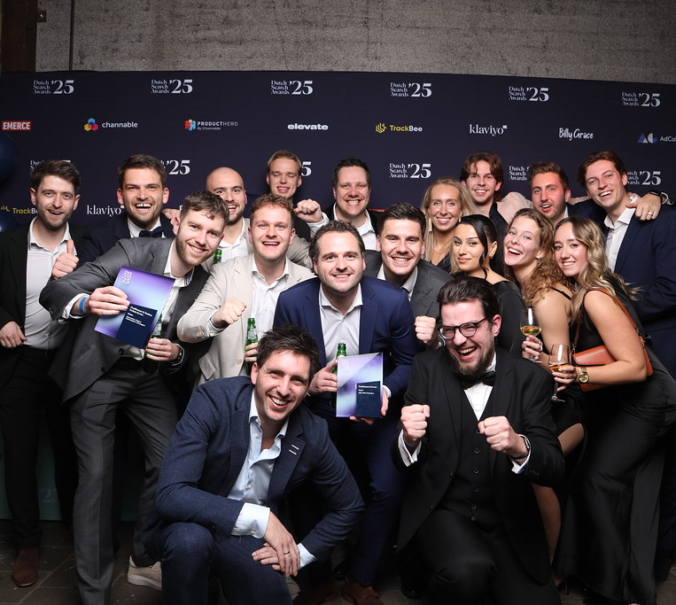
This was externally validated by winning the Dutch Search Award for Best Generative Engine Optimization Campaign in 2025, positioning Doublesmart as one of the best GEO agencies globally.
The framework connected AI visibility directly to measurable business growth.
Results
Revenue and growth
- 44 percent revenue growth over two years
- Substantial recurring monthly revenue directly attributable to AI search
- 92 percent growth in conversion rate
- Conversion rate structurally more than 10 percent above industry average
AI visibility
- 79 percent visibility increase across 189 strategic search terms
- Structural visibility in ChatGPT, Google Gemini, Perplexity, Copilot, Google AI Overviews and Mistral AI
- Transition from strong Amsterdam presence to consistent national coverage
Student Verhuis Service became the first mover in its category to generate measurable income via AI search tools.
Why it worked
Several structural advantages explain the outcome:
- Early investment while competitors focused solely on Google
- Technical accessibility that allowed AI systems to interpret core tools
- Clear, structured content built for extraction
- Proprietary data that strengthened authority recognition
- Functional AI usability via the pricing tool
This was not visibility layered on top of SEO. It was infrastructure designed for LLM environments.
Lessons and optimization opportunities
1. Technical accessibility is foundational
If AI systems cannot interpret tools and pricing logic, they cannot recommend them.
2. Authority signals amplify inclusion
Research, reviews and recognitions influence how AI models prioritize brands.
3. Functional usability matters
Being mentioned is valuable. Being operable inside AI environments is transformative.
4. Early experimentation compounds
Two years of structured experimentation created a durable advantage.
5. API-level integration is the next frontier
Direct data feeds and structured tables will likely become increasingly important for AI agent retrieval.
The core takeaway: AI search can drive measurable revenue when technical infrastructure, content structure and authority signals are aligned.
