

ChatGPT is the most visited AI tool, attracting 5.5 billion visits each month as of February 2026, according to research from Exploding Topics. They have over 900 million weekly users.
77% of all people in the U.S. who use ChatGPT treat it as a search engine.
And guess what? None of that shows up in Google Search Console.
Well, that’s the reality for most brands in 2026. You can own page one on Google and still be completely invisible in ChatGPT’s responses.
I’ve watched this happen across dozens of audits: a brand sitting at position #1 organically, nowhere to be found in ChatGPT’s response, while a smaller competitor gets mentioned three times with a citation link.
ChatGPT tracking tools exist to close that gap.
These LLM tracking tools help monitor how your brand appears across ChatGPT, Perplexity, Gemini, Claude, and Google’s AI mode, the platforms where a fast-growing share of your audience now starts their buying journey.
This blog post covers the 20 best options on the market right now. What each tool actually does, what it costs, and which type of team it’s built for. Let’s get into it.
Learn more about Generative Engine Optimization.
20 Best ChatGPT Tracking Tools: Quick Glimpse
| Tool Name | Best For | Starting Price |
| Rankshift | Reliable prompt tracking at scale | 30-day free trial (paid from €77/month ~$92/month) |
| Profound | Enterprise-grade AI intelligence | $99/mo |
| Scrunch AI | Enterprise brand monitoring & AXP | $250/mo |
| Peec AI | Affordable, AI search analytics for marketing teams | $95/mo |
| Otterly AI | Budget-friendly entry point | $29/mo |
| AthenaHQ | GEO platform with actionable optimization recommendations | $295/mo |
| Writesonic | All-in-one SEO + GEO platform | $199/mo (GEO from $249) |
| OmniSEO | Free AI visibility with services | $89/mo |
| Atomic AGI | Unified SEO + AI analytics | $20/mo |
| Ahrefs Brand Radar | Large-scale brand research + Users already using Ahrefs | $199/mo add-on |
| Semrush AI Visibility | Integrated SEO + AI workflows | $99/mo add-on |
| Gumshoe AI | Pay-per-use persona analysis | $0.10/conversation |
| Gauge | Action-oriented GEO + content | $99/mo |
| ZipTie.Dev | Simple, no-frills tracking | $69/mo |
| Prompt Monitor | Budget multi-model tracking | $29/mo |
| AirOps | Content ops + AI visibility | Custom pricing |
| Conductor | Enterprise SEO + AI strategy | Custom (quote-based) |
| SE Ranking ChatGPT Tracker | SEO teams adding AI tracking | $129/mo |
| Xofu | Bottom-of-funnel AI tracking | Free (paid from $99/mo) |
| Prerender | Technical AI crawlability | $49/mo |
How I Evaluated These Tools
Before we go tool by tool, a quick note on methodology.
I didn’t just read marketing pages and summarize features. I tested each platform where possible, cross-referenced user reviews on G2, SourceForge, and independent blogs, and spoke with SEO practitioners who use these tools daily.
Here’s what I weighted most heavily:
- Data collection method: This is the single most important distinction in this category. Some tools query LLM APIs directly. Others scrape the actual consumer-facing web interfaces. The difference is enormous. A 2025 SurferSEO study found just 24% overlap between API responses and scraped web interface results across 1,000 ChatGPT prompts. (Source)
Tools that scrape the real UI give you what your customers actually see. API-based tools give you an approximation that may miss retrieval-augmented generation (RAG) results entirely.
- Platform coverage: ChatGPT is the huge one as of now, but your customers use Perplexity, Gemini, Claude, and Google’s AI Overviews too. The best tools track multiple engines because each one surfaces different brands for the same query.
- Actionability: A dashboard full of charts means nothing if you can’t figure out what to do next. I prioritized tools that translate visibility data into specific recommendations; whether that’s content to create, sources to pitch, or technical fixes to implement.
- Pricing transparency: Some tools in this space use credit-based models, per-conversation billing, or domain-level add-on fees that make actual monthly costs nearly impossible to predict. I flagged those.
- Accuracy: Several independent reviews have documented significant accuracy gaps in certain tools. Where I found evidence of unreliable data, I noted it.
Now, let’s break down each tool.
The 20 Best ChatGPT Tracking Tools
1. Rankshift
Best for: Reliable, scalable prompt tracking with unlimited users and projects
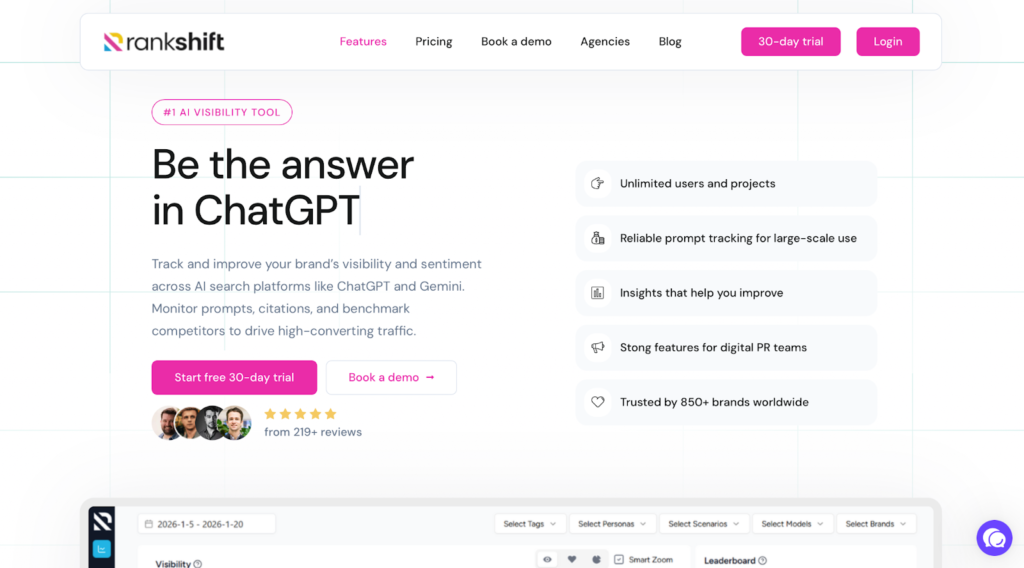
Rankshift is a focused AI visibility tracking platform that monitors brand mentions and citations across all major LLMs like ChatGPT, Gemini, AI Overviews, AI Mode, Claude, Perplexity, Copilot Mistral, and Llama (Meta).
The tool is built for marketing teams that need to track AI visibility across multiple brands, clients, or markets without worrying about seat limits or project caps.
Also read: How to improve brand mentions in AI.
Key features:
- Visibility scoring and share of voice metrics across 8+ AI platforms
- Sentiment analysis that surfaces how AI perceives your brand
- AI crawler log monitoring to see when AI models crawl your website
- Citation opportunity identification showing which sources AI trusts in your niche
- In-depth source analytics
- Integrations with Looker Studio, BigQuery, Power BI, and REST API access.
Pros:
- User-friendly and intuitive dashboard
- Every plan includes unlimited users and projects
- Supports 9 LLMs from day one, no per-platform add-on fees
- A 30-day free trial gives ample time to evaluate
Cons:
- Slight learning curve is involved but backed by a strong support team
Pricing: Offers a 30-day free trial. The paid plan starts at €77/month ($92/month).
Why not give it a try and see the difference?
2. Profound
Best for: Enterprise brands needing comprehensive AI visibility intelligence at scale
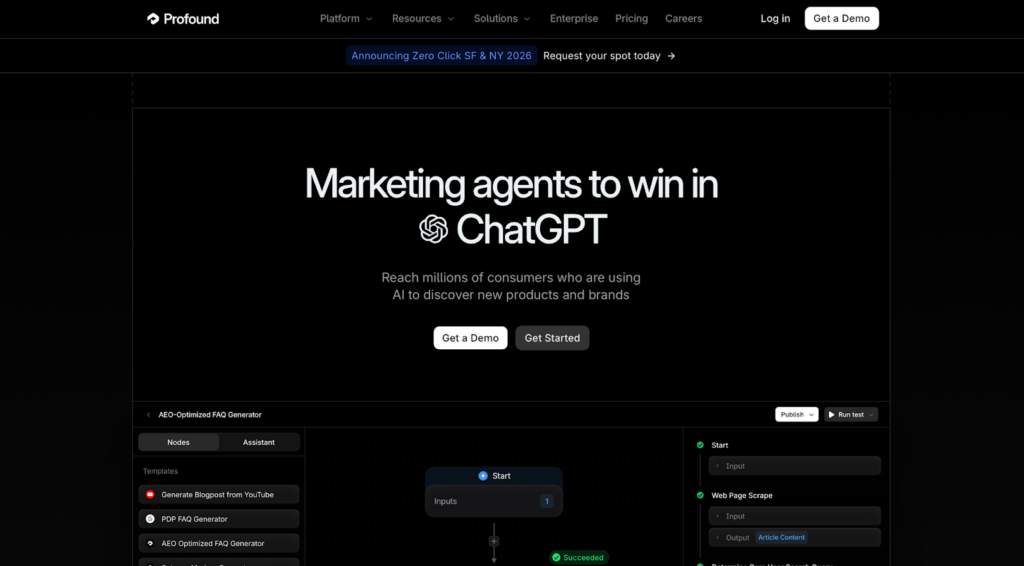
Profound has emerged as one of the most well-funded players in the AI visibility space, having raised a total of $155M in funding, including $96M Series C at $1B valuation.
The platform positions itself as a full-stack marketing solution for the AI era, going beyond visibility tracking into content creation, automated workflows, and crawl analytics.
Key features:
- Answer Engine Insights across 10+ platforms
- Prompt Volumes showing what millions of people ask AI
- Agent Analytics for AI crawler monitoring
- Automated content briefs and draft generation
- Agency mode with separate client workspaces
Pros:
- Deepest prompt volume data in the market sourced from real conversations
- SOC 2 Type II and HIPAA compliant
- Strong enterprise support
- Robust content action workflows
Cons:
- Entry-level plan ($99/mo) only tracks ChatGPT, you need the $399+ Growth plan for broader coverage.
- Premium pricing puts it out of reach for smaller teams.
Pricing: Starter at $99/month (ChatGPT only), Growth at $399/month, Enterprise is custom. 7-day free trial on Growth plan.
3. Scrunch AI
Best for: Enterprise brand monitoring with Agent Experience Platform (AXP)
Next on the list of ChatGPT tracking tools comes Scrunch AI. The tool takes a different angle from pure visibility trackers.
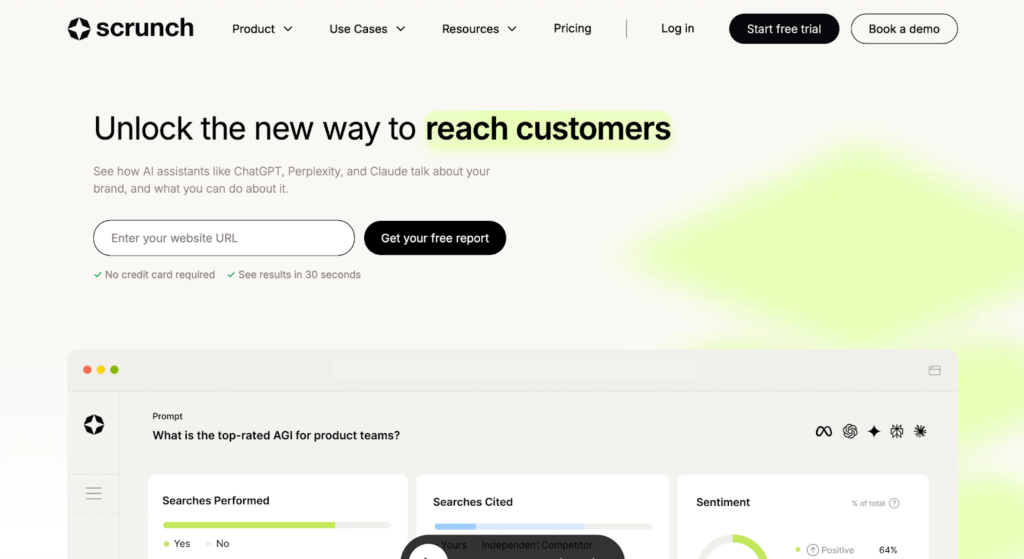
While it offers comprehensive monitoring across 7+ AI platforms, its standout vision is AXP, an Agent Experience Platform that creates a machine-readable version of your website specifically optimized for AI crawlers, without changing your human-facing site.
Key features:
- Prompt-level tracking with automatic prompt generation from keywords
- GA4 integration for AI referral traffic attribution
- Competitive benchmarking dashboards
Pros:
- Innovative AXP concept addresses AI crawlability at the infrastructure level
- Strong GA4 integration
- Enterprise-grade security
- SOC 2 Type II compliance
Cons:
- The starting price of $250/month is among the highest in the category.
- AXP is still in limited testing.
- Reporting and visualization capabilities have been criticized in reviews.
Pricing: Starts at $250/month (for brands). Enterprise pricing is custom. Free account option available for initial exploration.
4. Peec AI
Best for: Clean, simple AI search analytics that marketing teams actually enjoy using
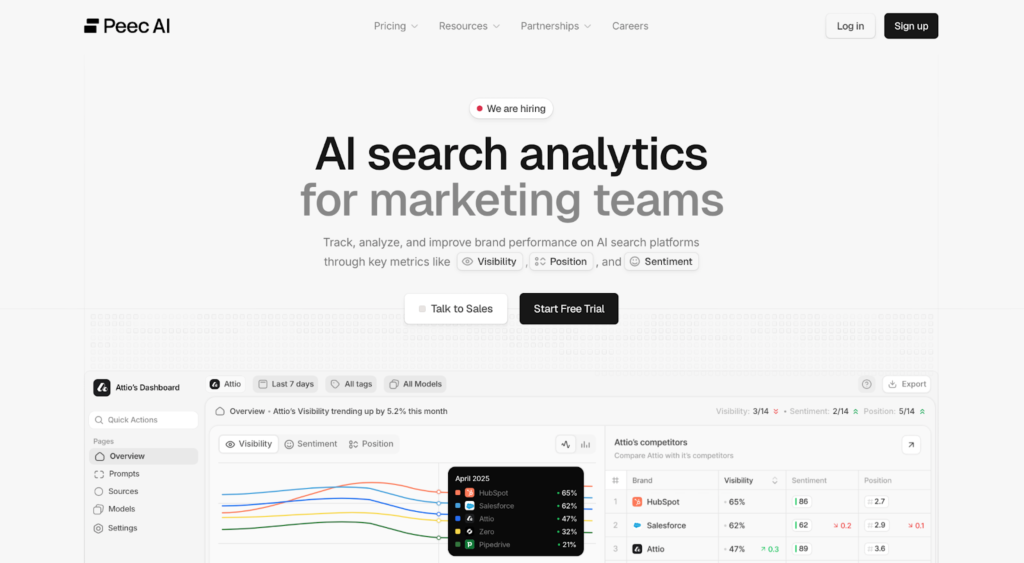
Peec AI has built its reputation on doing the basics really well. The platform tracks three core metrics: visibility, position, and sentiment, across AI search platforms, and presents them in an interface that’s genuinely intuitive.
Peec AI is primarily for marketing teams and has grown fast since its 2025 launch in Berlin. The appeal is straightforward: you add your prompts, pick your AI models, and get daily tracking across countries without drowning in dashboard complexity.
Key features:
- Daily prompt tracking across your chosen AI models
- Visibility score showing share of chats mentioning your brand
- Position tracking within AI search results
- Sentiment analysis revealing how AI perceives your brand
- Source tracking with URL-level citation data
- Competitor benchmarking and multi-country tracking
- Looker Studio/GSC/GA integrations on higher plans
Pros:
- Clean, enjoyable UX with a short learning curve
- Unlimited users on all plans
- Daily tracking frequency across the board
- Multi-country support on Advanced plan
- Free trial without credit card
Cons:
- Base plans include only 3 AI models, broader coverage requires Enterprise.
- Monitoring-focused; no built-in content creation or optimization tools.
- Starter plan limited to 1 project.
Pricing: Starter Plan is for $95/mo (50 prompts, 3 models, 1 project.)
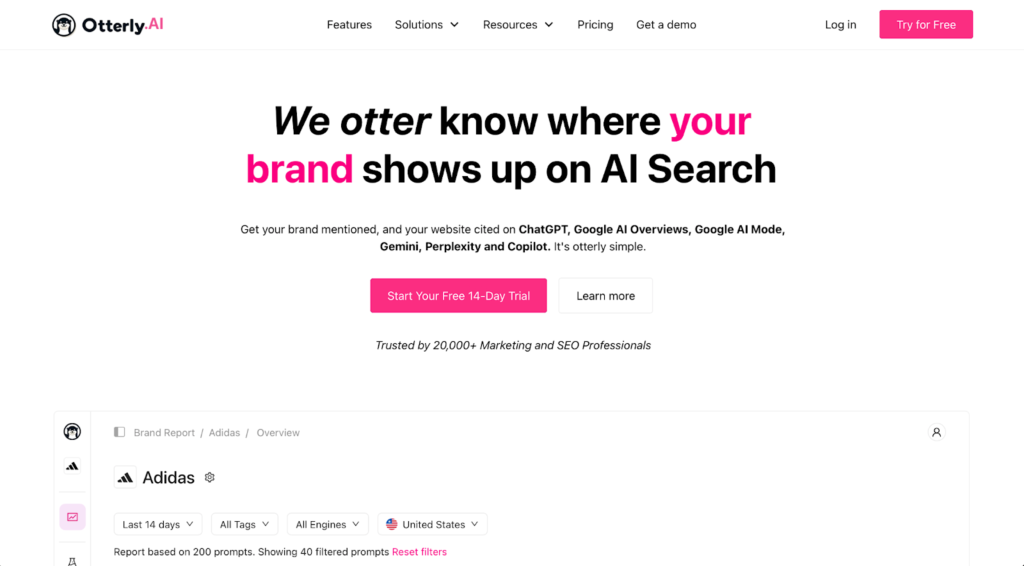
5. Otterly AI
Best for: Budget-friendly entry into AI visibility tracking with strong GEO audits
Otterly AI is another affordable AI visibility tracking tool that can help you track across ChatGPT, Google AI Overviews, and more.
The platform’s GEO URL audit feature is a standout, letting you analyze individual pages for AI citation readiness. It’s particularly well-regarded; multiple independent reviewers call it the best auditing tool at its price point.
Key features:
- Brand Visibility Index
- AI keyword research for discovering the prompts your audience asks
- Brand monitoring and website citation tracking across AI search platforms
- Domain ranking analytics
- Link citations analysis
- GEO URL audits (1,000-10,000/month depending on plan)
- Multi-country support across 50+ countries
- Unlimited brand reports and team members on all plans
- Looker Studio connector on Standard Plan
Pros:
- Lowest meaningful starting price at $29/month.
- Daily tracking on all plans.
- GEO audit tool is genuinely strong at this price point.
Cons:
- Lite plan limited to 15 prompts and 1 workspace.
- AI Mode and Gemini are add-ons, not included by default.
- The jump from Lite ($29) to Standard ($189) is steep.
- Missing Claude from platform coverage entirely.
- No sentiment analysis.
Pricing: The paid plan starts at $29/month – Lite (15 prompts, 4 platforms, 1 workspace, 1,000 GEO audits).
6. AthenaHQ
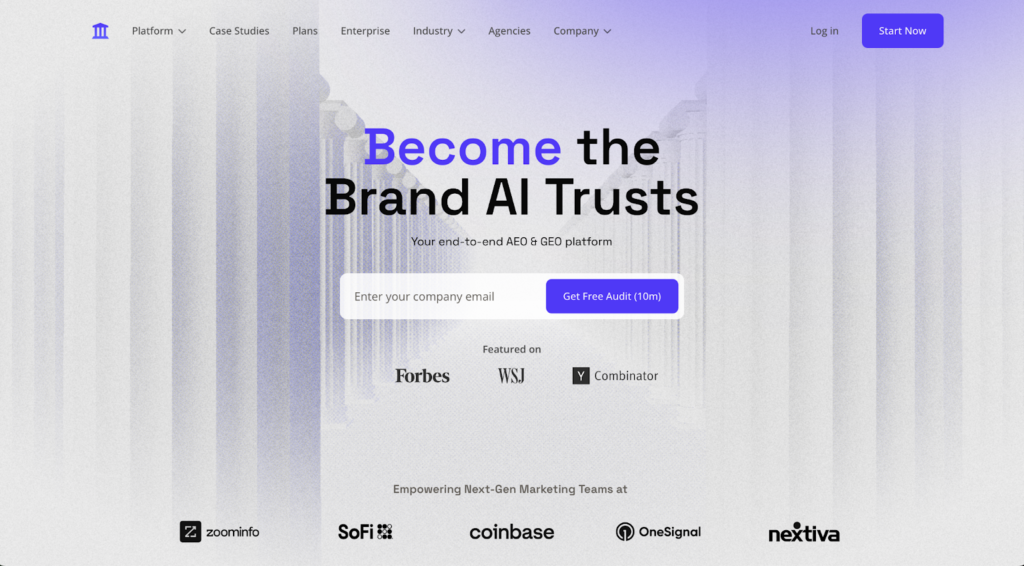
Best for: End-to-end AEO and GEO platform with actionable optimization recommendations
AthenaHQ is a Y Combinator-backed platform that positions itself as a complete AEO and GEO solution, not just monitoring, but taking action on AI search.
It covers 8+ major LLMs including ChatGPT, Perplexity, AI Overviews, AI Mode, Gemini, Claude, Copilot, and Grok. The platform is structured around three core capabilities: Prompt Volume tracking, Monitoring, and an Action Center.
Key features:
- Prompt Volume tool to identify the prompts that matter to your brand
- AI visibility monitoring and brand perception tracking across 8+ LLMs
- Action Center with prioritized recommendations to improve AI search presence
- Competitor benchmarking
- On-page and off-page GEO analysis
- Citation source intelligence
Pros:
- Covers 8+ LLMs on the Self-Serve plan from day one.
- Action Center translates data into specific next steps.
- Strong ecommerce angle with Shopify integration.
- Agency pitch workspace is a useful differentiator.
- Free audit available on their site. Serves recognizable enterprise clients.
Cons:
- Credit-based pricing can be hard to predict, each AI response burns credits, so tracking across multiple models depletes them faster.
- $295/month starting price (though $95 first-month promo exists).
- Steep learning curve reported by some users.
- Minor bugs typical of a fast-moving startup.
Pricing: Self-Serve at $295/month (3,600 credits, 8+ LLMs, $95 first-month promo available). Enterprise pricing is custom.
7. Writesonic
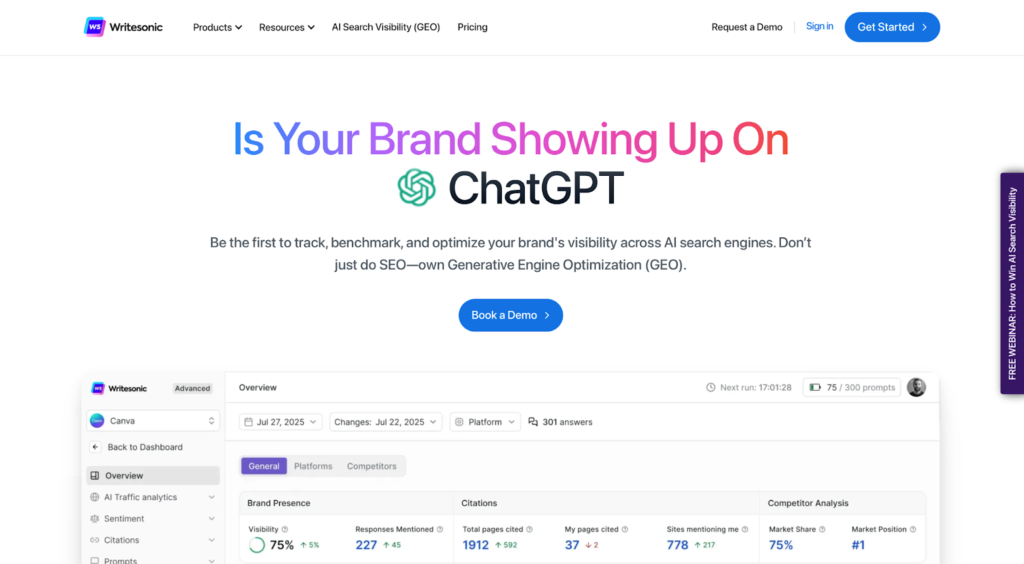
Best for: Teams wanting SEO + GEO + content creation in a single platform
Writesonic started as an AI writing tool and has pivoted hard into becoming what it calls a “full-stack GEO + SEO platform.”
The result is a uniquely integrated offering: you can track AI visibility, identify content gaps, create optimized content, and publish, all without leaving the dashboard.
Key features:
- AI visibility tracking across 10+ platforms
- Citation and sentiment analysis
- Action Center with prioritized recommendations
- AI crawler analytics
- AI-powered content generation and optimization
Pros:
- The only platform that integrates content creation and AI visibility tracking in a single workflow.
- Useful for teams already using Writesonic for SEO and content workflows
- User-friendly interface with quick setup
- Free AI Traffic Analytics tool available
Cons:
- GEO features are locked behind the $199/month Professional plan, lower tiers are just writing tools.
- Interface can feel overwhelming with so many features.
Pricing: The paid plan starts at $199/month.
8. OmniSEO
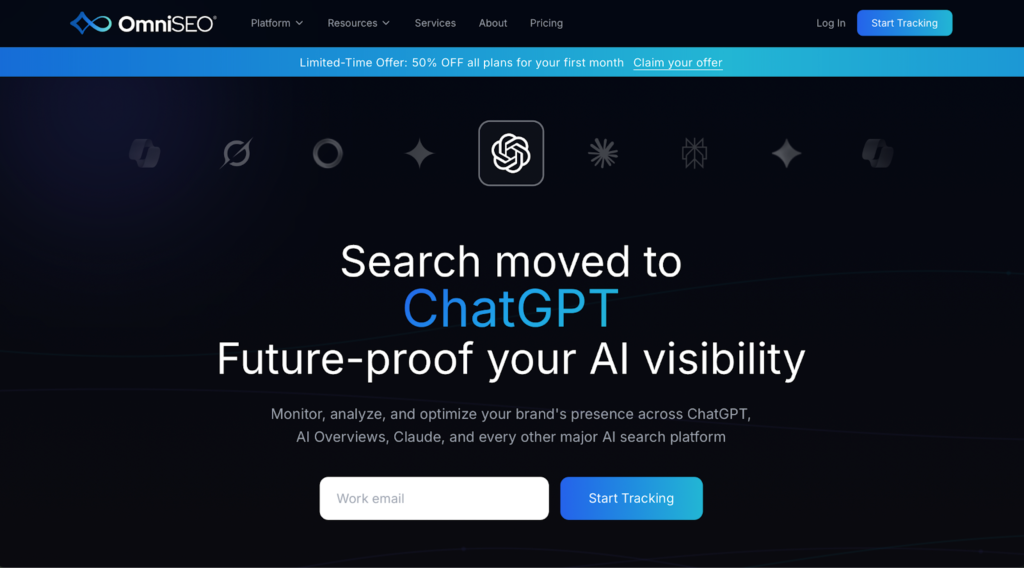
Best for: AI visibility platform with optional professional GEO services
OmniSEO is built by WebFX and tracks brand visibility across 8 AI platforms including ChatGPT, Claude, Perplexity, Gemini, Copilot, Grok, Meta AI, and AI Overviews.
The platform pairs self-serve AI visibility tracking with optional professional GEO and AEO services from WebFX’s 650+ person team. It also offers free tools like an AI Prompt Volume Checker and a Top Brands by Industry explorer that anyone can access without signing up.
Key features:
- Brand mention and citation tracking across 8 AI platforms
- Prompt performance analysis
- Competitive benchmarking (up to 5 competitors)
- Citation mapping
- Placement recommendations prioritized by engine and intent
- AI bot analytics
Pros:
- Broad 8-platform coverage.
- Free prompt volume checker is genuinely useful for research.
- Backed by WebFX’s deep SEO expertise.
- Optional done-for-you GEO services for teams that want hands-off execution.
- 50% off – first month currently available.
Cons:
- Pricing is higher than some dedicated tracking-only tools.
- Designed partly as a funnel into WebFX’s agency services.
Pricing: The paid plan starts at $89/month.
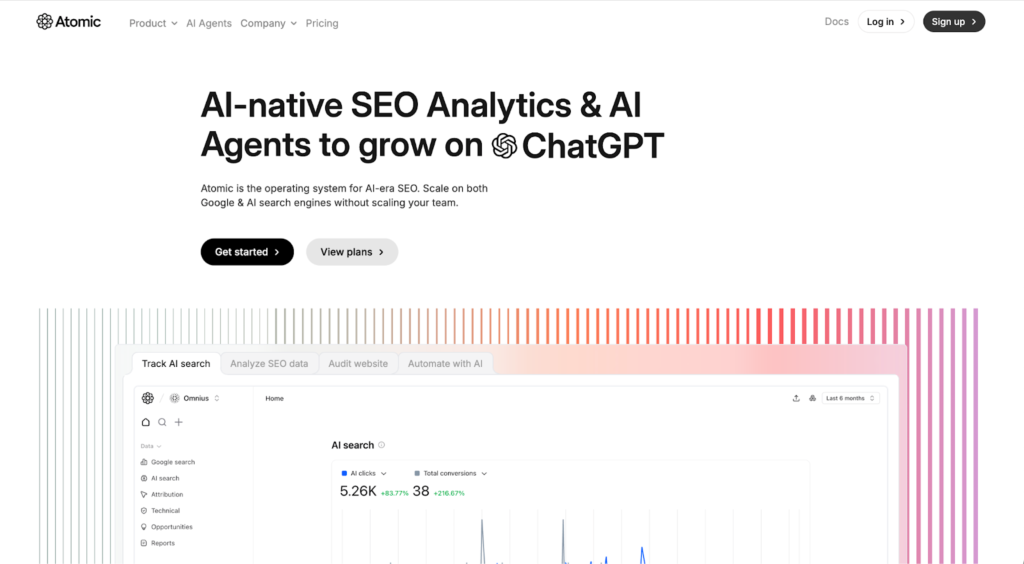
9. Atomic AGI
Best for: Unified SEO + AI search analytics with conversion attribution
Atomic AGI takes a “single pane of glass” approach, combining traditional SEO analytics, AI search tracking, technical health monitoring, and conversion attribution in one dashboard.
It’s particularly popular with teams tired of switching between five different tools to understand their overall search visibility.
Key features:
- AI search visibility tracking across ChatGPT, Perplexity, Gemini, Claude, and more
- Traditional SEO analytics integrated with AI data
- Prompt and query tracking to identify which AI searches mention your brand
- Citation and referral analysis showing which pages drive AI-generated traffic
- Content analysis and optimization with NLP-driven insights
- GA4 conversion attribution
Pros:
- Genuinely unified dashboard that connects SEO and AI data
- Setup takes under 5 minutes
- Free tier available
- GDPR-compliant
- Praised for clean UX and strong customer support
Cons:
- Steep learning curve involved.
- Off-page SEO features are less mature than established tools like Ahrefs or Semrush.
- A smaller user base means less community knowledge.
Pricing: Free tier available (1 project, 7 days historical data). Starter at $20/month per project (20 weekly AI prompts, 16 months historical data).
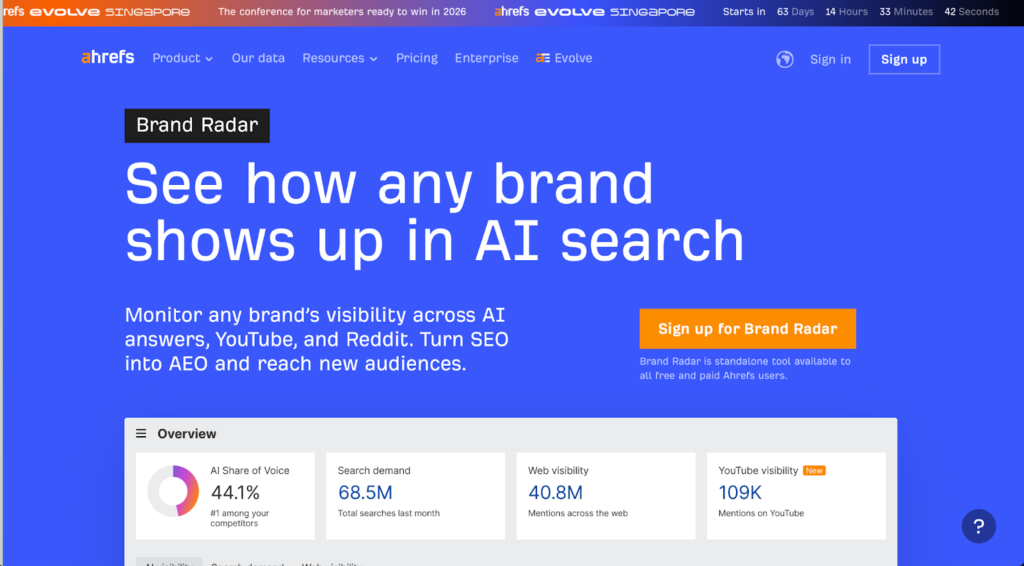
10. Ahrefs Brand Radar
Best for: Large-scale brand research across AI, YouTube, TikTok, and Reddit
Ahrefs Brand Radar extends one of SEO’s most trusted data ecosystems into the AI visibility space. With a database of 263M+ monthly prompts across 6 AI indexes, it’s built more as a research and exploration tool than a simple rank tracker.
Its recent addition of YouTube, TikTok, and Reddit mention tracking makes it unique in connecting upstream brand discovery with AI visibility. Brand Radar is available as a standalone tool to both free and paid Ahrefs users.
Key features:
- Brand mention analysis across 263M+ prompts
- AI visibility tracking across 6 indexes (AI Overviews, AI Mode, ChatGPT, Perplexity, Gemini, Copilot)
- YouTube and TikTok mention tracking
- Reddit discussion monitoring
- Custom prompt tracking packages
- AI Share of Voice and Search Demand tracking
- Integration with Ahrefs’ backlink and keyword data
Pros:
- Largest AI prompt database in the market (263M+)
- YouTube/TikTok/Reddit tracking is unique
- Available as a standalone tool, no Ahrefs subscription required to start
- Unlimited projects
- Zero setup, instant search
Cons:
- Expensive – $199/month per individual AI index or $699/month for all platforms, plus base Ahrefs subscription.
- Documented accuracy issues in independent testing.
- Missing Claude and Grok tracking.
- No sentiment analysis.
- UI requires SEO expertise.
Pricing: AI Indexes at $199/month per index or $699/month for all 6 platforms.
11. Semrush AI Visibility Toolkit
Best for: Teams already using Semrush who want integrated AI tracking
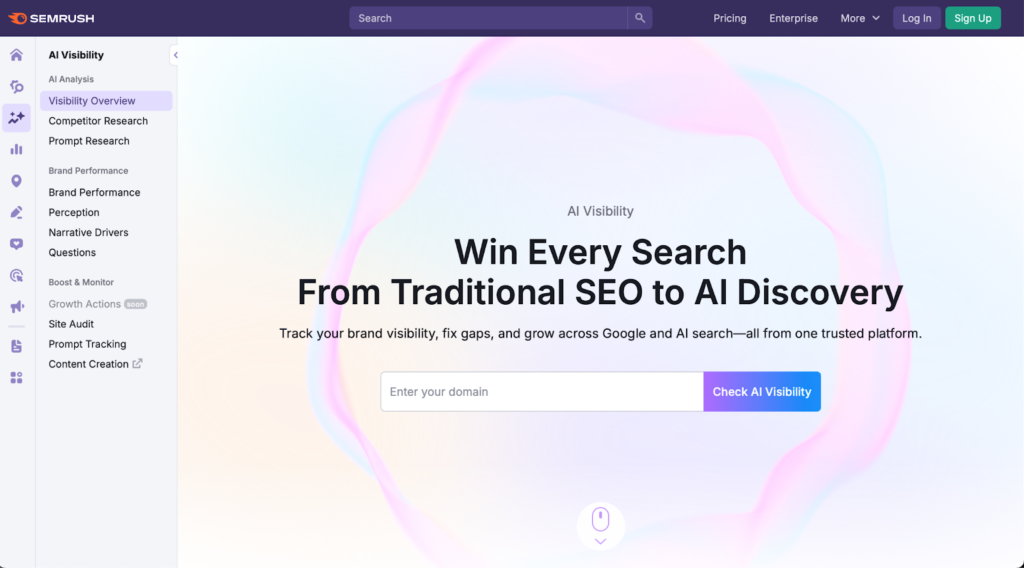
Semrush has added AI visibility as a natural extension of its dominant SEO platform.
The AI Visibility Toolkit, available standalone at $99/month or bundled in Semrush One starting at $199/month, gives existing Semrush users a way to track AI performance alongside their traditional SEO metrics without adopting a new tool.
Key features:
- AI Visibility Score benchmarking
- Prompt research (like keyword research for AI)
- Competitor analysis across AI platforms
- Brand performance reports with sentiment
- AI SEO audit for technical readiness
- Presentation-ready reports
Pros:
- Seamless integration with Semrush’s established SEO toolkit.
- Familiar interface for existing users.
- Prompt research feature fills a gap most tools ignore.
- Strong data infrastructure from 100M+ monitored prompts.
Cons:
- The standalone AI toolkit at $99/month includes only 25 custom prompts and one domain.
- Scaling costs add up fast ($99 per additional domain, $60 per 50 extra prompts, $99 per additional user).
- No free trial for standalone AI toolkit.
Pricing: AI Visibility Toolkit at $99/month per domain. Semrush One (bundled) starts at $199/month. Additional prompts, domains, and users cost extra.
12. Gumshoe AI
Best for: Persona-based AI visibility audits across LLMs
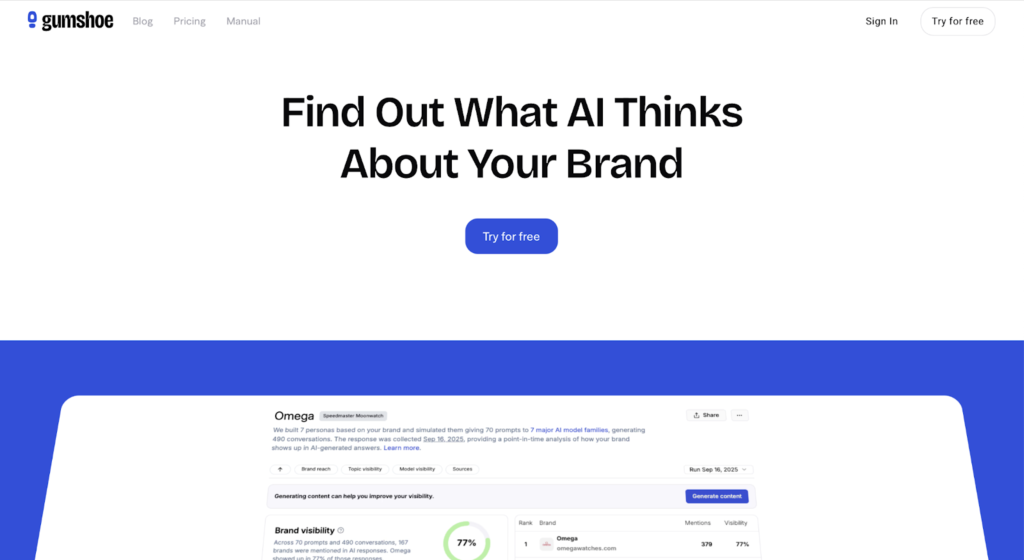
Gumshoe AI is another LLM tracking tool designed to help brands understand what AI models actually say about them. It analyzes how your brand appears across major AI tools such as ChatGPT, Gemini, Claude, and Perplexity, running large sets of simulated conversations to measure mentions, citations, and competitor positioning.
What differentiates Gumshoe is its persona-driven visibility analysis, allowing teams to see how AI answers vary depending on different audience personas, topics, and prompts.
Gumshoe AI takes a refreshingly different approach to pricing and methodology. Instead of monthly subscriptions, it uses pay-per-conversation billing at $0.10 per conversation.
Key features:
- Tracking across leading AI platforms including ChatGPT, Google Gemini, and Perplexity
- Persona-based visibility analysis
- Topic-level heatmaps
- Cited source discovery
- AI Optimization Score with recommendations
- AI-assisted content generation on paid plans
Pros:
- Pay-per-use model is ideal for periodic audits.
- Persona-driven insights are unique and strategically valuable.
- Clean, playful UX.
- Three free report runs to start.
- Includes optimization recommendations and AI-assisted content generation on paid plan.
Cons:
- Costs become unpredictable with frequent monitoring (daily tracking can hit $450-1,500+/month).
- API gated behind enterprise pricing.
- Not designed for continuous daily tracking.
Pricing: $0.10 per conversation. Typical single report costs $25-30. Three free reports for new users. Enterprise plans with custom pricing.
13. Gauge
Best for: Action-oriented GEO with built-in content generation
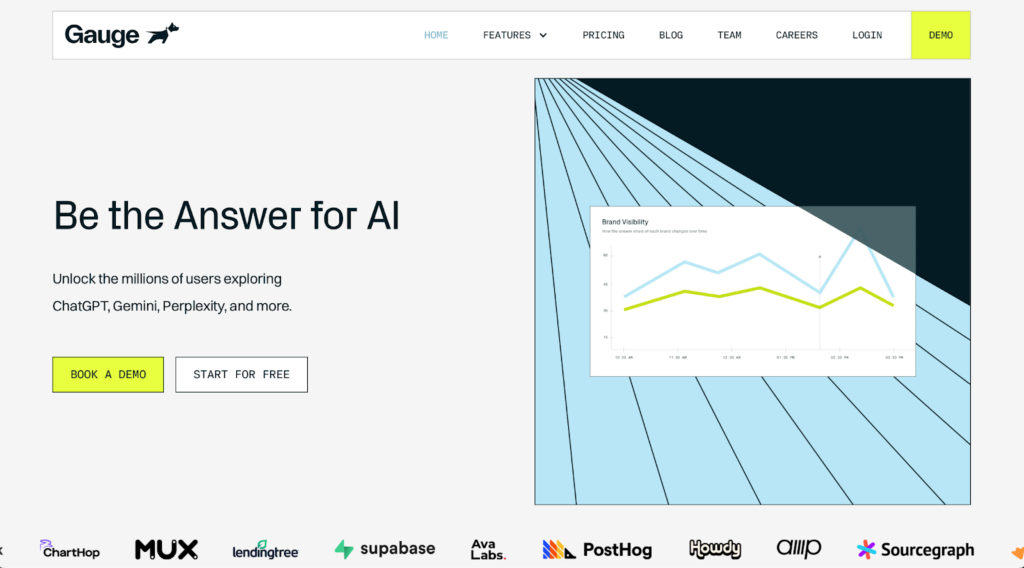
Gauge positions itself as the “complete GEO toolkit,” combining monitoring, analytics, content creation, and audit capabilities. Rather than just showing whether your brand is mentioned, Gauge focuses on competitive intelligence and content gap analysis.
It analyzes which prompts trigger competitor mentions, which sources AI models cite, and where your brand is missing from AI answers, then provides recommendations on how to close those gaps through better content and optimization strategies.
Key features:
- Monitoring across 7+ AI platforms including ChatGPT, Claude, Gemini, Perplexity, CoPilot, AI Mode, and AI Overviews.
- Daily prompt tracking.
- Citation source analysis.
- Built-in content engine (3-18 articles/month depending on plan).
- Actions Center with prioritized recommendations.
Pros:
- Content creation included in plans, not just tracking.
- UI-based scraping for accurate data.
- GA4 integration ties visibility to business outcomes. Strong case studies (one client achieved 50x visibility increase in 3 months). Multi-language and geo-targeted tracking.
Cons:
- Starter plan ($99/month) is ChatGPT-only.
- Growth plan at $599/month is a significant jump.
- Relatively newer player building market reputation.
Pricing: Starter at $99/month (100 prompts, ChatGPT only, 3 articles). Growth at $599/month (600 prompts, all platforms, 18 articles). Enterprise pricing is custom.
14. ZipTie.Dev
Best for: AI search intelligence with built-in content optimization
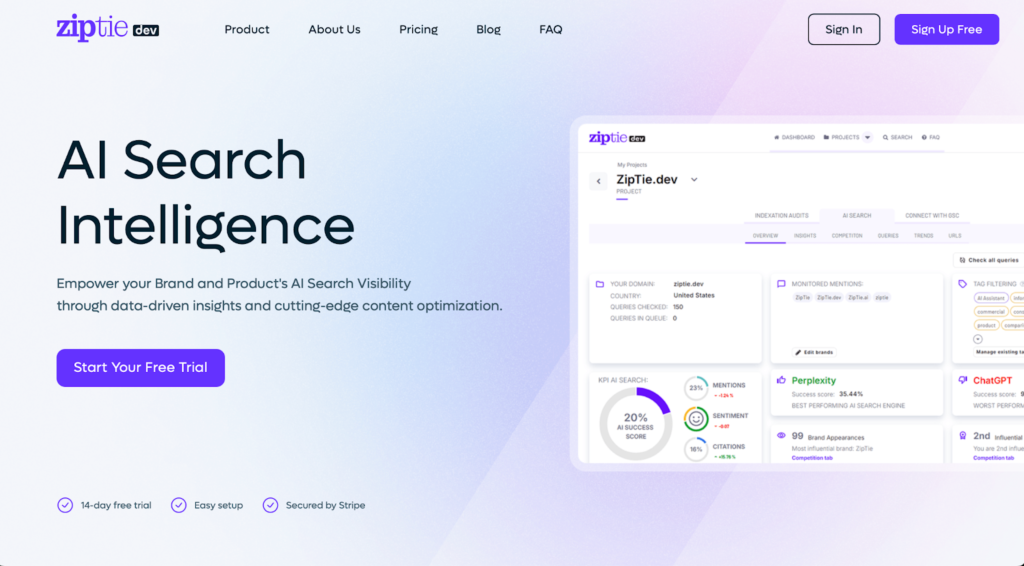
ZipTie.Dev focuses on three AI search platforms – Google AI Overviews, ChatGPT, and Perplexity, and does them well.
Rather than trying to track every LLM on the market, it goes deep on the three that drive the most traffic, pairing monitoring with AI Data Summaries and a Content Optimization module that gives you structural advice on how to improve your citation rates.
Key features:
- AI search monitoring across Google AI Overviews, ChatGPT, and Perplexity
- AI Data Summaries for actionable insights
- Content Optimization module with structural citation advice
- Competitive landscape analysis
- AI Search checks (500-2,000+/month depending on plan), 14-day free trial.
Pros:
- Focused depth on the three highest-traffic AI platforms
- Content Optimization feature goes beyond monitoring into actionable fixes
- 14-day free trial
Cons:
- Only tracks 3 AI platforms, no Claude, Gemini, Copilot, or Grok.
- Less suited for teams needing broad multi-engine coverage.
Pricing: Basic at $69/month (500 AI Search checks, 5 AI Data Summaries, 10 Content Optimizations).
15. Prompt Monitor
Best for: Affordable prompt-based AI visibility tracking across multiple LLMs
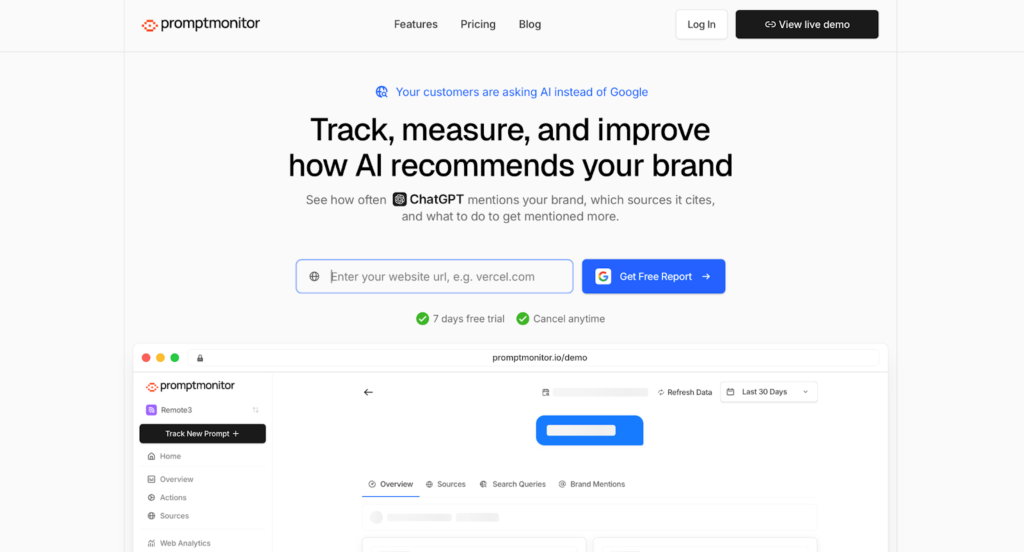
Prompt Monitor packs a surprising amount of value into its low price point. At $29/month, it tracks across 8 AI platforms, more broad coverage than tools costing 10x as much.
Its standout feature is publisher contact discovery: it extracts author emails and social profiles from cited sources, giving you a direct path to outreach for the publications AI already trusts.
Key features:
- Multi-model tracking across ChatGPT, Claude, Gemini, DeepSeek, Grok, Perplexity, Google AI Overview, and AI Mode
- Publisher contact extraction with domain ratings. AI crawler analytics
- GDPR-compliant website analytics
- Region-based tracking
- Agency program with white-labeling
Pros:
- Exceptional value at $29/month.
- Broadest model coverage at entry price.
- Contact discovery turns monitoring into an actionable outreach workflow.
- AI crawler analytics included from the $39 plan.
- 7-day free trial.
Cons:
- No built-in content creation or editing tools.
- Analytics is less sophisticated than premium platforms.
- Smaller team behind the product compared to well-funded competitors.
Pricing: Plans starting at $29/month with 7-day free trial. Agency and enterprise plans with custom pricing and white-labeling.
16. AirOps
Best for: Content teams needing integrated GEO within existing content operations
AirOps approaches AI visibility from the content operations side first.
If your team already uses AirOps for content workflows, adding AI visibility tracking feels natural, you can see where you show up in AI answers and adjust your content pipeline from the same workspace. Its Grid system for managing content at scale is particularly well-regarded.
Key features:
- AI search visibility monitoring integrated with content workflows
- Brand Kit for maintaining consistent voice across AI-optimized content
- Power Agents for automating GEO tasks
- Content grid with CMS connections (Webflow, WordPress), Google Search Console integration
- Page360 analytics combining SEO
Pros:
- Unique integration of content ops and AI visibility
- Free ChatGPT-only plan to get started
- Workflow automation reduces manual effort
Cons:
- Not a pure GEO specialist, AI visibility features are layered onto a content ops platform.
- Task-based billing complicates cost prediction.
- Multi-engine tracking requires higher-tier plans.
- Setup requires time to configure workflows effectively.
Pricing: Free ChatGPT-only plan available. Paid plans use usage-based pricing. Contact for specifics.
17. Conductor
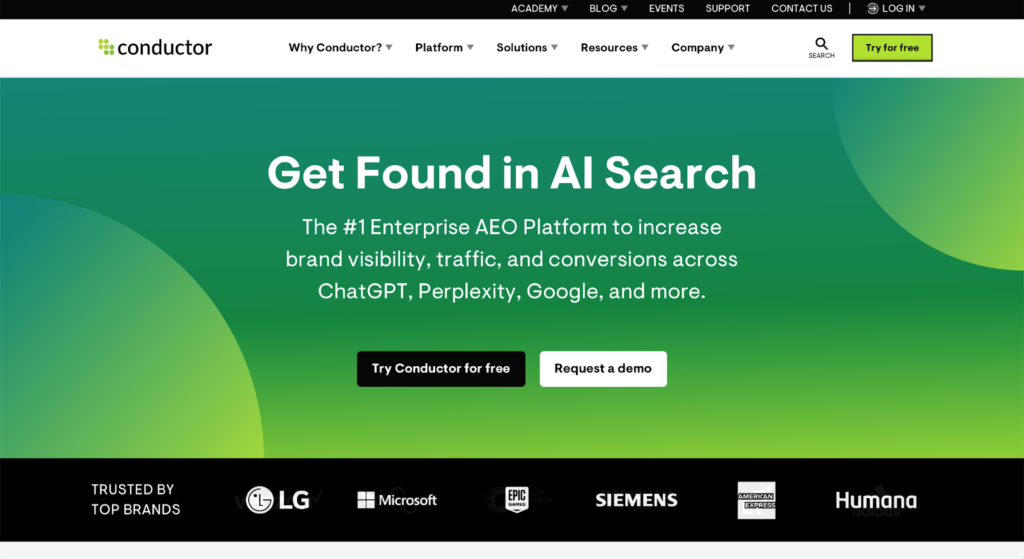
Best for: Enterprise SEO teams adding structured AI tracking to existing workflows
Conductor is an established enterprise SEO platform that has expanded into AI visibility tracking. It’s built for organizations that need structured programs; choosing topics, balancing branded and unbranded prompts, selecting engines, and building repeatable tracking strategies.
If you already run your SEO through Conductor, adding AI tracking is a logical extension.
Key features:
- Structured AI prompt tracking programs
- AI visibility integrated with traditional SEO workflows
- Competitive analysis across AI platforms
- Content optimization recommendations
- Enterprise-grade compliance and governance
- Robust reporting for stakeholder communication.
Pros:
- Enterprise-ready from day one.
- Structured approach helps large teams stay organized.
- Integrates with the broader Conductor SEO ecosystem.
- Strong guidance on prompt tracking strategy.
Cons:
- Quote-based pricing creates a barrier for smaller teams.
- Enterprise platforms can feel like overkill for lightweight tracking needs.
- Sales-led motion means no instant self-service signup.
- Learning curve for new Conductor users.
Pricing: Custom, quote-based pricing. Contact sales for details.
18. SE Ranking ChatGPT Visibility Tracker
Best for: SEO teams wanting to add AI tracking alongside traditional rank tracking
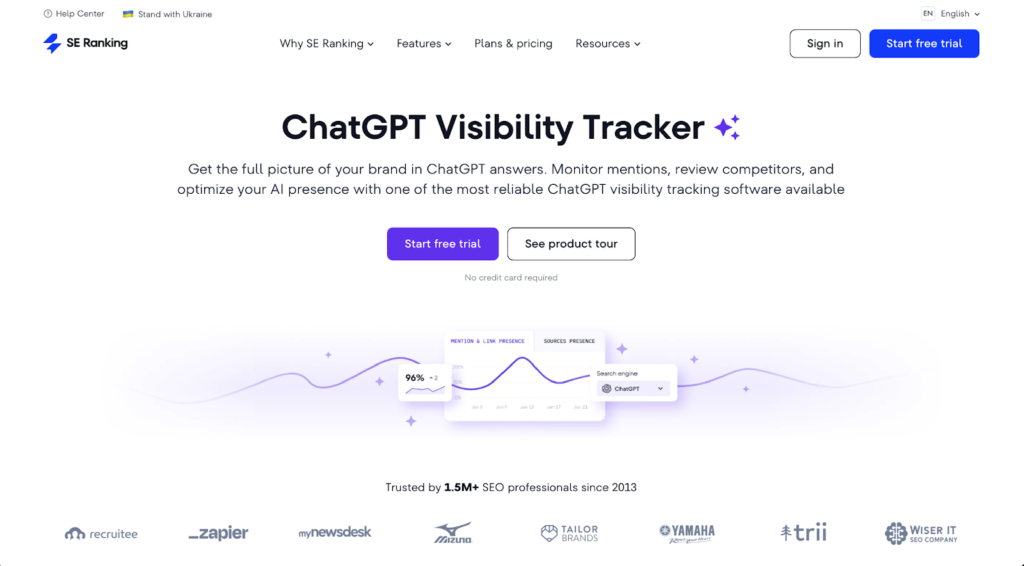
SE Ranking’s ChatGPT Visibility Tracker fits neatly into the SE Ranking ecosystem, giving SEO-focused teams a way to monitor AI visibility without switching platforms.
It covers the essentials; ChatGPT, Perplexity, and AI Overviews tracking, and integrates that data with your existing SE Ranking SEO workflow.
Key features:
- ChatGPT, Perplexity, and Google AI Overviews tracking
- Brand mention monitoring
- Competitor visibility comparison
- Integration with SE Ranking’s full SEO toolkit
- Prompt-based tracking with customization options.
Pros:
- Natural extension for existing SE Ranking users
- Combines traditional SEO and AI tracking in one interface
- Straightforward pricing
- Strong value for teams already invested in SE Ranking
Cons:
- Limited AI platform coverage compared to dedicated tools.
- Basic AI visibility features that may not satisfy teams with advanced GEO needs.
- You may outgrow it as your AEO strategy matures.
Pricing: Available as part of SE Ranking plans. Core plan at $129/month.
19. Xofu
Best for: Tracking when AI recommends your brand on buyer-intent prompts
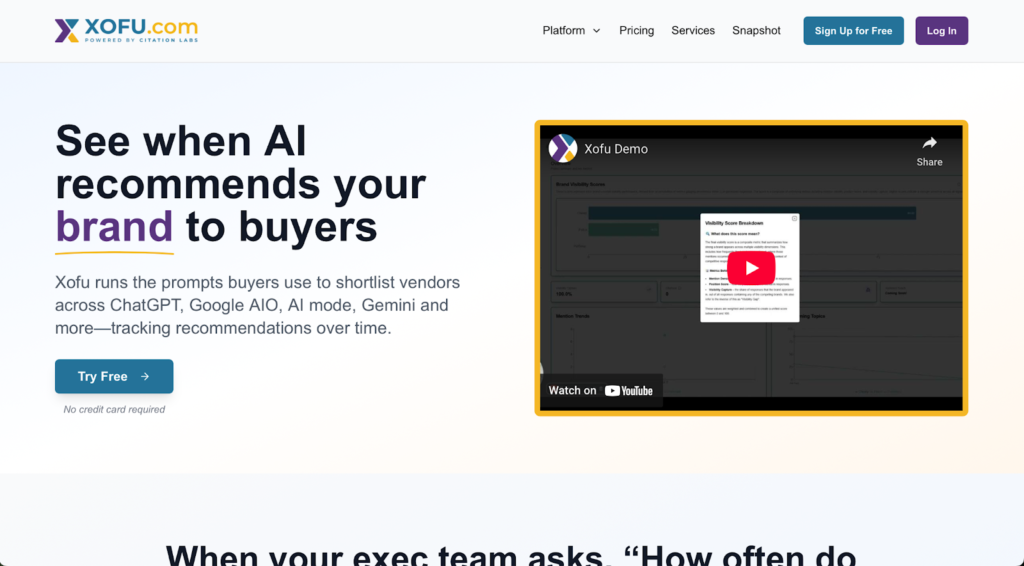
Xofu is built by Citation Labs and focuses on a question most other tools don’t ask directly: when buyers use AI to shortlist vendors, does your brand show up?
The platform runs the prompts buyers actually use, “best X for Y,” vendor comparisons, solution evaluations, across ChatGPT, Google AI Overviews, AI Mode, Gemini, Perplexity, and Claude, then tracks recommendations over time.
It also offers a free BOFU Visibility Snapshot that shows how your brand stacks up against competitors in AI answers.
Key features:
- Bottom-of-funnel prompt tracking across 6+ AI platforms
- Competitive benchmarking showing who shows up on each prompt and share over time
- Citation gap analysis revealing which sources get cited when competitors appear and you don’t
- Multi-platform monitoring with scheduled runs
- Visibility score and source share trending
Pros:
- Unique buyer-intent focus that maps directly to pipeline and revenue
- Free BOFU Snapshot is a smart, no-commitment entry point
- Multi-platform coverage across 6+ AI assistants
- Citation Labs partnership turns insights into an actionable execution plan
- Free signup, no credit card required
Cons:
- Niche BOFU focus means it’s not a comprehensive full-funnel visibility solution on its own
- Smaller brand compared to well-funded competitors
- Pricing not publicly displayed on site, requires contact or signup
Pricing: Free signup available (no credit card). Consultant plan at $99/month, Agency (Weekly) at $499/month, Agency (Daily) at $999/month per third-party sources. Free BOFU Snapshot with no signup.
20. Prerender
Best for: Technical AI crawlability and rendering optimization
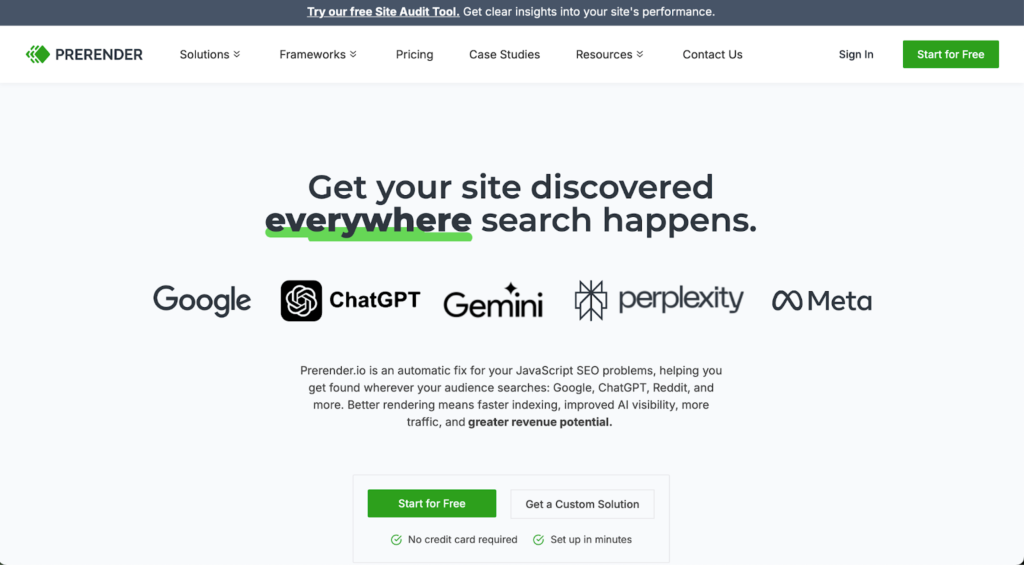
Prerender approaches the AI visibility problem from the infrastructure side. Rather than tracking mentions in AI responses, it focuses on ensuring AI crawlers can actually access, render, and understand your content.
If your site uses heavy JavaScript, client-side rendering, or dynamic content, AI bots may not be able to see your pages at all, and Prerender solves that specific problem.
Key features:
- Server-side rendering for AI crawlers and search bots
- JavaScript rendering optimization
- Dynamic content serving for bots
- Crawl analytics showing AI bot behavior
- Integration with existing CDN and hosting infrastructure
- Support for major AI crawlers
Pros:
- Solves a fundamental problem that most tracking tools ignore entirely
- If AI can’t crawl your content, no amount of optimization will help
- Works at the infrastructure level for immediate, measurable impact
- Established player with a track record in rendering optimization
Cons:
- Not a visibility tracking tool, it’s a crawlability solution
- Needs to be paired with an actual tracking tool for complete AI visibility strategy
- Technical implementation required
- Pricing can be opaque
Pricing: The paid plan starts at $49/month.
How to Choose the Right Tool for Your Team
After testing all 20 of these tools, here’s my honest take on how to think about this decision.
If you’re just getting started with AI visibility and want reliable tracking without breaking the bank, Rankshift, Otterly AI, Prompt Monitor, or Atomic AGI give you solid foundations at accessible price points.
Rankshift in particular stands out for offering unlimited users and projects across all plans, a rarity in a market where per-seat pricing can double your costs overnight.
If you’re an enterprise brand with a dedicated AEO strategy, Profound, AthenaHQ, or Scrunch AI bring the compliance, scale, and depth that large organizations need. Profound’s real prompt volume data from 400M+ conversations is genuinely differentiated.
If you already live inside an existing SEO platform, Semrush’s AI Visibility Toolkit or Ahrefs Brand Radar let you add AI tracking without adopting a new tool, though both come with meaningful pricing add-ons and coverage limitations.
If you need action, not just data, Gauge and Writesonic integrate content creation directly into the monitoring workflow. Prompt Monitor’s publisher contact discovery feature bridges the gap between “knowing you’re invisible” and “doing something about it.”
And if your problem is technical, AI crawlers literally can’t see your content, Prerender and ZipTie.Dev address foundational issues that no amount of content optimization can fix.
Get Your Hands on the #1 ChatGPT Tracking Tool – Rankshift
The AI visibility tracking market in 2026 looks nothing like it did 12 months ago.
We’ve gone from a handful of scrappy startups to a mature category with tools for every budget, every team size, and every use case. The category is still evolving fast, tools ship major features monthly, pricing models shift, and new entrants keep appearing.
But one thing is clear: the brands that are tracking and optimizing their AI visibility today are the ones that will own the conversation tomorrow. The gap between “visible in AI” and “invisible in AI” is already wide, and it’s getting wider.
My advice? Pick a tool that fits your budget and team size, start tracking today, and commit to acting on the data. The specific tool matters less than the habit of measuring and optimizing consistently.
And if you’re looking for a platform that makes that habit easy, with unlimited users, reliable UI-based tracking, and straightforward pricing, I’d recommend giving Rankshift a look. The 30-day free trial is good enough to see real data before you commit.
The future of search is already here. The only question is whether you’re measuring it.
