
If you’ve Googled “best GEO tools” recently, you’ve probably noticed the problem: every SEO platform now claims to do Generative Engine Optimization.
The lists all look the same. The descriptions are interchangeable. And nobody seems willing to say that half these tools solve completely different problems.
The truth is, some are genuinely useful. Some are repackaged keyword tools at a 30% markup. And the right one for your team depends entirely on what you’re actually trying to do, like track AI visibility, monitor + optimize + generate content, fix rendering issues, or all three.
Here’s the honest breakdown of the 14 GEO tools worth paying for in 2026, what each one does best, where each one falls short, and how to pick the right one for your team.
How I Evaluated These Tools
Every “best of” article is an opinion in disguise. Here’s mine, with the criteria laid out so you can disagree where it matters.
- Engine coverage: Does the tool track ChatGPT, Perplexity, Gemini, AI Overviews, AI Mode, Claude, Copilot, and Grok, or just a subset? Are extra engines bundled or charged as add-ons?
- Tracking method: Is data captured from the actual chat interface (closer to what users see) or from APIs (cheaper, but can drift from real user experience)?
- Pricing transparency and real-world math: Headline prompt counts are marketing. The number that matters is prompts × engines × frequency × your actual use case.
- Workflow depth: Does the tool stop at monitoring, or does it actually help you fix what’s broken; content recommendations, citation analysis, page audits, content generation?
- Team economics: Per-seat pricing or unlimited users? How agency-friendly is the model?
- G2 validation: What do real users say after 90 days of use, not 9 days?
The 14 Generative Engine Optimization (GEO) tools below earn their place against those criteria. Some are best-in-class at one thing; others are solid generalists. Where each one wins (and loses), I’ve called out specifically.
The 14 GEO Tools At a Glance
| Tool | Best For | Key Features | Starting Price |
| Rankshift | Mid-market & agencies wanting UI-accurate data | UI-based tracking, sentiment & citation analysis, AI content writer, AI crawler analytics, MCP integration, unlimited users & projects | $82/mo |
| Profound | Enterprise teams with content workflow needs | Marketing Agents (autonomous content workflows), Prompt Volumes dataset, deep agent analytics | $99/mo |
| Peec AI | Mid-market SaaS teams wanting fast setup | 30-min setup, Visibility/Position/Sentiment metrics, MCP integration, unlimited seats | $89/mo |
| Gumshoe AI | Teams needing persona-based AI visibility | Persona-simulated prompts across 11 AI models, brand leaderboards, page audits | $0.10/conversation |
| Respona | Teams that want citations earned, not just tracked | Done-for-you outreach & placement, citation-driven targeting, 6-engine AI visibility tracker, white-label | $100 per placement (tracker bundled) |
| Otterly AI | Solos & SMBs validating AI visibility | 6-engine coverage, country-level monitoring, AI prompt research, Gartner Cool Vendor 2025 | $29/mo |
| Scrunch AI | Enterprise teams with JavaScript-heavy sites | Agent Experience Platform (CDN-level AI rendering), multi-LLM monitoring, SOC 2 Type II | $250/mo |
| Addlly AI | Enterprise teams running multi-market GEO | Brand-trained AI agents, citation forensics, multilingual content, SOC 2 + ISO 27001 | Custom |
| Writesonic | Content-led teams wanting GEO + writing in one stack | Brand Presence Explorer, AI Traffic Analytics, built-in AI writer + SEO optimizer | Demo-gated |
| Athena HQ | Enterprise teams needing attribution depth | Ask Athena agentic copilot, native GA4/GSC/Shopify integrations, SOC II Type 2 | $295/mo ($95 intro) |
| Rankscale | Agencies with shifting client volumes | 17+ AI engines on every plan, credit-based pricing with 3× rollover, white-label dashboards | $20/mo |
| Prerender.io | Any team with a JavaScript-heavy site | Pre-rendered HTML for AI crawlers, 3x faster crawling, framework-agnostic integration | Usage-based (free tier) |
| Scrunch AI | Enterprise teams with Javascript heavy sites | Agent Experience Platform (CDN level rendering), multi-LLM monitoring, SOC Type II | $250/mo |
| Semrush AI Toolkit | Existing Semrush users wanting AI tracking in same dashboard | AI Visibility Score, Brand Performance reports, prompt tracking, AI Search Site Audit | $99/mo per domain |
| Ahrefs Brand Radar | Research-heavy teams in Ahrefs ecosystem | 372M+ indexed monthly prompts, AI Share of Voice, YouTube + Reddit visibility | €358/mo |
1. Rankshift – The #1 AI visibility tracking
About Rankshift
Most AI visibility tools track responses through APIs because it’s cheaper and easier to scale. Rankshift makes the harder bet: capturing data from the actual chat interface, the way real users see it.
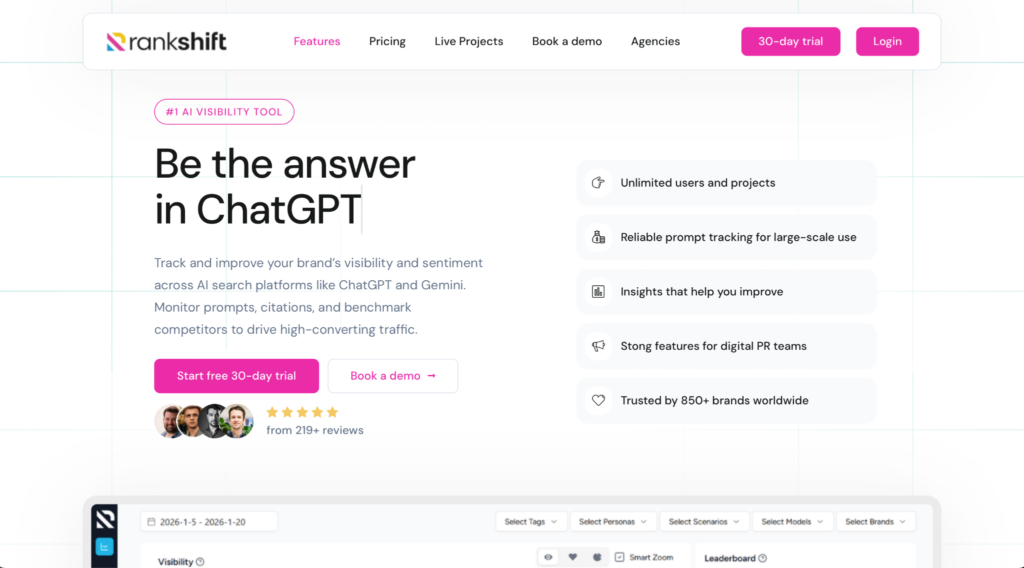
The difference matters more than it sounds. APIs return what the model technically generates; chat UIs return what your customer actually experiences, with web augmentation, real citations, and personalized retrieval factored in.
That’s the core differentiator, and it’s what gets it on lists like this. The other thing worth noting: Rankshift includes unlimited users and unlimited projects on every plan, which makes it one of the few LLM tracking tools in this list that doesn’t penalize agencies for adding clients.
Key features
- UI-based prompt tracking across ChatGPT, Gemini, AI Overviews, AI Mode, Claude, Perplexity, Mistral, and Meta AI, captured directly from the chat interface.
- Sentiment analysis that surfaces how AI describes your brand, the themes it associates you with, and where perception is drifting over time.
- Citation analysis showing which third-party sources AI engines pull from in your category, so you can prioritize digital PR and earned media accordingly.
- Built-in AI content writer. Rankshift analyzes LLM responses and your citations, connects key concepts to relevant entities, and drafts optimized content designed to perform in answer engines.
- AI crawler analytics that track GPTBot, ClaudeBot, PerplexityBot, and other crawlers hitting your site in real time, with error monitoring built in.
- MCP integration for connecting Rankshift to Claude, ChatGPT, Cursor, n8n, or other tools via Model Context Protocol.
- Unlimited projects and users on every plan, with Looker Studio integration baked in across all tiers.
Pros and cons
Pros: UI-accurate data is a real differentiator, transparent flat-rate pricing, unlimited seats and projects, strong sentiment depth, Looker Studio on every tier.
Cons: A bit of a learning curve is involved but the support team is there to help.
Pricing
Starts at $82/month (annual) for the Starter plan with 9,500 credits. Professional at €159/month, Business at €359/month. 30-day free trial.
Verdict
If you want AI visibility data that reflects what your customer actually sees in ChatGPT or Perplexity, not what the API returns, Rankshift is the most defensible pick on this GEO tools list.
Ready to see how Rankshift is different from the others?
2. Profound – Enterprise GEO tool
About Profound
Profound is an enterprise GEO tool that sits at the high end of this list because it does something most visibility trackers don’t: take action on what it finds.
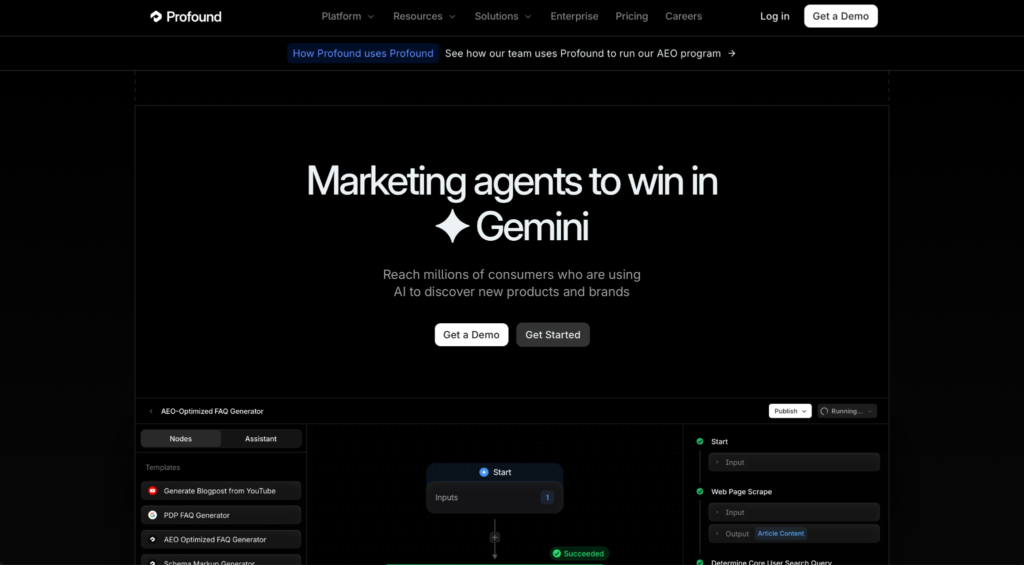
Where most tools surface gaps, Profound deploys autonomous “Marketing Agents” that handle FAQ generation, content optimization, and earned-media research, the manual work most teams do after their tracker tells them they’re losing prompts.
The trade-off is price and complexity. Profound is built for teams that have outgrown monitoring-first tools and have the bandwidth to operationalize agentic workflows.
Key features
- Answer Engine Insights with granular share of voice, sentiment, and competitor positioning across 9+ AI engines.
- Agent Analytics provides log-level tracking of which AI bots crawl your site and how often.
- Prompt Volumes, a proprietary dataset that estimates how often real users ask each prompt, so you can prioritize by demand rather than guess.
- Marketing Agents that automate FAQ generation, content optimization, and earned-media discovery.
- Enterprise security stack including SOC 2 Type II, SSO, RBAC, and dedicated CSMs.
Pros and cons
Pros: Deepest enterprise feature set, agentic workflows nobody else matches, and actionable prompt suggestions.
Cons: Realistic enterprise usage runs $399+/month even though Starter is accessible at $99, limited geographic coverage on lower tiers, and not a great fit for solo marketers.
Pricing
Starter starts around $99/month (ChatGPT only), with meaningful coverage requiring Growth or Enterprise tiers. Demo-gated.
Verdict
If you need attribution-grade reporting plus content workflows in one place, Profound is the most complete option. However, for most growth-stage teams, it’s overbuilt.
3. Peec AI – Fast-setup mid-market favorite
About Peec AI
The most common complaint about GEO tools that doesn’t show up on feature comparisons: time-to-first-insight. Most platforms take days of setup before useful data appears.
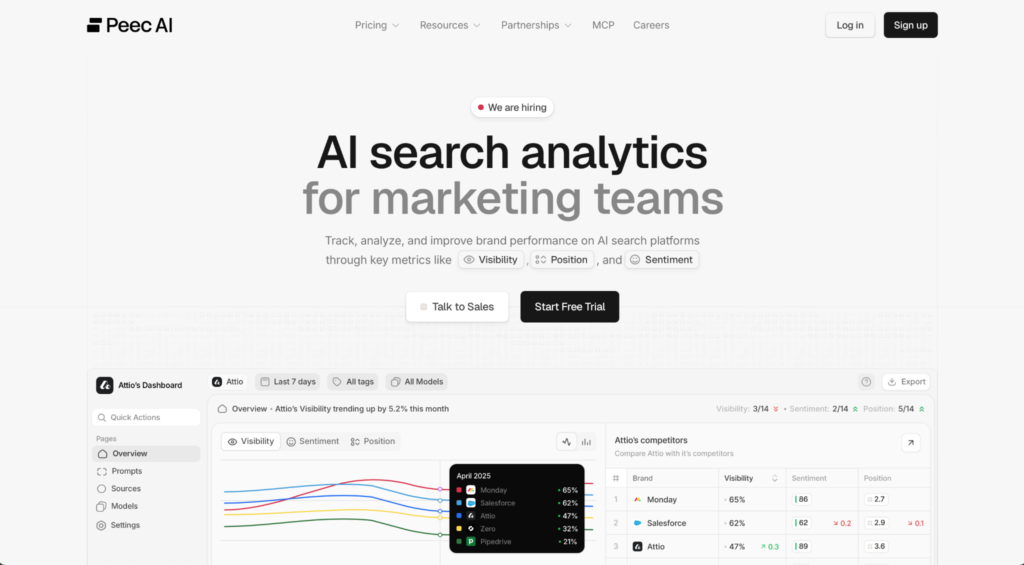
Peec AI is the inverse, most users go from signup to running tracked prompts in under 30 minutes. That speed comes from radical simplification.
Peec strips the dashboard down to three metrics most marketers actually act on (Visibility, Position, Sentiment), auto-generates suggested prompts based on your site, and includes unlimited seats on every plan.
Key features
- Visibility, Position, and Sentiment metrics tracked daily across ChatGPT, Perplexity, Gemini, AI Overviews, Copilot, and AI Mode.
- Suggested prompts that auto-generate based on your site and category, which speeds setup considerably.
- MCP integration for connecting Peec to Claude, Cursor, n8n, or other tools via Model Context Protocol.
- Looker Studio and API access on Advanced and Enterprise tiers.
- Unlimited seats on every plan, with no per-user upcharges.
Pros and cons
Pros: Fastest setup in the category, clean UI, unlimited seats, founder-level Slack support, strong G2 ratings.
Cons: Only 3 of 6 base engines included on Starter and Pro, with Claude, DeepSeek, and Grok costing €30-€140/month extra. API access is Enterprise-only.
Pricing
Starter at $89/month (50 prompts), Pro at $199/month (150 prompts), Advanced at $425/month (350 prompts), Enterprise custom. 7-day free trial.
Verdict
If you need to be tracking AI visibility by Friday, not next sprint, Peec is the fastest path there. Just budget for the engine add-ons.
If you’re looking specifically for ChatGPT, you should check out our guide on ChatGPT tracking tools.
4. Gumshoe AI – Persona-based AI visibility analysis
About Gumshoe AI
Most AI visibility tools run anonymous prompts. The problem is that AI assistants give different answers depending on who’s asking, a CTO and a marketing manager get different recommendations even for the same question.
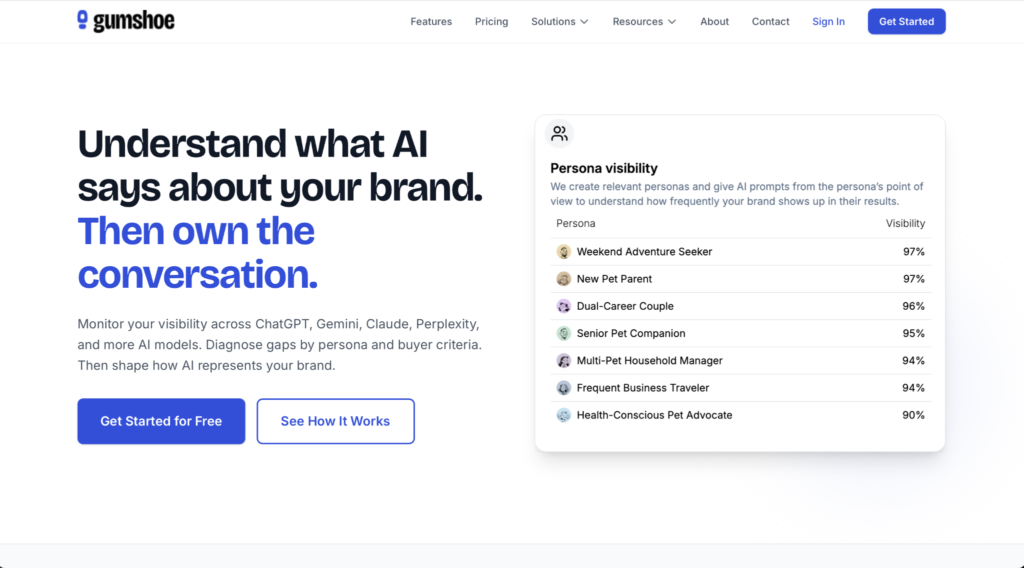
Gumshoe AI is the only tool on this list that runs prompts as specific buyer personas across 11 AI models, so you see what your actual buyers see, not what an anonymous browser sees.
The pricing model is also unusual in this category: $0.10 per conversation, pay-as-you-go, with the first report run free. For teams that don’t need continuous monitoring, that economics makes sense.
Key features
- Persona-based prompt simulation across 11 AI models including ChatGPT, Claude, Gemini, Perplexity, DeepSeek, and Grok.
- Brand leaderboard comparing your visibility against up to 30 competitors per report.
- Page Audit and AIO Score with specific JSON-LD and schema recommendations to improve AI optimization.
- Citation source tracking showing which third-party domains AI cites most in your category.
- Built-in content generator that creates structured content targeting specific persona × topic gaps from your reports.
Pros and cons
Pros: Persona simulation is genuinely unique, pay-as-you-go pricing is friendly to non-recurring use cases, free first report, integrated content generator.
Cons: Per-conversation pricing can be hard to budget for at scale. Less polished than enterprise platforms for ongoing monitoring workflows.
Pricing
Free for the first report. Pay-as-you-go at $0.10 per conversation. Enterprise tier with custom pricing for volume.
Verdict
If you want to see what AI actually tells your specific buyer personas (not what it tells an anonymous user), Gumshoe is the only tool in this list that does it natively.
5. Respona – Done-for-you GEO execution
About Respona
Every other tool on this list answers the same question: where is my brand showing up in AI answers? Respona answers a different one: how do I actually get cited in the first place? It’s not a monitoring tool. It’s a done-for-you link building service with an AI visibility tracker attached.
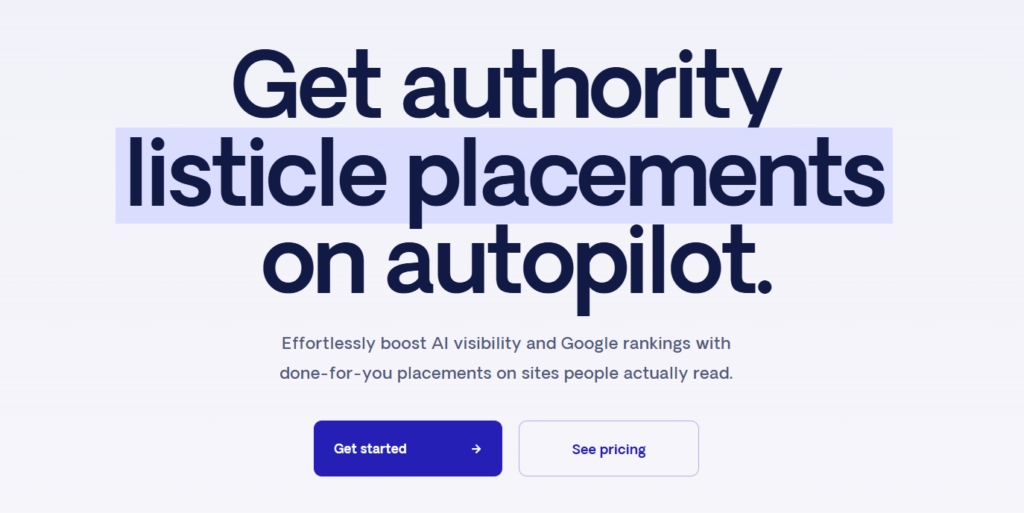
The logic is straightforward. AI engines assemble answers from third-party articles they trust, so the way to show up in those answers is to get your brand mentioned in those articles. Respona runs the prompts you want to win, sees which articles are getting cited, then finds those articles plus similar publications with comparable metrics and keyword profiles, and its team runs the outreach to get you placed. The bundled tracker then monitors your brand across six engines so you can watch the results land.
In other words, where the rest of this list stops at telling you what’s broken, Respona is the layer that goes and fixes it through actual outreach.
Key features
Done-for-you outreach and placement, not self-serve software. The team handles prospecting, pitching, follow-ups, negotiation, and securing each placement. Citation-driven targeting: Respona identifies articles that already rank AND already get cited by AI engines, then finds comparable publications to replicate as citation sources rotate. AI visibility tracking across six engines: ChatGPT, Perplexity, Google AI Overviews, Gemini, Claude, and Microsoft Copilot. Every link is editorial, on a real page with real traffic, filtered for authority and relevance before outreach begins. White-label ready, with around 80% of customers being agencies reselling to their own clients.
Pros and cons
Pros: The only option here that executes rather than just reports; pay-per-result pricing with no retainer; white-label friendly; covers the six major answer engines; removes the manual outreach work most GEO strategies stall on.
Cons: Not a self-serve monitoring dashboard, so it isn’t a like-for-like swap for a pure tracker; the tracker comes bundled with the service rather than sold standalone; no free monitoring tier; best suited to teams ready to act on visibility gaps, not just measure them.
Pricing
Pay-per-placement rather than a monthly prompt subscription: $100 per link (DR 20+) scaling to $500 (DR 60+), with no monthly retainer or setup fee. The AI visibility tracker is bundled with the service. An optional pre-approval add-on (manual sign-off on every prospect) is available for an extra 20%.
Verdict
If you’ve already run a few audits with the trackers on this list and you’re staring at a list of gaps you don’t have the bandwidth to close, Respona is the execution layer that actually closes them. It’s the wrong pick if all you want is a cheap monitoring dashboard, and the right one if you want a team earning the citations while you track them.
6. Otterly AI – Affordable entry point with Gartner recognition
About Otterly AI
Otterly AI is the answer to a simple question: how do solo marketers and SMBs validate AI visibility as a channel without committing $200+/month?
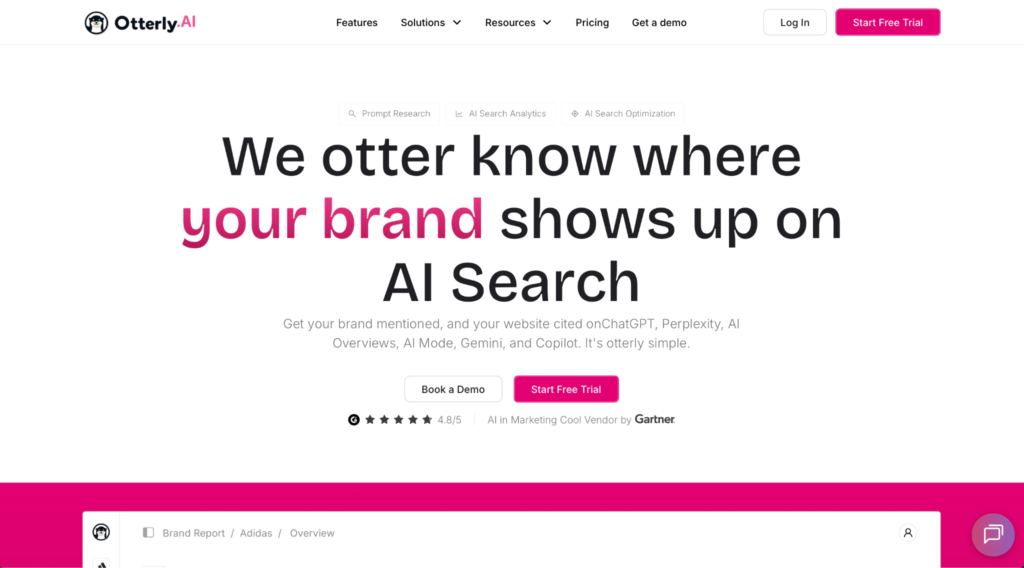
Well, at $29/month for the Lite plan, Otterly AI is the lowest credible price in this category. Also, Otterly AI is Gartner-recognized as a Cool Vendor for AI in Marketing 2025 and used by 25,000+ marketers worldwide.
Key features
- Six-engine coverage including ChatGPT, Google AI Overviews, AI Mode, Gemini, Copilot, and Perplexity.
- Country-level monitoring that tracks per-market visibility across seven countries, not just global aggregates.
- AI Prompt Research that turns keywords into the actual prompts your buyers use in AI search.
- Content Audit and GEO Recommendations with predictive AI-readiness scoring and content briefs.
- Citation tracking and brand sentiment including link-level citation data.
Pros and cons
Pros: Lowest price point on this list, clean UI, country-level granularity, strong G2 and OMR recognition.
Cons: Prompt limits multiply fast across engines, API-based tracking has known accuracy gaps versus what real users see, and add-ons for Gemini and AI Mode cost extra on lower tiers.
Pricing
Lite at $29/month (15 prompts), Standard at $189/month (100 prompts), Premium at $489/month (400 prompts).
Verdict
If pricing is what’s stopping you from getting started, Otterly is the cleanest path in. You’ll outgrow Lite within a quarter if you’re serious, but you’ll have validated the use case for less than a single month at most enterprise-tier tools.
Analyze the market and discover the best Otterly AI alternatives.
7. Addlly AI – Enterprise GEO + content execution
About Addly AI
Most GEO platforms stop at monitoring or stop at content. Addlly AI is one of the few that connects audit, citation forensics, and content execution into a single enterprise workflow.
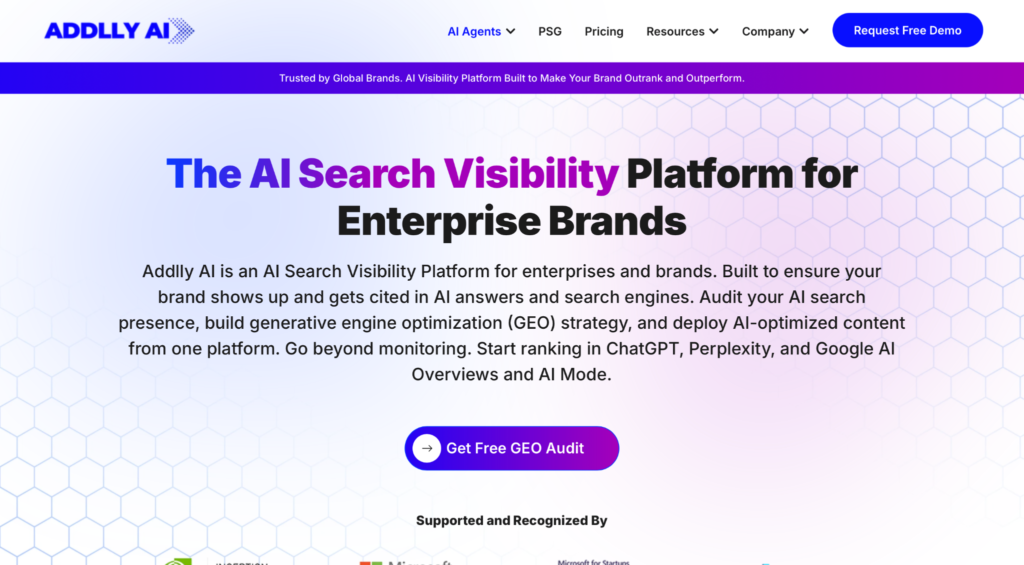
For enterprise teams that need to centralize how AI search is managed across markets, regions, and brand portfolios, Addlly’s “zero-prompt” agents handle visibility audits and content generation without requiring manual prompt engineering.
Key features
- AI visibility audits across ChatGPT, Google AI Overviews, Perplexity, Gemini, and Claude.
- Citation forensics that surface which competitors are cited and where new citation opportunities exist.
- Brand-trained AI agents that generate optimized content aligned with your brand tone and marketing goals.
- Multilingual content generation for AI search visibility across global markets and languages.
- Managed service option for teams that want experts to run GEO end-to-end rather than self-serve.
Pros and cons
Pros: Enterprise security stack (SOC 2, ISO 27001), strong all-in-one workflow, multilingual support, optional managed service for teams that don’t want to self-implement.
Cons: Pricing is opaque (custom only), more complex than monitoring-first tools.
Pricing
Custom enterprise pricing. Free GEO audit available without signup.
Verdict
If you’re an enterprise team running GEO across multiple markets and need the audit, citation, and content layers connected with enterprise-grade compliance, Addlly is built for that profile.
8. Writesonic – GEO + content generation in a single stack
About Writesonic
One of the loudest complaints about visibility-only tools is that they tell you what’s broken without telling you what to write.
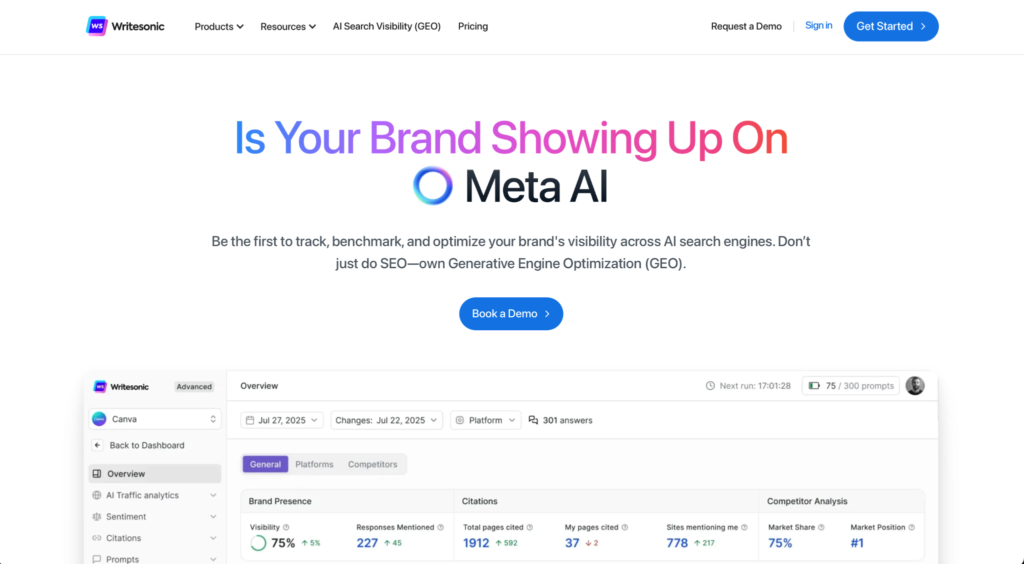
Writesonic closes that loop by bundling GEO monitoring with an AI writer and SEO optimizer in the same workflow. When Writesonic surfaces a content gap, you can draft, optimize, and publish a response without leaving the platform.
However, it lacks depth. Writesonic’s monitoring is solid but not best-in-class; so you’re paying with a slight accuracy gap to gain a bundled workflow.
Key features
- Brand Presence Explorer tracking visibility, share of voice, and sentiment across ChatGPT, Claude, Gemini, AI Overviews, Copilot, Meta AI, and Perplexity.
- AI Traffic Analytics that captures AI crawlers visits Google Analytics misses, broken down by platform and content.
- Citation source intelligence surfacing which third-party sites AI pulls from in your category.
- Built-in AI writer and SEO Optimizer to close the loop from “we found a gap” to “here’s the published article.”
- LLM Optimization recommendations keyed to AI ranking factors, not just traditional SEO signals.
Pros and cons
Pros: End-to-end workflow in a single tool, AI Traffic Analytics is a free product that provides genuine value, strong multi-platform coverage.
Cons: GEO platform is demo-gated with no transparent pricing, bundling can feel like overpaying if you already have a content workflow, AI writing quality is solid but not best-in-class.
Pricing
Demo-gated. AI Traffic Analytics is free; Brand Presence Explorer requires booking a sales call.
Verdict
If you want one platform to monitor visibility and create the content that closes the gaps, Writesonic is the most complete bundle. Less ideal if your content workflow is already mature elsewhere and you’re okay to compromise slightly with the accuracy.
9. Athena HQ – Agentic GEO with deep integrations
About AthenaHQ
Athena HQ was built on a specific bet: that AI visibility data is only useful if it connects to revenue. Where most platforms in this category stop at dashboards, Athena pulls AI visibility into the same place your team already discusses traffic, conversions, and pipeline via native integrations with GA4, Google Search Console, and Shopify.
The other thing that sets it apart is how you interact with the data. Ask Athena, the platform’s built-in copilot, is trained on your real-time AEO data. Instead of building a custom report to figure out why a competitor is suddenly outranking you on Perplexity, you ask it in plain English and get an answer grounded in your actual numbers.
For enterprise teams running quarterly business reviews, that’s the difference between a tool that justifies its cost and one that quietly disappears at renewal.
Key features
- Ask Athena agentic copilot that answers strategic questions in plain English with grounded data from your account.
- Cross-platform tracking across 8+ LLMs including Claude, Grok, and AI Mode.
- GA4, GSC, and Shopify integrations that connect AI visibility directly to traffic, conversions, and revenue.
- AthenaHQ Content as a recommendation engine that maps content gaps to specific source passages AI pulls from.
- Enterprise security including SOC II Type 2, GDPR, and NIST CSF Tier 3 compliance.
Pros and cons
Pros: Genuinely strong enterprise feature set, agentic copilot is differentiated, integrations close the attribution loop.
Cons: Self-serve plan is $295/month (with $95/month introductory). Enterprise tier requires sales conversation. Some overlap with Profound on positioning.
Pricing
Self-Serve at $295/month ($95/month introductory), Enterprise custom. Free 10-minute audit available.
Verdict
If your CMO is asking attribution questions you can’t answer from a standard visibility dashboard, Athena is built for that conversation.
10. Rankscale – Credit-based agency favorite
About Rankscale
Most AI visibility tools sell tiers. Rankscale sells credits, and that distinction is what makes it the most rationally-priced tool in this category for agencies. Onboard a new client, allocate credits from the pool you already have. When a client pauses, those credits don’t go away, they roll over up to 3x and redistribute to the next account.
The other thing that compounds: engine coverage. Rankscale tracks 17+ AI engines on every plan, including DeepSeek, Mistral, Grok, and Copilot, without the engine add-on fees that quietly inflate the total at most competitors.
Key features
- 17+ AI engines covered on every plan, including ChatGPT, Perplexity, Claude, Gemini, AI Overviews, AI Mode, DeepSeek, Mistral, Grok, and Copilot.
- Credit-based pricing that lets you pay for usage rather than tier limits, with unused credits rolling over up to 3x.
- AI Rank Tracker, Citation Analysis, and Sentiment Analysis with daily-to-hourly monitoring frequency.
- Page Audits evaluating 200+ AI readiness factors per URL.
- REST API and Looker Studio integration on Growth and Enterprise tiers, with white-label dashboards for agencies.
Pros and cons
Pros: Most engine coverage on this list, flexible credit model is genuinely agency-friendly, strong G2/OMR/SourceForge ratings, white-label options.
Cons: Credit math has a learning curve, and agencies typically need a billing cycle to calibrate. UI is dense compared to Peec or Rankshift for first-time users.
Pricing
Essentials at $20/month, Pro at $99/month (1,200 credits), Growth at $385/month (5,500 credits, agency tier), Enterprise at $780/month (12,000 credits).
Verdict
If you’re an agency where client volume swings monthly, Rankscale’s credit model is the most rational answer in the category. For single-brand teams, simpler tools like Rankshift or Peec will feel less dense.
11. Prerender.io – Technical AI rendering infrastructure
About Prerender.io
Prerender.io solves a technical problem most GEO tools don’t even address: AI crawlers like GPTBot, ClaudeBot, and PerplexityBot don’t execute JavaScript. If your site is built on React, Vue, or Angular and your content loads dynamically, those bots see a mostly blank page, regardless of how good your content actually is.
The fix sits at the infrastructure layer. When an AI bot hits your site, Prerender serves it pre-rendered HTML in 0.03 seconds. When a human hits the same URL, they get the full JavaScript experience.
Prerender.io is the only tool in this list that addresses AI visibility at the rendering layer rather than the monitoring layer. Skip it if your site is mostly static HTML. If you’re running a modern JS framework, the rest of your GEO stack may be tracking metrics on pages AI can’t actually read.
Key features
- Pre-rendered HTML for AI crawlers including GPTBot, ClaudeBot, PerplexityBot, and traditional search engines.
- 3x faster crawling and 260% increased indexing as measured across thousands of clients.
- Compatibility with all major JS frameworks including React, Angular, Vue, and others.
- No code rewrites required; Prerender integrates as middleware without changing your existing site.
- Page caching system that delivers rendered pages in 0.03 seconds on average.
Pros and cons
Pros: Solves a real technical problem most monitoring tools don’t address, fast integration (hours not weeks), strong customer base in enterprise.
Cons: Doesn’t track AI visibility, it’s infrastructure, not monitoring. Only valuable if your site has actual rendering issues. Pricing scales with usage, which can surprise high-traffic sites.
Pricing
Usage-based with a free tier available. Custom enterprise pricing for high-volume sites.
Verdict
If you’ve been running AI visibility audits and getting weak results despite good content, the problem might be that AI bots can’t see your pages at all. Prerender.io is the tool that fixes that, and it pairs naturally with anything in this list that does monitoring.
12. Scrunch AI – Technical GEO with Agent Experience Platform
About Scrunch AI
Most Generative Engine Optimization tools focus on the marketing side of AI visibility; tracking, sentiment, content gaps. Scrunch AI is one of the few that treats it as a technical problem.
Its Agent Experience Platform (AXP) sits at the CDN level and serves a parallel, lightweight version of your site specifically optimized for AI crawlers, while preserving your normal user experience for humans.
The only drawback is its entry price: $250/month is steep for solo marketers or teams still validating AI search as a channel.
Key features
- Agent Experience Platform (AXP) that delivers compressed, machine-readable pages to AI crawlers at the CDN level without disrupting human UX.
- Multi-LLM monitoring across ChatGPT, Perplexity, Claude, Meta AI, Gemini, Google AI Mode, and AI Overviews.
- Citation analysis and competitor benchmarking by persona, topic, and geo.
- Real-time AI bot traffic feed showing how AI crawlers interact with your site.
- Enterprise security with SOC 2 Type II compliance and Data API for internal integrations.
Pros and cons
Pros: Most differentiated technical product in the GEO category (AXP), real enterprise customer base, strong G2 ratings, solid monitoring layer alongside the technical infrastructure.
Cons: $250/month entry point is high for small teams. Custom prompt limits multiply across engines (125 prompts × 4 engines = 30 effective prompts). Insights layer is described as “diagnostic” by reviewers — surfaces gaps but doesn’t always tell you how to close them.
Pricing
Starter at $250/month, Growth at $500/month, Pro at $1,000/month, Enterprise custom. 7-day free trial.
Verdict
If your site has rendering issues that block AI crawlers and you want monitoring + technical fixes in one tool, Scrunch’s combination of AXP + monitoring is genuinely unique. For pure visibility tracking on a tighter budget, more affordable options in this list will get you 80% of the way.
Find the best Scrunch AI alternatives based on features, visibility, and performance.
13. Semrush AI Visibility Toolkit – For existing Semrush users
About Semrush AI Visibility Toolkit
If your team already runs SEO out of Semrush, the AI Visibility Toolkit is the path of least resistance. It bolts AI visibility tracking onto the existing Semrush stack; same dashboard, same reporting templates, same My Reports integration, for $99/month per domain.
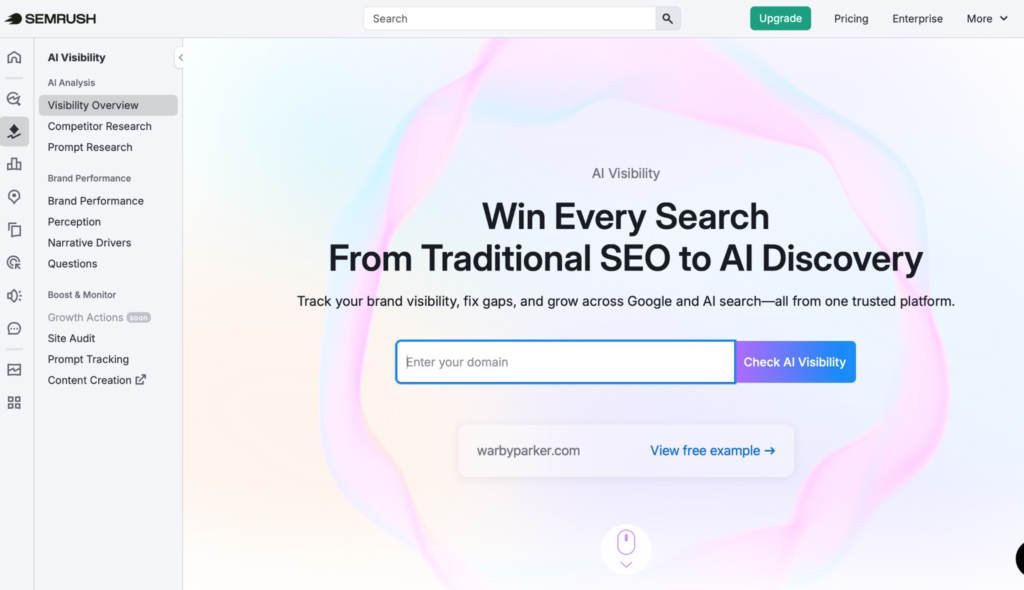
For agencies and SEO teams that don’t want to manage another vendor relationship or learn another interface, that integration is genuinely valuable.
The trade-off is depth. As Profound’s review of the toolkit notes, Semrush’s tracking is good for basic AI monitoring but lacks the depth and CDN integration of specialized tools.
Key features
- AI Visibility Score benchmarking your brand’s presence across ChatGPT, Google AI Mode, AI Overviews, Perplexity, and Gemini.
- Brand Performance reports analyzing share of voice, sentiment, and key narratives.
- Prompt Tracking for monitoring specific high-value prompts day-by-day.
- AI Search Site Audit flagging technical issues that block AI crawlers.
- Integration with My Reports to turn AI insights into presentation-ready slides.
Pros and cons
Pros: Native integration with Semrush SEO stack, familiar interface for existing users, strong My Reports for client-facing decks.
Cons: $99/month per domain adds up fast for agencies. Limited multilingual support (US English only at time of review). Less depth than specialized tools. No free trial.
Worth flagging separately from tool selection: multilingual GEO monitoring only tells you half the story. A tool can track your visibility across ten countries, but if the content being tracked was translated once, generically, rather than built natively for each market, weak visibility in that market may reflect the content, not the tracking. Before assuming a monitoring gap is a GEO problem, confirm the underlying content was properly localized. Tools like Lara Translate handle that step, producing market-native content rather than a direct translation, which is the actual precondition for multi-country GEO data to mean anything.
Pricing
$99/month per domain as an add-on to existing Semrush plans. Higher tracking limits available via Semrush One bundles.
Verdict
If you already pay for Semrush and want AI visibility data in the same dashboard, the toolkit is the easy answer. If you’re starting fresh, specialized tools usually deliver more depth for similar money.
14. Ahrefs Brand Radar – Largest AI visibility database
About Ahrefs Brand Radar
Ahrefs Brand Radar takes a different bet than most tools on this list. Instead of running custom prompts on your behalf, it indexes 400M+ real AI prompts every month, pulled from actual search data, not synthetic queries, and lets you query that database.
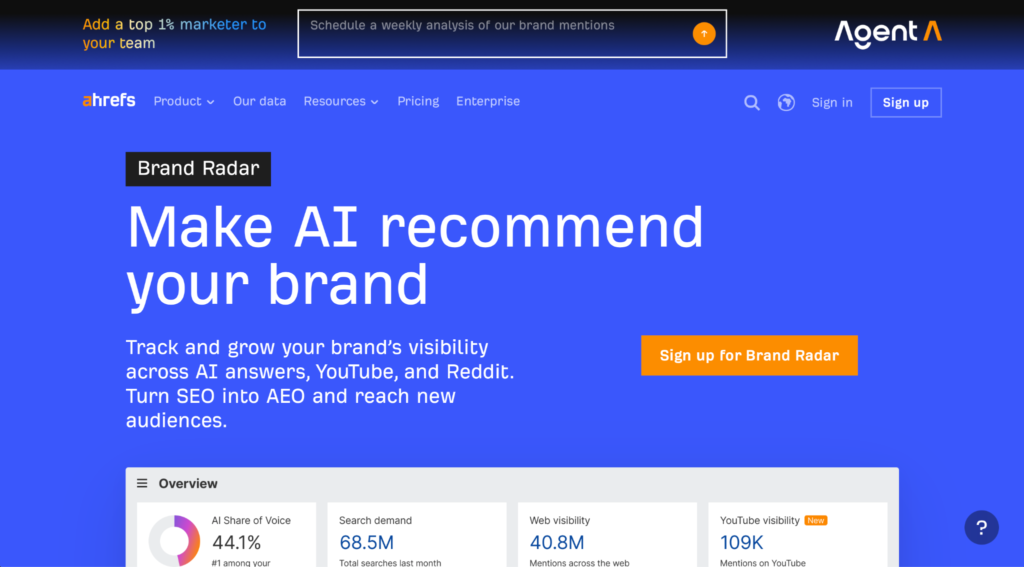
It’s the largest AI visibility dataset publicly available, covering AI Overviews, AI Mode, ChatGPT, Copilot, Gemini, Perplexity, and Grok. So, instead of guessing which prompts to track, you can research what’s actually being asked in your category and see your real share of voice across them.
For research-heavy teams already living in the Ahrefs ecosystem, that scale is genuinely useful. The trade-off is that it’s optimized for analysis and benchmarking rather than continuous prompt monitoring or content optimization workflows.
Key features
- 400M+ monthly prompts indexed across AI Overviews, AI Mode, ChatGPT, Copilot, Gemini, Perplexity, and Grok.
- AI Share of Voice metrics showing what percentage of AI conversations mention your brand against competitors.
- AI citation tracking to identify the sources AI engines pull from in your category.
- YouTube, TikTok, and Reddit visibility (free while in beta) for video and forum brand mentions. Learn more about how to improve your brand mentions in AI.
- Custom Prompts add-on for tracking specific sales-driving questions across ChatGPT, Gemini, Perplexity, and Copilot.
Pros and cons
Pros: Largest AI prompts database in the category by a wide margin, search-backed prompts (not synthetic), unlimited projects so you can analyze any domain, zero setup time, and integrates with the rest of Ahrefs’ SEO suite.
Cons: Custom prompt tracking is a paid add-on. Pricing is steep ($398-$699/month) compared to specialized GEO tools at similar tiers. Less action-oriented than dedicated GEO platforms for closing the loop on content optimization.
Pricing
Select Platforms at $398/month (individual AI engines). All Platforms at $699/month (full access to 243M+ organic prompts across all 7 engines, plus 2,500 monthly checks for custom prompts).
Verdict
If your team values research depth and you’re already inside the Ahrefs ecosystem, Brand Radar’s database is the largest in the category, useful for benchmarking, competitor analysis, and finding content gaps. For pure visibility tracking and action-oriented optimization workflows, more specialized tools deliver more depth for less money.
How to choose the right GEO tool
Most teams overcomplicate this decision. Here’s the framework that actually matters:
1. Start with what category you need.
Visibility tracking, all-in-one, technical infrastructure, or SEO-incumbent extension. Most teams don’t need all four, they need one or two.
2. Filter by team profile.
- Agencies: Rankshift (unlimited everything) or Rankscale (credit-based pooling). Both solve the per-client growth problem differently.
- In-house SaaS/B2B teams: Peec AI for fast setup, Rankshift if data accuracy matters more than speed, Athena if you need attribution depth.
- Enterprise teams: Profound, Athena HQ, or Addlly. All three are built for the security stack and integration requirements your CFO will eventually want.
- Solo marketers/SMBs: Otterly Lite ($29/mo), Rankscale Essentials ($20/mo), or Gumshoe pay-as-you-go. Don’t pay enterprise prices for a category you’re still validating.
- Content-led teams: Writesonic for the bundled writer, or pair Rankshift/Peec with your existing content workflow.
- Existing Semrush/Ahrefs users: Try the native AI add-ons first before adding a specialized vendor.
- JavaScript-heavy sites: Add Prerender to whichever monitoring tool you choose. They solve different problems.
3. Cut through the marketing copy with two filters.
Is the tool capturing data from the chat UI or the API? UI is closer to ground truth. And what’s the real prompts × engines × frequency math? Headline prompt counts are marketing, not math.
Choose the #1 GEO Tool – Rankshift
GEO tooling has matured faster than most analyst categories. A year ago, the conversation was “which tool tracks ChatGPT?” Today, it’s “which combination of tools fits my stack?”
The best GEO tool for your team depends less on which one is “best” than on which problems you actually have.
If you’re starting from zero, pick one visibility tracker (Rankshift, Peec, or Otterly depending on budget), add Prerender if your site has rendering issues, and skip the all-in-one platforms until you’ve validated the channel. If you’re scaling, consider whether the bundled platforms (Profound, Athena, Writesonic, Addlly) are worth the consolidation tax.
The category will keep moving. The tools that win will be the ones that solve specific problems specifically, not the ones with the longest feature list.
Rankshift offers a 30-day free trial here if you want to start with the option that pulls data from the chat UI rather than APIs, the way your customer actually sees it.
