
LLM tracking tools are becoming the new must-have stack for Generative Engine Optimization (GEO).
And honestly, that shift is inevitable.
We’ve spent years measuring rankings, traffic, impressions, and CTR. But today, when people ask AI for answers, none of those metrics matter if your brand isn’t showing up inside the response.
Simply, if ChatGPT, Perplexity, Gemini, or Claude don’t mention you, your “visibility strategy” doesn’t matter; you’re invisible where decisions are actually happening.
This is where LLM tracking tools come into the picture.
These AI visibility tools show how often models cite you, how they describe you, who they recommend instead of you, and where you simply don’t exist in AI answers. And if you aren’t tracking how AI search engines treat your content, you aren’t doing GEO, you’re pretending to do it.
In this piece, I’m covering the top 11 LLM tracking tools, their key features, pros and cons, pricing, and why they’re becoming essential for anyone serious about visibility in the generative era.
What Are LLM Tracking Tools?
LLM tracking tools are systems built to answer a very simple question: how do AI models talk about your brand?
They monitor responses from systems like ChatGPT, Perplexity, Gemini, and Claude to show whether you’re mentioned, how often you’re cited, how accurately you’re represented, and where competitors replace you in recommendations.
In other words, they make AI visibility observable. And for GEO teams, that visibility is the starting point for every decision that follows.
Why Do LLM Tracking Tools Matter Right Now?
Simply, because the way people discover information has changed faster than how most companies measure it.
Search traffic still exists. But influence is moving to AI-generated answers.
Today, a single response from ChatGPT, Perplexity, or Gemini can decide which brand gets trusted, shortlisted, or ignored. And that happens without rankings, links, or visible attribution.
As I often put it: “If you don’t know how AI talks about you, you don’t know how discoverable you really are.”
That creates a new reality:
- You can dominate Google and still be absent from AI answers.
- You can publish great content and still never get cited.
- You can lose mindshare to competitors without realizing it.
And, LLM tracking tools matter because they expose this gap.
They show whether generative engines recognize you, trust you, and consider you relevant enough to include. Without that visibility, GEO isn’t something you manage; it’s something that happens to you.
How I Selected These LLM Tracking Tools
Not every product that claims to track “AI visibility” is actually useful for GEO.
For this list, I filtered out tools that only show surface-level mentions or vague sentiment. I focused on platforms that reveal what really matters inside generative engines: who gets cited, who gets trusted, and who gets ignored.
I looked for three things:
- Model coverage: Tools that analyze responses across ChatGPT, Gemini, Perplexity, Claude, and AI-powered search.
- Visibility depth: Whether they track citations, mention frequency, competitive presence, and accuracy of representation.
- Actionability: Whether the data can actually be used to improve GEO, not just observed.
The result is a shortlist of platforms that give teams real leverage in generative search and not just another analytics dashboard.
Top 11 LLM Tracking Tools To Try in 2026
Here are top 11 LLM tracking tools that can help you 10x your AI visibility:
1. Rankshift – #1 LLM Tracking Tool Built for AI Visibility Monitoring
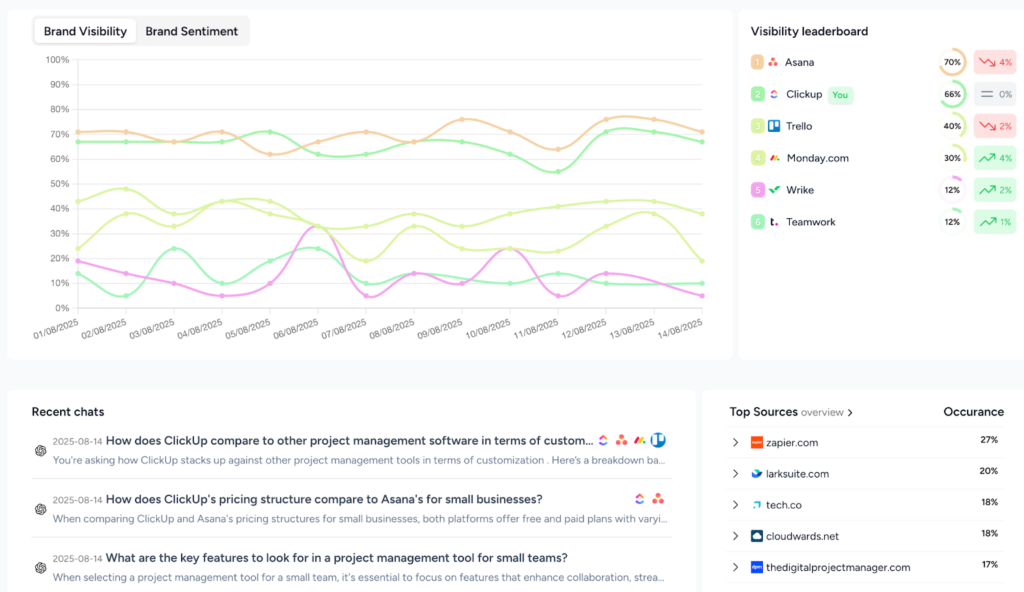
Rankshift is a leading AI visibility tracking and brand monitoring tool focused on measuring how brands appear inside AI-generated answers.
Rankshift tracks how large language models like ChatGPT, Gemini, Claude, Perplexity, Mistral, and Llama mention your brand across different prompts and search modes. It records what the models actually say, who they cite, and which competitors appear in the same responses.
Key Features
- Multi-model visibility: Monitor how your brand shows up across all major LLMs, including ChatGPT, Gemini, Ai Mode, AI Overviews, Claude, Perplexity, Mistral, Copilot, and Llama.
- Prompt suggestions: Start with a smart set of prompts that reflect how people actually ask AI systems about your category.
- Competitor benchmarking: Track which competitors appear in the same AI answers and where you’re being out-ranked inside generative responses.
- Actionable GEO insights: See where your visibility breaks down and get guidance on what to improve based on real AI outputs.
- Source tracking: Identify which domains and pages AI models rely on when answering questions about your brand.
- Advanced citation gap analysis: See which sources AI models trust over you for the same prompts and pinpoint where exactly you need stronger citations.
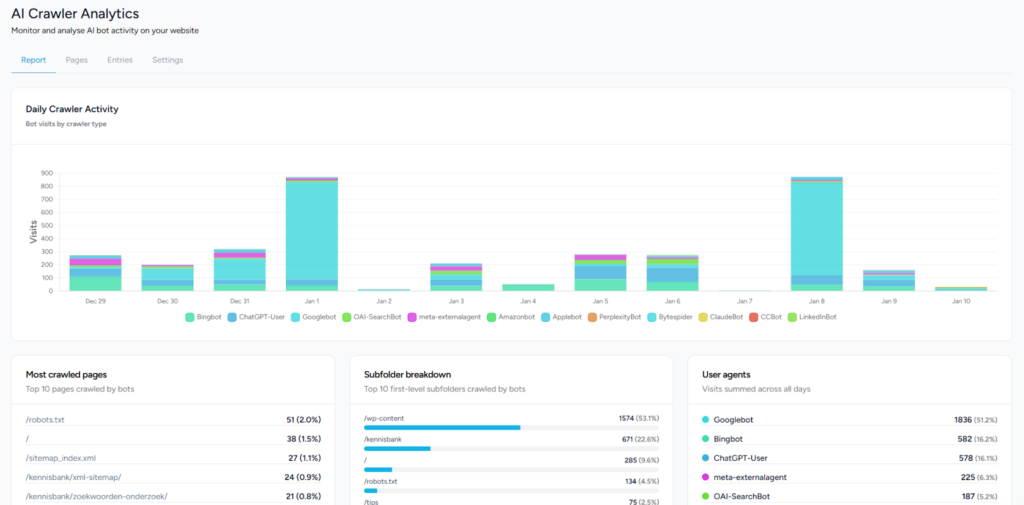
- AI Crawler Analytics: Go beyond answers and see how AI bots actually interact with your site. See which AI crawlers visit your website, which pages and topics they crawl most, and issues like 404s and even hallucinated URLs. This gives you real log-level insight into how generative engines discover and process your content, not just how they reference it.
Also read: How to track brand mentions in ChatGPT.
Pros
- Real-time monitoring across multiple LLMs
- Competitors insights for GEO
- Monitors how AI crawlers interact with your site, a crucial metric many tools overlook.
- Scales from small teams to larger enterprises (unlimited users and projects)
- Flexible pricing and prompt control
Cons
- Requires thoughtful prompt setup to maximize signal
- The depth of analytics can be overwhelming for teams new to GEO
Pricing
Rankshift runs on a credit-based model. It offers a 30-day free trial and paid plans starting at €77 per month, with unlimited projects and users.
Unlike tools that lock you into daily runs for every prompt, Rankshift lets you control prompt frequency. You can schedule prompts to run daily, a few times a week, or a few times a month; which means you can track more prompts without burning budget on unnecessary checks.
Verdict: The best part about Rankshift is: it doesn’t try to be everything. It focuses on what matters for GEO: visibility inside AI answers. It gives you direct line-of-sight into whether generative models consider your brand relevant, and where the gaps are. That insight alone can radically change how you approach content, citations, and optimization for this new AI search.
Why not give Rankshift a try and see the difference?
2. Profound
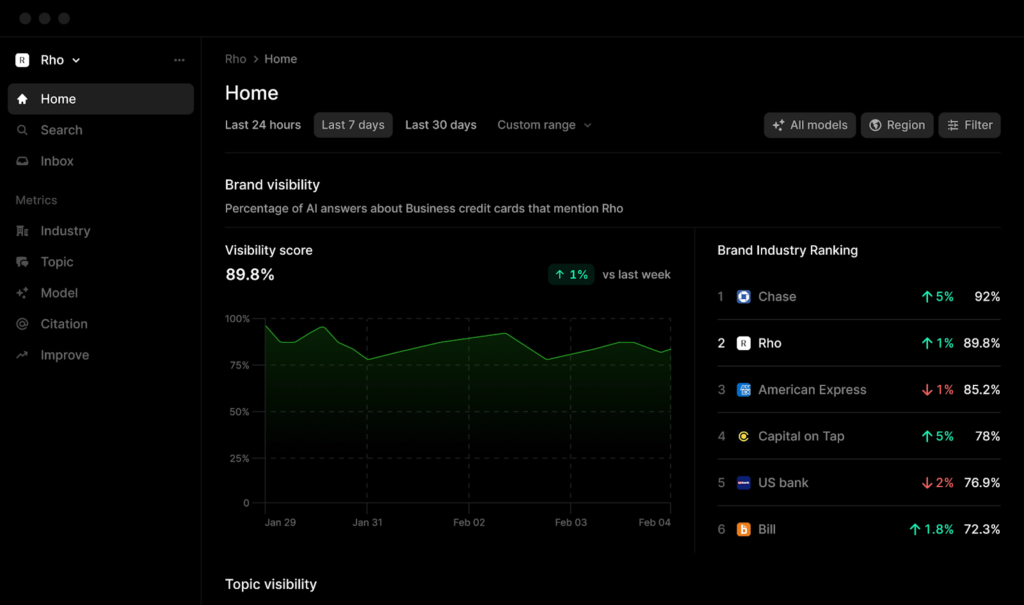
Profound sits at the more data-heavy end of the LLM tracking spectrum. It’s designed to help teams understand how brands surface inside AI-powered search results and generative answers, not just whether they appear, but what drives those appearances.
The platform monitors outputs from systems like ChatGPT, Perplexity, Gemini, Claude, and Google’s AI Overviews, capturing which brands are cited, which sources influence the response, and how competitors are positioned across the same queries.
Also read: If your focus is more on Perplexity, learn more about Perplexity AI tracking.
Key Features
- Answer Engine Insights: Visibility scores and share-of-voice across multiple AI channels, showing where and how often you’re cited.
- Prompt Volumes: Trend and intent data revealing what real users are asking across AI platforms and where opportunities exist.
- Shopping Visibility: Specialized tracking for how products appear in AI-driven shopping surfaces like ChatGPT Shopping.
Pros
- Covers most major AI search and LLM platforms
- Useful for benchmarking against competitors
- Includes both answer visibility and demand data
- Built for teams running structured GEO programs
Cons
- More complex than other LLM tracking tools
- Geared toward larger organizations
- Pricing can be a barrier for small teams
- Require a learning curve for non-specialist teams
Pricing
Profound uses tiered and custom pricing. A Starter plan has been introduced for around $99/month, which is not that helpful since it just includes 1 user and 1 LLM, i.e., ChatGPT. The enterprise plans are based on usage, data volume, and model coverage.
Verdict: I see Profound as a strong option for teams that want a wide, high-level view of how AI search engines treat their brand. It captures a lot of signals across multiple generative systems, but much of it is designed for large, data-heavy workflows. For teams that need tighter, prompt-level visibility and faster GEO iteration, tools like Rankshift tend to be more practical.
3. Scrunch AI
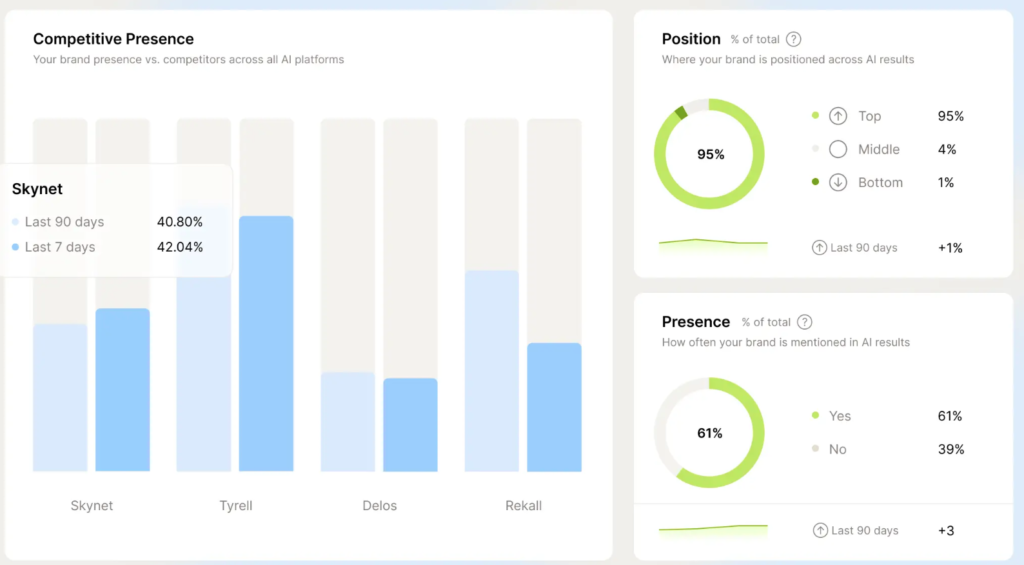
Scrunch AI is a brand visibility and AI search analytics platform that tracks how companies appear inside AI-generated answers.
Scrunch AI pulls data from models like ChatGPT, Claude, Gemini, Perplexity, and Google AI Overviews to show where and how often a brand is referenced, which sources influence those responses, and how competitors stack up, all at the prompt level.
Key Features
- Prompt-level monitoring: Track your presence, placement, and sentiment for specific AI prompts across multiple generative engines.
- Multi-engine coverage: Compare visibility across ChatGPT, Claude, Gemini, Perplexity, and AI overlays like Google AI Overviews.
- Citation and source mapping: See which pages AI models cite and where they derive their answers from, helping you influence the source signal.
- Actionable insights: Identify technical errors, crawl issues, and content opportunities that affect visibility inside AI search.
- Competitor benchmarking: Understand not just whether you’re being cited, but how often competitors appear in the same prompts.
Pros
- Comprehensive monitoring across multiple LLMs
- Prompt-level segmentation and insights help with detailed visibility analysis
- Includes technical and actionable recommendations (e.g., crawl errors, content gaps)
- Agent Experience Platform (AXP) adds specialized support for AI traffic optimization
Cons
- Monitoring-focused; some features are heavy on data but lighter on strategic action planning, especially compared to tools built specifically for prompt-level GEO workflows.
- Pricing typically starts higher than lightweight visibility trackers (~$300/month), making it a more significant investment.
Pricing
Scrunch’s pricing starts around $100/month for starter plans, covering just ChatGPT, 100 prompts, and one user. The higher tiers are available for broader prompt counts, additional engines, and enterprise features like APIs and role-based access control.
Verdict: Scrunch shows where your brand appears in AI search, but it doesn’t go far in telling you what to do next. Most of its data is descriptive rather than actionable. For teams running GEO in practice, prompt-level tools like Rankshift tend to offer more useful signals for day-to-day AI visibility work.
4. Writesonic
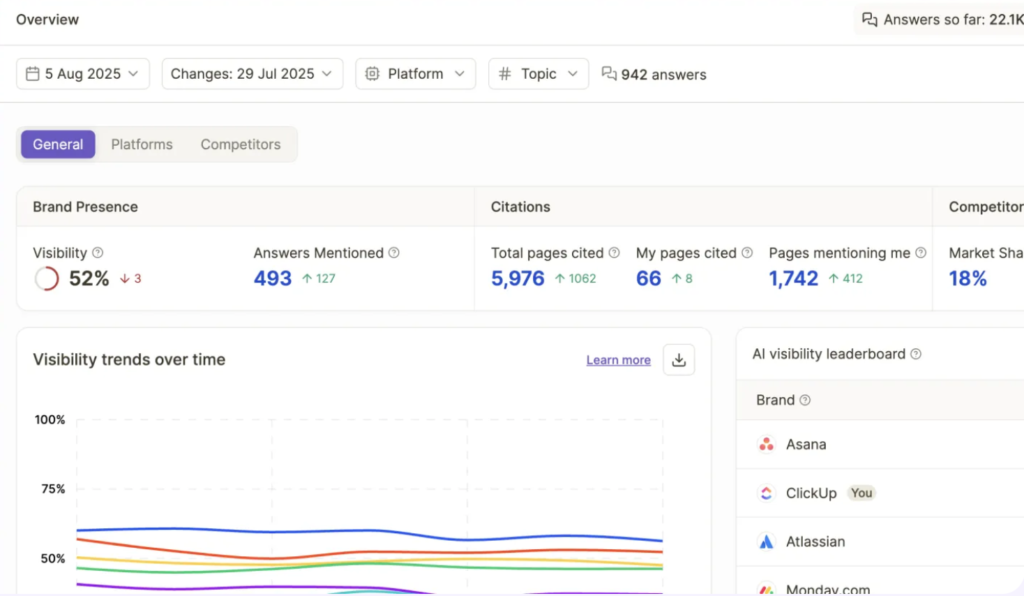
Next on the list of LLM tracking tools comes Writesonic, an all-in-one tool that combines AI search visibility tracking with content creation and optimization workflows.
It helps brands monitor how they appear inside AI-generated answers, understand prompt performance, and take action to improve visibility across major generative engines.
Key Features
- AI visibility analytics: Track how often your brand is cited, where it appears in responses, and how positively AI models present it across ChatGPT, Gemini, Perplexity, and other platforms.
- Citation and competitor mapping: See which prompts include you, which include competitors, and where gaps exist in generative search visibility.
- Action center: Goes beyond tracking to suggest specific actions, including content refreshes, citation gap fixes, and outreach opportunities.
- AI traffic analytics: Reveals how AI crawlers visit your site and generate human traffic through citations.
Pros
- Combines LLM tracking with content creation and optimization
- Useful for teams that want an all-in-one GEO workflow
- Covers multiple AI search engines and prompt types
Cons
- LLM tracking is part of a much larger platform, not its core focus
- Less control over prompt-level testing and visibility experiments
- Can feel heavy for teams that only need AI visibility monitoring
- Higher complexity may require steeper onboarding for small teams
Pricing
Writesonic’s GEO and visibility features are bundled within its broader platform. Visibility tracking and optimization tools typically start around mid-tier plans ($199/month), with pricing influenced by volumes, features, and AI platforms covered (e.g., citation analytics, prompt volume data).
Verdict: I see Writesonic as a hybrid platform that bridges LLM tracking, content optimization, and execution workflows. It works best for teams that want to combine AI visibility tracking with content production inside a single platform. But for GEO teams that need deep, prompt-level insight into how models cite, compare, and recommend brands, a dedicated LLM tracking tool like Rankshift offers a more focused and faster way to understand and improve AI visibility.
5. Otterly AI
Otterly AI is a brand and content visibility platform focused on helping teams track where they show up in generative search responses across multiple AI search engines.
The product lets you define search prompts you care about and then automatically runs them across systems like ChatGPT, Google AI Overviews, Perplexity, Gemini, and Microsoft Copilot to capture brand mentions, link citations, and visibility trends.
Key Features
- Prompt monitoring: Schedule and run prompts across AI engines to see how responses evolve over time.
- Multi-engine tracking: Track visibility across ChatGPT, Gemini, Perplexity, Google Bard/AI Overviews, and more.
- Response capture: Store and compare actual model outputs for the same prompt over time.
- Citation and link tracking: See which URLs and domains are cited in AI responses.
- Share of voice: Compare how often your brand appears relative to competitors for the same prompts.
- Geo Audit: Analyze visibility distribution across regions or localized prompt variations.
- Domain tracking: Monitor your own domain and compare it with others for AI visibility and citation patterns.
- Exportable reports: Generate visibility reports for teams and stakeholders.
Pros
- Tracks real AI responses across multiple models.
- Historical response capture enables visibility trend analysis.
- Domain tracking and exportable reports support auditing workflows.
Cons
- Primary focus on monitoring, with limited tactical guidance on how to improve visibility.
- Less emphasis on prompt optimization and iterative GEO workflows compared with dedicated GEO-first tools.
- Advanced engine coverage can increase plan cost.
Pricing
Otterly AI offers a range of plans starting at a lower price point ($29/month), with higher tiers for increased prompt counts and engine coverage. Daily monitoring and expanded visibility features scale with premium plans.
Verdict: Otterly AI is useful for teams that want straightforward prompt-level monitoring and citation tracking across LLMs. But its focus is on observation rather than actionable optimization. For teams who need deep, iterative GEO workflows, especially prompt refinement and targeted visibility improvement, a platform like Rankshift often delivers more direct, task-oriented signals.
6. Peec AI
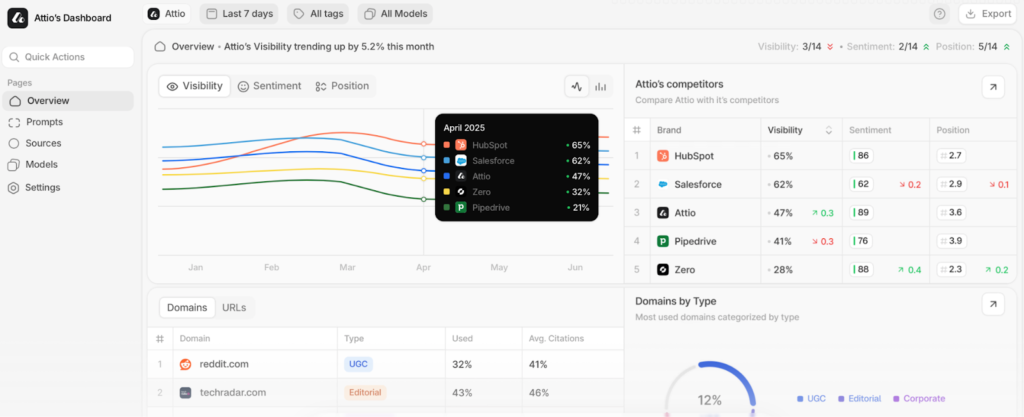
Peec AI is an AI search analytics platform built to help marketing and SEO teams track how their brand appears in generative search results across leading large language models and AI engines such as ChatGPT, Perplexity, Claude, and Gemini.
It focuses mainly on brand visibility metrics like mentions, position, and sentiment inside model-generated answers.
Key Features
- Brand visibility: See how often your brand is mentioned across AI-generated answers.
- Position tracking: Understand your brand’s relative position within AI responses.
- Sentiment analysis: Measure how models are framing your brand in responses.
- Prompt monitoring: Track visibility for defined prompts across systems like ChatGPT, Perplexity, Gemini, and Claude.
- Competitive benchmarking: Compare your visibility metrics against competitors for the same prompts.
- Reporting and exports: Produce dashboards and exportable reports to share insights with teams.
- APIs & integrations: Connect data with workflows or external dashboards.
Pros
- Tracks core visibility metrics; mentions, position, sentiment, across major AI search engines.
- Clean, intuitive dashboards that surface trends quickly.
- Competitive benchmarking helps teams gauge relative visibility.
Cons
- Focuses on reporting visibility signals rather than offering deep guidance on how to improve them.
- Doesn’t include built-in GEO audit workflows or prompt optimization automation.
- For advanced GEO workflows, deeper prompt-centric insight and tactical recommendations are limited.
- Standard tracking only includes ChatGPT, Perplexity, and AIOs. You need to pay an additional fee for Gemini, AI Mode, Claude, and other LLMs.
- Allows you to track up to 25 prompts in the starter plan for €89 per month.
Pricing
Peec AI offers tiered plans aimed at marketing and SEO teams, typically starting with pricing around €89 per month, scaling with prompt count and model coverage.
Verdict: Peec AI delivers core AI search visibility tracking across multiple LLMs with metrics like position, sentiment, and share of voice. However, its strength is in reporting what’s happening rather than helping teams act on it. For teams that want structured, tactical prompt-level optimization; the kind needed to improve visibility inside AI answers, a tool like Rankshift offers more actionable signals for real GEO workflows.
7. AthenaHQ
AthenaHQ is a GEO platform built by former Google Search and DeepMind engineers. It combines AI visibility monitoring with an action layer that goes beyond reporting into execution, something most tracking tools don’t attempt.
The platform tracks how your brand shows up across ChatGPT, Perplexity, Claude, Gemini, Copilot, Grok, Google AI Overviews, and Google AI Mode. But the real pitch is attribution.
AthenaHQ connects visibility data to Shopify and GA4, letting e-commerce brands tie AI citations directly to traffic and revenue. That’s a meaningful step beyond “you got mentioned” toward “this mention drove $X in sales.”
Key Features
- GEO Score and Share of Voice: A unified score combining citation frequency, sentiment, traffic impact, and query coverage across models.
- Action Center with AI Agents: Automated workflows that analyze content gaps and draft optimizations, rather than just flagging problems for you to solve manually.
- Athena Citation Engine (ACE): A proprietary algorithm that predicts citation probability and tracks on-page and off-page GEO signals.
- Revenue Attribution: Native integration with Shopify and GA4 that connects AI visibility to actual sales and conversions.
- Regional Tracking: Segment AI visibility by geography, useful for global brands since AI models respond differently by region.
Pros
- One of the few tools that connects AI visibility to revenue attribution
- Covers 8+ major LLMs
- Action Center generates specific fixes rather than just flagging issues
Cons
- Pricing starts at $95/month, with many features locked behind the enterprise tier
- No free trial on the monthly plan
- Can feel over-engineered for teams that just need basic visibility monitoring
Pricing
AthenaHQ uses a credit-based model. The Self-Serve plan starts at $295/month (with a promotional first month at $95). Enterprise plans are custom.
Verdict: AthenaHQ is trying to solve the “so what?” problem that is there with most GEO tools. Seeing that you got mentioned is one thing. Knowing it drove revenue is another. For e-commerce brands and enterprise teams that need to justify GEO spend to a CFO, that attribution layer is genuinely valuable. But the price puts it out of reach for most small and mid-market teams. For those who need focused, prompt-level visibility without the enterprise overhead, tools like Rankshift deliver the core GEO signals at a fraction of the cost.
8. AirOps
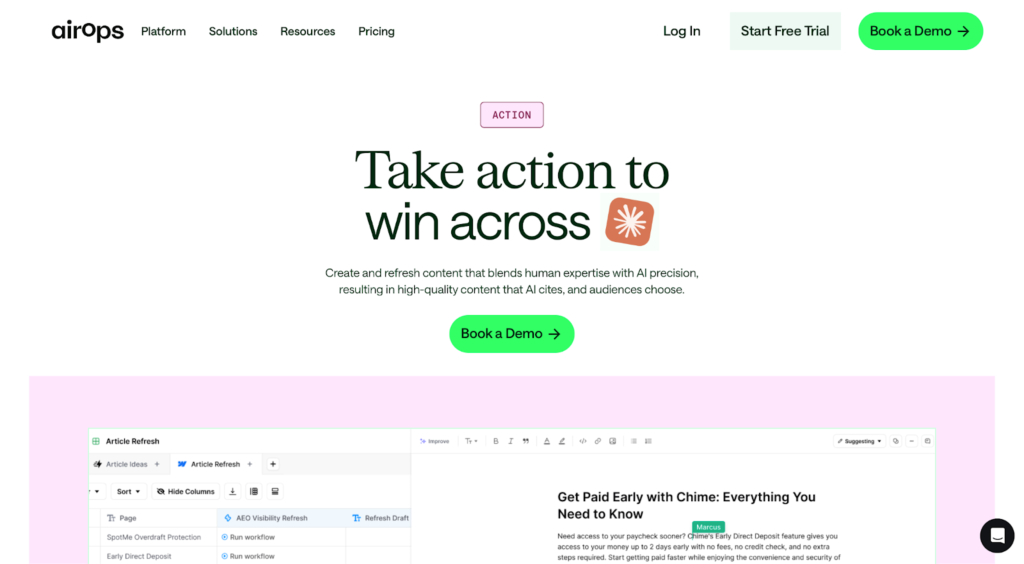
AirOps is fundamentally different from every other tool on this list. It’s not a monitoring platform. It’s a content engineering system that happens to include AI visibility features.
AirOps was primarily built for teams whose bottleneck isn’t “we don’t know what’s happening in AI search” but rather “we know what’s happening and we can’t update 500 pages fast enough to do anything about it.”
The platform integrates 30+ AI models, connects to your CMS (WordPress, Webflow, Shopify), and lets you build multi-step content workflows that go from insight to published update without leaving the interface.
The AI visibility piece was added more recently. AirOps now tracks citations and mentions across ChatGPT, Gemini, Perplexity, Google AI Mode, and AI Overviews. But it’s not the core of what the platform does. That core is execution at scale.
Key Features
- Page360 Analytics: Page-level view combining AI citations, Google Search Console data, and GA4 performance to guide prioritization.
- Bulk Execution (Grids): Update hundreds of pages at once using structured, spreadsheet-style controls with AI assistance.
- Configurable Pipelines: Multi-step content workflows with review, approval, and direct CMS publishing built in.
- AI Visibility Insights: Tracks which prompts mention your brand, which competitors appear, and where content gaps exist.
Pros
- Connects AI visibility directly to content updates and publishing
- Scales to massive content libraries (Webflow reported 5x faster content refresh)
- Integrates with CMS, SEO tools, and analytics natively
Cons
- Not an AI visibility tool first; monitoring is a secondary feature
- Steep learning curve, building workflows requires significant time investment
- No transparent pricing; Solo and Pro plans require sales conversations
- Overkill for teams that just want to track how AI mentions their brand
Pricing
AirOps offers a 14-day free trial, where you get access to all Scale plan features for a period of 14 days. For more details, please get in touch with the sales team.
Verdict: AirOps solves a real problem: the gap between knowing you need to update content for AI and actually doing it at scale. If your bottleneck is execution speed across hundreds of pages, AirOps is hard to beat. But if your primary need is understanding how AI talks about your brand, it’s the wrong tool for the job. You’d spend weeks learning the workflow builder before you even get to the visibility data. For teams whose first question is “where do we show up in AI answers?”, a dedicated GEO tracking tool like Rankshift gets you to that answer in minutes, not weeks.
9. xFunnel
xFunnel takes a consultative approach to AI visibility. Rather than being a pure self-serve SaaS tool, it pairs its platform with dedicated analyst support, creating something closer to a done-with-you service than a standalone dashboard.
The platform tracks brand performance across ChatGPT, Perplexity, Gemini, Claude, AI Overviews, AI Mode, and Microsoft Copilot. It emphasizes buying journey analysis, showing how AI answers shift as users move from awareness to consideration to decision.
Their xFlow feature maps how content and mentions lead to brand citations inside AI answers, helping teams trace the path from source to mention.
Worth noting: HubSpot acquired xFunnel, so expect the product to evolve and potentially integrate into HubSpot’s broader marketing stack.
Key Features
- xFlow Visualization: Maps the path from content and brand mentions to AI citations, showing which sources influence which answers.
- Buying Journey Analysis: Tracks how AI responses change across different stages of the customer journey and different buyer personas.
- Bot Detection: Filters out non-human queries to ensure you’re looking at genuine brand mentions from real users.
- GA4 Integration: Connects AI visibility data to website performance metrics for downstream impact measurement.
- Dedicated Analyst Support: Expert-level guidance and optimization playbooks included with enterprise plans.
Pros
- Unique xFlow feature that traces the path from source to AI citation
- Strong buying journey and persona-level analysis
- GA4 integration for measuring real-world impact
- Now backed by HubSpot, which adds long-term stability
Cons
- Enterprise pricing model with limited self-serve flexibility
- Custom pricing makes it difficult to evaluate cost before committing
- The done-with-you model can feel slow for teams that prefer to move fast independently
- Less suited for teams that want lightweight, prompt-level monitoring
Pricing
xFunnel offers a free one-time audit. Beyond that, pricing is custom and enterprise-focused. Expect it to require a sales conversation.
Verdict: xFunnel is interesting for teams that want strategic guidance alongside the data. The buying journey analysis and xFlow visualization genuinely add depth that most monitoring tools don’t offer. But the enterprise-first model means you’re buying a relationship, not just a tool. For teams that want self-serve control, clear pricing, and the ability to iterate on prompts quickly without waiting for an analyst, Rankshift is a more practical daily driver.
10. Semrush AI Toolkit
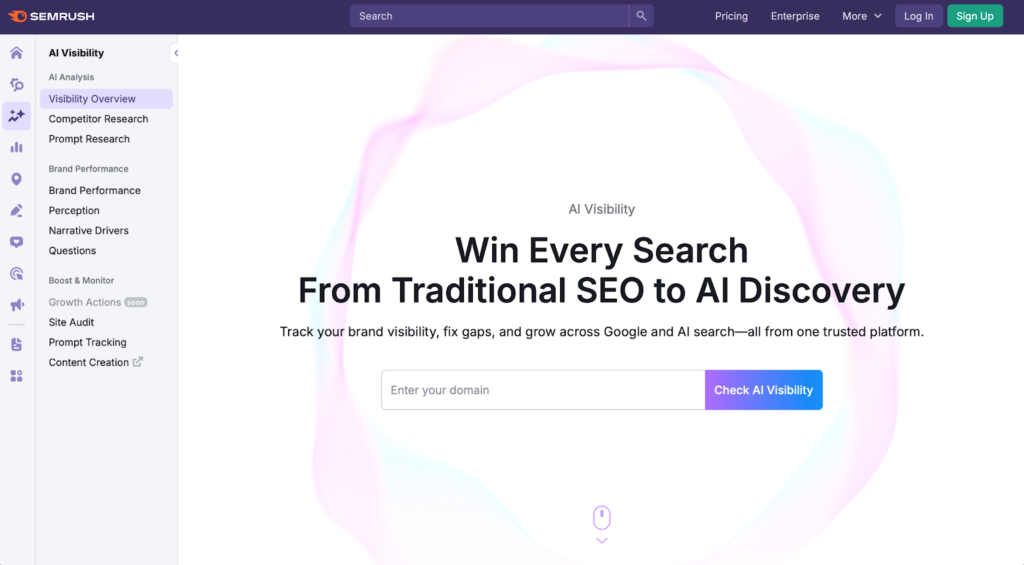
Semrush is the legacy SEO platform that most marketers already know. Their AI Toolkit adds AI visibility tracking as a layer on top of the existing Semrush ecosystem, making it the path of least resistance for teams already paying for Semrush and wanting to add GEO monitoring without adopting a new vendor.
The toolkit tracks brand mentions and citations across Google AI Overviews and major LLMs. It provides visibility scores, prompt tracking, competitive benchmarking, and brand perception analysis.
The real value is integration: you can see AI visibility data alongside your keyword rankings, site audits, backlink profiles, and content gaps, all in one interface.
Key Features
- AI Visibility Scores: Track how often your brand appears in AI-generated answers across platforms.
- Brand Perception Analysis: See how AI models describe and frame your brand in their responses.
- Prompt Research: Discover what users are asking AI tools in your category and track visibility against those prompts.
- Competitive Benchmarking: Compare your AI mention frequency against competitors for the same queries.
- Unified Dashboard: AI data sits alongside traditional SEO metrics (rankings, backlinks, audits) in the same interface.
Pros
- No new tool to learn if you’re already a Semrush user
- Combines AI visibility with traditional SEO data for a complete picture
- Massive existing keyword and backlink database adds context
- Semrush Academy provides strong educational resources
Cons
- AI visibility is an add-on, not the core product; depth doesn’t match dedicated GEO tools
- Less granular prompt-level control than specialized platforms
- Pricing adds up: $99/month per domain on top of a base Semrush subscription (starting at $139.95/month)
- Not AI-first; the platform is still fundamentally built for traditional SEO
Pricing
The AI Visibility Toolkit is available at $99/month per domain, or bundled into Semrush One starting at $139.95/month. Requires an active Semrush base subscription.
Verdict: If you’re already living inside Semrush and want a quick way to see AI visibility data without adding another tool to your stack, the AI Toolkit is convenient. It provides directional insights and a useful high-level view. But it’s not built for teams whose primary focus is GEO. The prompt tracking is less flexible, the refresh rates are slower, and you don’t get the kind of citation source analysis or crawler analytics that dedicated tools like Rankshift provide.
11. Ahrefs Brand Radar
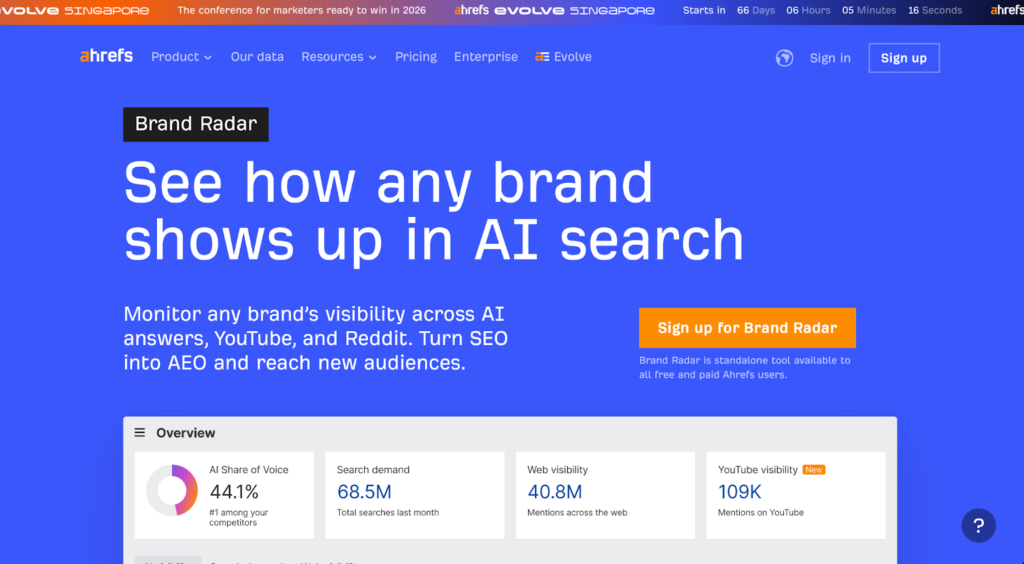
Ahrefs Brand Radar is Ahrefs’ entry into AI visibility tracking. It’s built on their massive proprietary dataset (192M+ prompts) and approaches AI visibility more like a research database than a traditional rank tracker.
For teams already deep in the Ahrefs ecosystem, it offers the ability to view AI mentions alongside traditional SEO metrics without leaving the platform.
Brand Radar tracks brand mentions across ChatGPT, Perplexity, Google AI Overviews, Google AI Mode, Gemini, and Microsoft Copilot. It also extends into YouTube and Reddit visibility, which is unique among the tools on this list. The Web Analytics integration breaks out AI referral traffic as a distinct channel, so you can see which pages are actually driving visits from LLMs.
Key Features
- Massive Prompt Database: Access to 192M+ prompts across 6 major AI platforms for broad brand visibility analysis.
- AI Share of Voice: Measures what percentage of AI conversations mention your brand versus competitors.
- Custom Prompt Tracking: Recently added the ability to monitor specific prompts alongside the native database.
- YouTube and Reddit Tracking: Monitors brand mentions across video and community platforms, not just AI search.
- Web Analytics Integration: Breaks out AI referral traffic by engine (ChatGPT, Perplexity, etc.) with landing page and conversion data.
Pros
- Largest prompt database in the market (192M+)
- Unique YouTube and Reddit visibility tracking
- Native integration with Ahrefs’ SEO toolkit
- Web Analytics shows actual AI referral traffic by engine
Cons
- Expensive: $199/month per AI index, on top of a base Ahrefs subscription ($129+/month)
- Not scalable for agencies (per-domain pricing adds up fast)
Pricing
AI indexes cost $199/month each. Or requires an active Ahrefs subscription (starting at $129/month).
Verdict: Brand Radar’s unique strength is its dataset scale and the ability to combine AI visibility with Ahrefs’ backlink and content data. If you want to correlate whether pages with more referring domains get cited more by AI, Ahrefs is the only tool that can show you that. But the pricing is prohibitive for most teams. It’s 2-3x the cost of dedicated GEO tools that offer more granular prompt-level tracking. And the accuracy questions are real. For teams that need focused, affordable AI visibility with daily-refresh data and deeper prompt control, Rankshift provides that at a fraction of the price.
How LLM Tracking Actually Powers GEO
This is the part most people skip.
LLM tracking isn’t just about seeing your name in an AI answer. What I care about is what that data lets me do.
When I look at LLM tracking data, I can see which prompts I’m losing, which competitors keep getting cited, which sources models trust, and where my content isn’t being picked up at all.
That changes how I think about GEO. It tells me what to write next, what to update, what to strengthen with citations, and where I’m simply invisible.
Without that, the GEO strategy remains incomplete. It’s more like you’re publishing content and hoping it gets noticed by models you can’t see. With it, you’re working off real signals from the answers themselves.
That’s the difference between optimizing for generative engines and just producing more content and crossing your fingers.
Try the #1 LLM Tracking Tool – Rankshift
By now, one thing should be clear: generative search has changed what visibility means.
It’s no longer just about ranking pages. It’s about whether large language models choose to mention you, cite you, or ignore you when people ask real questions. That shift is already happening, even if most teams are still measuring the old metrics.
The tools in this list all try to make that invisible layer visible in different ways. Some focus on reporting. Some on dashboards. Some on broad AI search analytics.
But if GEO is going to become a real growth discipline, it needs something more basic first: clear, prompt-level visibility into how models treat your brand.
That’s the gap Rankshift was built to close.
If you want to know where you actually stand inside AI answers, not in theory, not in a deck, but in the words models are generating, you can try Rankshift free and see it for yourself.
