
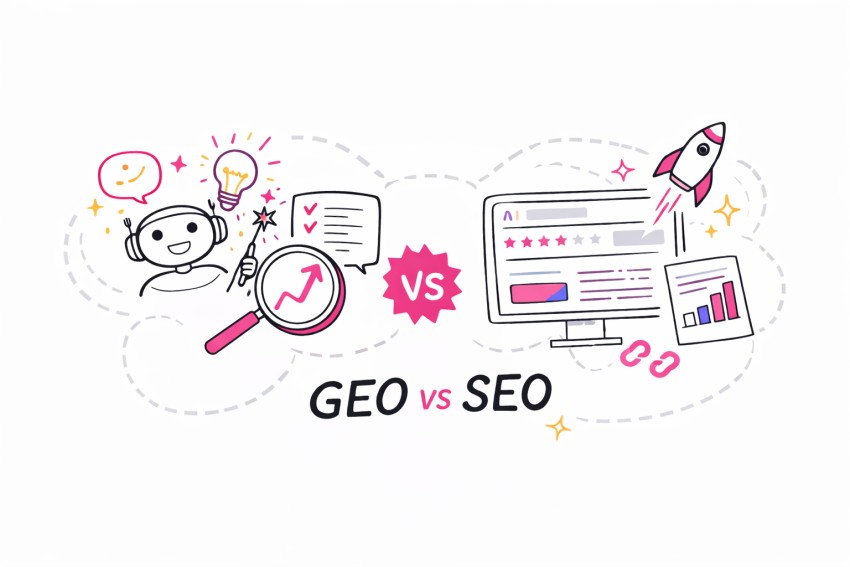
Marketers love a good battle, and right now, the trenches are dug deep around AI search optimization (specifically GEO vs SEO!)
Scroll LinkedIn and you’ll notice something interesting: most arguments aren’t really about tactics but labels.
On one side, you’ll see bold claims like ‘SEO is dead,’ and that generative engines demand an entirely new discipline, new metrics, and a new acronym: GEO. On the other, a more dismissive take: nothing has really changed and “GEO” is just SEO with better branding.
The truth sits in between. There’s an overlap. But overlap ≠ sameness.
SEO is the foundation (always has been, always will be.) The principles that make content rank; authority, clarity, structure, relevance; still matter in AI search. You cannot build effective GEO on weak SEO fundamentals. It’s not possible.
But, strong SEO alone doesn’t guarantee AI visibility. I’ve watched brands with impeccable SEO; page one rankings, solid backlinks, perfectly optimized content, get completely ignored by ChatGPT and Perplexity. Meanwhile, competitors with weaker rankings dominate AI citations.
Simply because SEO and GEO optimize for different outcomes.
This piece breaks down where GEO and SEO overlap, where they diverge, and why understanding that gap now matters more than ever.
What is SEO and GEO?
What is SEO (Search Engine Optimization)?
SEO is the practice of optimizing your website to rank higher in traditional search engines like Google, Bing, and Yahoo.
The goal is simple: get your pages to appear at the top of search results when people type in relevant queries. Higher rankings mean more visibility, more clicks, and more traffic to your website.
SEO relies on a set of well-established principles:
- Authority signals like backlinks from credible domains
- User behavior metrics like click-through rates and time on page
- Technical optimization like site speed, mobile-friendliness, and crawlability
- Keyword targeting to match what users are searching for
- Content quality that satisfies search intent
Google’s algorithm evaluates these signals to determine which pages deserve to rank. It’s fundamentally about earning your spot in the search results hierarchy.
SEO has been the foundation of online visibility for two decades. It’s not going anywhere.
What is GEO (Generative Engine Optimization)?
Generative Engine Optimization (GEO) is the practice of optimizing your website to get cited or mentioned in AI-generated answers from platforms like ChatGPT, Perplexity, Google’s AI Overviews, Gemini, and Claude.
The goal here is different: ensure AI engines can accurately extract, understand, and reference your information when generating AI answers.
GEO focuses on:
- Entity clarity so AI can identify who, what, when, and where
- Proper structure that makes information easy to extract and verify
- Explicit attribution with clear sources and references
- Context-rich content that helps AI understand relationships and relevance
- Cross-source consistency so your brand is recognized accurately across the web
AI engines don’t rank pages; they synthesize information from multiple sources and decide what’s cite-worthy based on clarity, accuracy, and how confidently they can extract facts without misrepresentation.
You don’t win at GEO by being the loudest result. You win by being the cleanest source.
Note: GEO and SEO aren’t enemies. They solve different visibility problems. SEO helps you get discovered in search results, and GEO helps you get selected inside AI answers.
GEO vs SEO: Quick Glimpse
Here’s where GEO and SEO actually diverge:
| Aspect | SEO | GEO |
| Primary Goal | Rank higher in search results | Get cited in AI-generated answers |
| What’s Being Optimized | Pages and their position in SERPs | Information and its cite-worthiness |
| Visibility Model | List of links (SERPs) | AI responses |
| Key Question | “Does this page deserve to rank #1?” | “Can I cite this without misrepresenting facts?” |
| Authority Signal | Backlinks, keywords, on-page signals, domain authority, and more | Clarity, structure, entity recognition, cross-source mentions, and more. |
| Success Metric | Rankings, organic traffic, clicks | Brand mentions, AI citations, visibility in answers |
| User Journey | User clicks link → visits your site → converts | User reads AI answer → (maybe) visits later |
| Content Structure | Optimized for crawling and indexing | Optimized for extraction and synthesis |
| Visibility Control | Mostly your owned content | Your content + third-party mentions |
| Main Risk | Low rankings | Being ignored despite ranking, being misinterpreted because of third party content |
The reality: You need both strategies. Strong SEO gives you the foundation. GEO ensures AI engines can actually use that content when answering questions.
Why the Distinction Actually Matters
Here’s what I keep seeing: brands with stellar SEO getting zero AI citations.
Perfect rankings, solid backlinks, content that checks every optimization box. And yet, ChatGPT ignores them entirely while citing competitors who barely crack page two.
Because ranking signals and citation signals aren’t the same thing.
SEO taught us to build authority through links. GEO requires us to build clarity through entity recognition and factual structure. SEO rewards popularity. GEO rewards parse-ability.
Both need strong content. Both value expertise. But they’re evaluating that content through fundamentally different lenses.
Will GEO Replace SEO?
Let’s kill this myth right now: no, GEO will NOT replace SEO.
And it’s simply because they solve different problems. SEO exists to make content discoverable across the web. GEO exists to make content usable inside AI-generated answers.
Moreover, the real question isn’t whether GEO will replace SEO. It’s whether you can afford to ignore how people actually find information now.
Before, if someone wanted software recommendations, they Googled it. Today, they might ask ChatGPT first, then Google the top recommendation to verify. Or they Google it, see an AI Overview, and never click anything. Or they use Perplexity exclusively and bypass Google entirely.
The user journey has changed a lot, and the marketing funnel has collapsed.
Traditional search engines aren’t dying. They’re sharing space with AI engines. And that means visibility isn’t just about ranking anymore, it’s about being present wherever your audience looks for answers.
The teams still debating “GEO vs SEO” are missing the bigger shift: discovery is now multi-channel, and you need to show up everywhere.
If SEO disappeared tomorrow, generative engines would have nothing reliable to pull from. They still depend on indexed, structured, and authoritative content ecosystems, most of which are built through SEO. But the reverse isn’t true.
Where GEO and SEO Actually Overlap (And Why That Matters)
Here’s what both disciplines can’t escape: poor quality content fails everywhere.
Thin, vague, poorly structured content won’t rank on Google. It also won’t get cited by ChatGPT. Bad writing is bad writing, regardless of which algorithm reads it.
So, the overlap is real:
Content quality is non-negotiable in both. AI engines won’t cite content they can’t trust. Search engines won’t rank content users don’t engage with.
Clear structure serves both AI and traditional search. Proper heading hierarchies help Google understand your content architecture. They also help LLMs parse information correctly and extract facts without losing context.
Expertise still wins. Google’s E-E-A-T guidelines aren’t going away. AI engines are even pickier; they need sources they can verify and quote without introducing errors.
Intent matching is universal. If you’re answering the wrong question, you fail in both search results and AI citations. Understanding what users actually want remains the core skill.
So, I repeat, SEO is the foundation. You can’t skip fundamentals and expect GEO tactics to save you. AI engines are reading the same web that search engines index. If your content is weak there, it’s weak everywhere.
But, again, being good at SEO doesn’t automatically make you good at GEO.
Why SEO Alone Isn’t Enough
I’ve watched this pattern repeat: strong SEO team, solid rankings, decent traffic. Then someone asks, “Are we showing up in ChatGPT?” and the answer is NO.
Here’s why that happens.
Google forgives ambiguity. AI engines don’t.
You can rank with hedged language and vague claims because Google optimizes for links and engagement. Generative engines need precision and accuracy. If they can’t extract a clear fact, they skip your content entirely.
For example: “Our platform is considered one of the leading solutions” ranks fine. But an AI system can’t cite that. Who considers it leading? Based on what? Keyword-friendly doesn’t mean citation-ready.
Backlinks show popularity to Google. They don’t help with an LLM parsing text. AI systems evaluate what’s written, not how many sites link to it. If authority relies on link equity rather than clear information, that advantage disappears.
The same problem shows up in structure. SEO content often delays the answer to boost time on page. AI systems need the answer stated clearly and early. Google can rank uncertainty. AI engines can’t cite it.
This is where SEO-first strategies quietly fail in AI search. Not because the content is bad but because it’s optimized for the wrong outcome.
The Four Key Differences Between GEO and SEO
Here’s where these disciplines actually split:
Difference #1: Scope of Optimization
SEO: You optimize content you own and control like your website, blog posts, landing pages. Build authority through backlinks, improve technical performance, and target keywords.
GEO: You optimize for how your brand appears across the entire web, including content you didn’t create. Reddit discussions, third-party reviews, forum mentions, news articles, and user-generated content all shape how AI describes you.
Why it matters: ChatGPT doesn’t just read your website when answering queries. It synthesizes information from G2 reviews, Quora threads, Twitter discussions, and comparison blogs. One negative Reddit thread can influence how AI presents your pricing. An outdated review can introduce inaccuracies into AI answers.
Difference #2: Authority Signals
SEO: Backlinks are the primary authority signal. Links from high-domain-authority sites tell Google your content is credible and worth ranking.
GEO: Entity mentions matter more than links, even unlinked ones. If authoritative sources consistently mention “Slack” alongside “team communication,” AI engines associate that entity with that concept, regardless of hyperlinks.
Why it matters: AI engines can’t always follow links the way crawlers do. Some sources block AI crawlers. Others use JavaScript navigation that LLMs can’t parse. So AI relies on explicit entity naming and cross-source consistency instead of link graphs.
Example: Ten articles mention “Notion for project management” without linking. That entity-topic association still registers with AI, influencing how ChatGPT categorizes and recommends Notion.
Difference #3: Content Structure
SEO: Content is often structured to satisfy broad intent and maximize engagement, long introductions, layered subtopics, internal links, and progressive disclosure, to maximize engagement metrics like time on page and scroll depth.
GEO: Content needs to be structured for extraction. Clear headings, explicit definitions, concise explanations, and statements that can stand alone matter far more. Hedged claims like “considered one of the best” or buried key points don’t get cited.
Why it matters: Generative engines don’t read for flow; they read for parts. If the core answer is buried under narrative or delayed for engagement, AI systems are less likely to pull from it.
Example: “Our platform helps teams collaborate better” works for SEO. “Asana is a project management platform used by over 100,000 organizations” works for GEO; it’s specific, verifiable, and extractable.
Difference #4: Success Metrics and User Journey
SEO: Success = rankings → clicks → conversions. Users see your result, click through to your site, and (hopefully) convert. Direct, measurable ROI.
GEO: Success = citations → brand awareness → delayed action. Users see your brand mentioned in an AI answer, build initial trust, then search for you later when ready to buy. Indirect, compounding ROI.
Why it matters: GEO delivers top-of-funnel awareness without guaranteed clicks. Someone asks Perplexity “best CRM for small teams,” sees your brand mentioned, doesn’t click anything, but Googles you two weeks later when they’re ready to purchase.
You track citation frequency, share of voice in AI answers, and brand search lift; not immediate traffic and conversions.
Now let’s move to the most important part, i.e., how to ensure your content is both GEO and SEO optimized.
How to Optimize Content for Both GEO and SEO
You don’t need separate content strategies. You need one strategy that serves both algorithms.
Here’s how:
Write with Entity Clarity
Name everything explicitly. Instead of “the platform,” write “Rankshift AI.” Instead of “recent studies show,” write “a 2024 Stanford study found.” Instead of “our tool,” write “our GEO tracking platform.”
Clear entity naming helps search engines understand topic relevance while giving AI engines the explicit references they need to cite accurately. Vague language fails everywhere.
Structure for Extraction
Put your main point first in each section. Don’t bury the answer after three paragraphs of setup.
Use proper heading hierarchy (H1 → H2 → H3). This helps crawlers understand content organization and helps AI engines parse information correctly without losing context.
Example: Don’t write “After analyzing various factors, we discovered that…” Write “GEO requires entity clarity. Our analysis of 2.4 million AI answers showed…”
The opening sentence of each section gets extracted most frequently. Make it count.
Answer Full Questions, Not Just Keywords
Target “best project management software” but write content that answers “What’s the best project management software for remote teams under 50 people?”
Build around conversational intent clusters, not isolated keywords. One comprehensive answer serves both search queries and AI prompts.
Simply, think about how people actually ask questions, not just what they type into search bars.
Add Schema Markup
Article schema, FAQ schema, Organization schema, Product schema, all these communicate clearly to both search engines and AI systems.
Structured data helps categorization, improves rich snippet chances, and gives AI engines clear entity relationships and factual structure to work with.
Monitor How You’re Represented
Run regular content audits. Update outdated information. Fix contradictions. Track how AI engines describe your brand.
Use tools like Rankshift AI to see where you’re cited, check for misrepresentations, and identify gaps where competitors dominate.
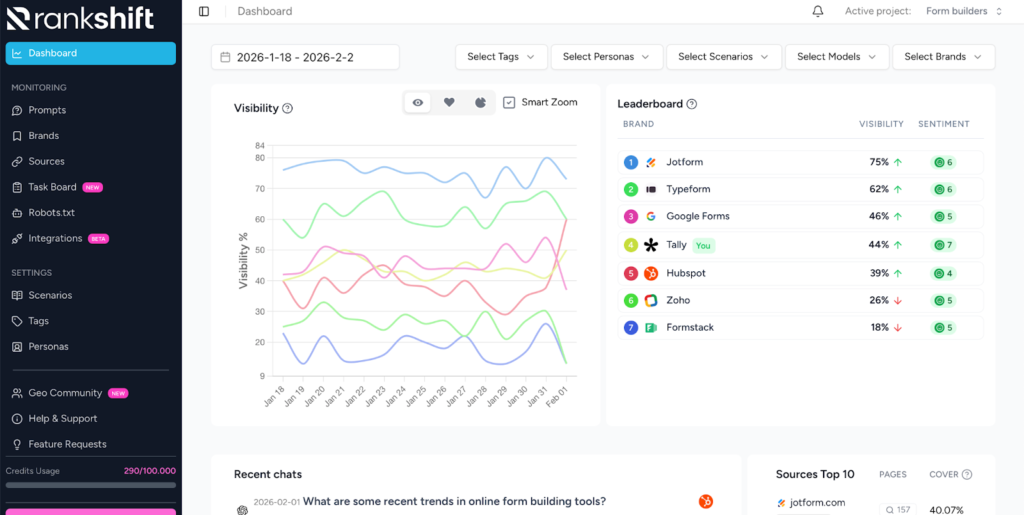
Critical step: If AI answers contain incorrect information about your brand, trace it back to the source and fix it, whether it’s your content or a third-party mention.
Build Authority Everywhere
Create content valuable enough that it naturally attracts backlinks and mentions. Earn links from authoritative domains. Get mentioned in credible sources even without links.
Also, you can contribute to industry discussions, get featured in roundups, and participate in relevant communities where your audience asks questions.
Quality content that provides real value works across both channels.
Strong fundamentals serve both disciplines. Clear writing, explicit facts, proper structure, and genuine expertise win whether a search engine or an AI engine is reading your content. You don’t optimize for GEO or SEO. You optimize for being cite-worthy and rank-worthy simultaneously.
The Future of Visibility Is GEO + SEO
Framing this as GEO vs SEO misses what’s actually changing.
SEO is still the foundation. It’s what gets content indexed, understood, and trusted across the web. That hasn’t changed. What has changed is what happens after discovery. Increasingly, AI systems decide which sources get used, summarized, and cited; often without sending users anywhere else.
That’s where GEO fits in.
Not as a replacement for SEO, but as the layer that determines whether content holds up once it’s inside an AI answer. Ranking well is no longer the final step. Being clear, precise, and usable is.
The teams that win won’t choose between GEO and SEO. They’ll optimize for both, building strong SEO fundamentals while making sure their content can survive extraction and synthesis.
That shift is already underway, whether teams are tracking it or not.
Tools like Rankshift AI exist to make that second layer visible,so SEO efforts don’t stop at rankings, and brands understand how they’re represented inside AI-generated answers.
It’s not GEO vs SEO, but GEO + SEO.
Why not try Rankshift AI and see the difference?
