
If you’re here, you probably already know what Rankability does: content optimization, AI writing, rank tracking, and AI search visibility monitoring bundled into one platform.
And you’re probably also familiar with what it doesn’t do so well: the credits that vanish mid-month, the $199/month entry price that still doesn’t cover backlinks, and the integration gaps that force you into a multi-tool stack anyway.
I’ve spent weeks digging into 9 tools across AI visibility tracking, content optimization, and full-suite SEO to find the ones that genuinely compete and solve the specific problems Rankability users run into.
Check out these 9 best Rankability alternatives worth your time, broken down by what they nail and where they don’t.
Why Teams Are Looking Beyond Rankability
I want to be upfront: Rankability isn’t a bad tool.
On G2 and Capterra, users genuinely praise the content optimizer and live coaching calls. But even its own G2 review tags surface the friction: High Costs, Integration Issues, Learning Curve, and Keyword Issues.
Check this out:

Moreover, here’s the short version of what I keep hearing: The credit system creates a huge problem.

Of course, eating too many credits is a serious issue.
Additionally, the $199/month entry price doesn’t include backlink analysis, so you’re still paying for Ahrefs or Semrush alongside it. There’s no WordPress plugin or native CMS publishing. And even the top plan caps at 15 seats.
None of this erases what Rankability does well. But stacked together, it’s worth exploring whether something else fits better.
How I Evaluated These Rankability Alternatives
I didn’t just compile a list of tools with “AI” in the name. Every tool here was evaluated against criteria that actually matter to SEO and marketing teams navigating the shift toward generative search:
1. AI Visibility Tracking Depth: Does the tool monitor brand mentions and citations across ChatGPT, Gemini, Perplexity, Claude, and Google AI Overviews? How does it collect that data, API calls (which can differ from what real users see) or UI-based scraping?
2. Content Optimization Capabilities: Does it offer real-time scoring, NLP-driven suggestions, and content briefs that help writers produce content search engines and LLMs actually want to cite?
3. Pricing vs. Value: I looked at what you actually get at each price tier, not just headline numbers. Credit systems, per-seat costs, and essential add-ons were all factored in.
4. Integration Ecosystem: How well does the tool fit into existing workflows? Google Docs, WordPress, Looker Studio, and API access all matter.
5. Team Scalability: Unlimited seats? Role-based access? Agency features? Tools that penalize you for growing your team didn’t score well.
6. User Feedback: I reviewed verified feedback from G2, Capterra, and independent review sites to get an honest read on real-world performance.
Top 9 Rankability Alternatives: Quick Comparison
| Tool Name | Best For | Starting Price |
| Rankshift AI | AI visibility tracking & citation monitoring | €69/mo or $82/mo (annual) |
| Peec AI | AI search analytics for brands & agencies | $95/mo |
| Otterly AI | Affordable AI search monitoring | $29/mo |
| Surfer SEO | Content optimization + emerging AI tracker | $119/mo |
| Jasper AI | AI-powered content creation at scale | $69/mo |
| Semrush | All-in-one SEO suite + AI visibility | $139.95/moSemrush One: $199/mo |
| Ahrefs | Backlink analysis + keyword research | $29/mo (Starter) |
| MarketMuse | Content intelligence & topical authority | Free tier; custom |
| Clearscope | Writer-friendly content optimization | $129/mo |
1. Rankshift AI – Best for Dedicated AI Visibility Tracking
Rankshift AI is purpose-built for the one thing that keeps marketing teams up at night in 2026: understanding how their brand shows up (or doesn’t) in AI-generated answers.
While Rankability bundles content optimization with AI tracking, Rankshift goes all-in on the visibility monitoring side with a depth that’s hard to match.
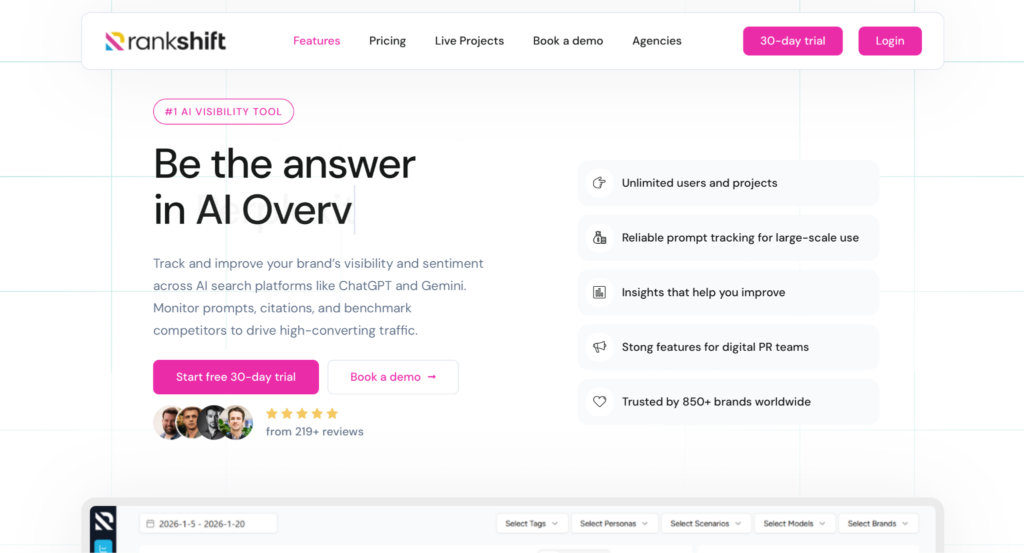
What makes Rankshift technically distinct is how it collects data. Their technology captures AI responses directly from the user interface, not API outputs. This is a meaningful difference because API responses can differ significantly from what an actual user sees in ChatGPT or Gemini. That distinction matters when you’re trying to understand real-world brand visibility.
Key Features:
- Prompt tracking across ChatGPT, Gemini, AI Overviews, AI Mode, Claude, Copilot, Perplexity, Mistral, and Llama (Meta)
- Visibility score and share of voice metrics across all monitored AI platforms
- Sentiment analysis showing how AI perceives your brand, strengths, themes, and areas for improvement
- Citation opportunity identification, see which sources AI trusts in your niche
- AI Crawler Logs tracking when AI models crawl your site and which pages get cited
- Looker Studio, BigQuery, and Power BI integrations plus full API access
Pros:
- Unlimited users and projects across every plan.
- UI-based scraping for more accurate data.
- 30-day free trial (the longest in this space).
- Clean onboarding; setup in about 3 minutes.
Cons:
- A bit of a learning curve is involved, but the support team can help.
Pricing: Starts at €69/month (billed annually) for the Starter plan with 150 prompts/day and 9.500 credits. Explore more about pricing plans.
Verdict: If your primary challenge is measuring and improving how your brand appears across AI search platforms, Rankshift AI is the sharpest tool for the job. The unlimited seats model is a genuine differentiator; most competitors charge per user, which creates friction as teams scale. Pair it with a content optimization tool like Surfer or Clearscope and you’ve got a stack that covers both sides of the GEO equation.
2. Peec AI – Best for Agency-Scale AI Search Analytics
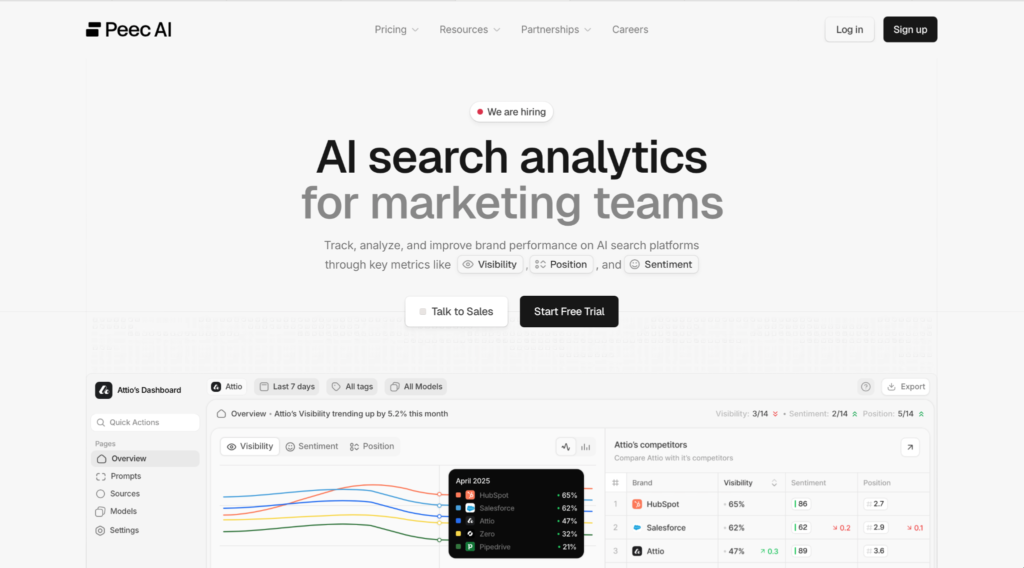
Peec AI is a Berlin-based AI search analytics platform that tracks brand visibility, position, and sentiment across ChatGPT, Perplexity, and Google AI Overviews. Additional models like Gemini, Claude, and DeepSeek are available; but as paid add-ons, not included in base plans.
The platform launched in early 2025 and has attracted VC backing, though it’s still relatively early in its product lifecycle.
Key Features:
- Visibility, position, and sentiment tracking across major AI platforms
- Competitor benchmarking with regional visibility breakdowns
- Actions module that clusters citation opportunities into owned and earned media categories
- Unlimited user seats on all plans
- Agency-specific plans with pitch workspaces and multi-project management
Pros:
- Excellent customer support.
- Clean, modern interface.
- Strong agency-oriented features.
Cons:
- Base plans only include 3 AI models, including more would cost significantly higher than the headline price.
- Primarily a monitoring tool with limited actionability guidance.
Pricing:
Brand plans start at $95/month (Starter, 50 prompts) up to $495/month (Advanced). Agency plans from $245/month to custom enterprise pricing.
Verdict: Peec AI is a strong choice for agencies that need clean reporting and client-ready analytics. But watch the add-on math, if you need full LLM coverage, Rankshift AI’s all-inclusive model often works out cheaper.
3. Otterly AI – Best Budget-Friendly AI Search Monitor
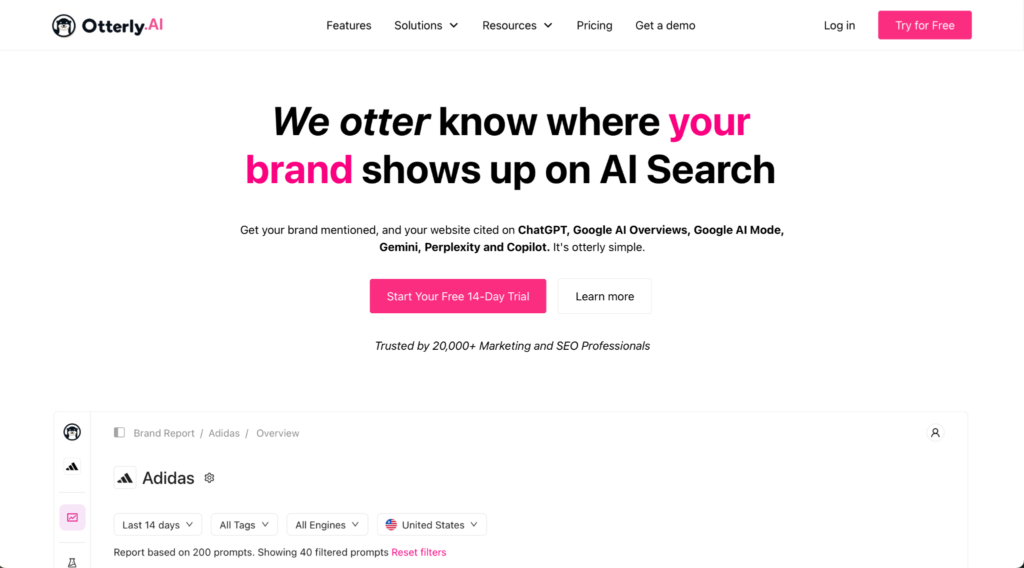
Otterly AI positions itself as the accessible entry point into AI visibility tracking, with plans starting at just $29/month.
It covers ChatGPT, Google AI Overviews, Perplexity, and Microsoft Copilot on the base plan, with Google AI Mode and Gemini available as add-ons.
The platform claims over 20,000 users and has recently added free GEO tools and an optimization guide.
Here are 7 Otterly AI alternatives you can check out in 2026.
Key Features:
- Brand mention tracking across 6 major AI platforms
- Competitor coverage analysis with share of voice metrics
- Multi-country tracking with daily monitoring
- Free GEO tools for basic optimization checks
- Agency and ambassador programs for scaled deployments
Pros:
- Most affordable entry point in the AI visibility category.
- 14-day free trial with no credit card required.
- Growing ecosystem of educational resources (GEO guides, free tools).
Cons:
- The $29/month Lite plan is limited to 15 search prompts and fewer AI engines.
- Scaling to Standard ($189/month) is a significant jump.
- Google AI Mode and Gemini are add-ons, not included in base plans.
Pricing:
Lite at $29/month (15 prompts, 4 AI engines). Standard at $189/month. Pro and Enterprise tiers for larger teams. Annual billing saves 15%.
Verdict: The $29 price tag gets attention, but the limitations at that tier are significant. Fifteen prompts won’t give you a meaningful read on your AI visibility. It’s a toe-in-the-water plan, useful for proving the concept to a skeptical stakeholder, not for running a real GEO strategy. By the time you scale to Standard, you’re in the same price range as Rankshift AI’s Starter plan, which includes more LLMs and unlimited seats.
4. Surfer SEO – Best for Content Optimization With Emerging AI Tracking
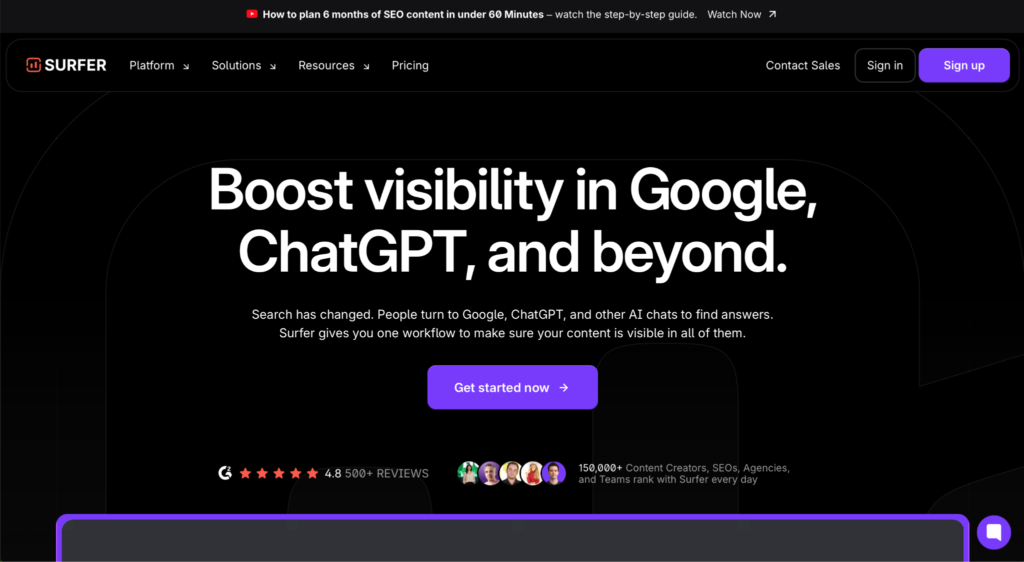
Surfer SEO is a content optimization platform; you put in a keyword, it analyzes the top-ranking pages, and gives you a content score with NLP-driven suggestions on what to include. That core workflow is solid and well-established, making it a strong Rankability alternative.
What’s newer is the AI Tracker (Discovery), a $59/month plan that monitors brand visibility in ChatGPT, Perplexity, and similar platforms. It’s more as a “check the box” feature than a serious GEO monitoring solution.
Key Features:
- Content Editor with real-time scoring based on 500+ web signals from top-ranking pages
- Topical Map for building content clusters and topical authority
- Content Audit for identifying ranking drops and refresh opportunities
- Keyword research with search intent analysis
- AI Tracker for AI visibility monitoring
Pros:
- Mature, well-tested content optimization that actually moves rankings.
- Google Docs and WordPress integrations.
- Strong community and educational resources.
- Surfer Academy for onboarding.
Cons:
- Credit system can be restrictive; some users wish for more flexible usage models. Not a full SEO suite; no backlink analysis or technical audits.
Pricing:
The paid plan starts at $119/month, including AI tracking. However, this plan only includes 25 prompts and a weekly refresh.
Verdict: Surfer remains the gold standard for on-page content optimization, I’ve used it across multiple client projects and the content scoring genuinely moves rankings. If you’re already a Surfer user and want to add basic AI visibility tracking, the AI Tracker add-on is convenient. But for serious GEO monitoring, pairing Surfer with a dedicated tool like Rankshift AI gives you deeper coverage.
5. Jasper AI – Best for Scaling Content Production
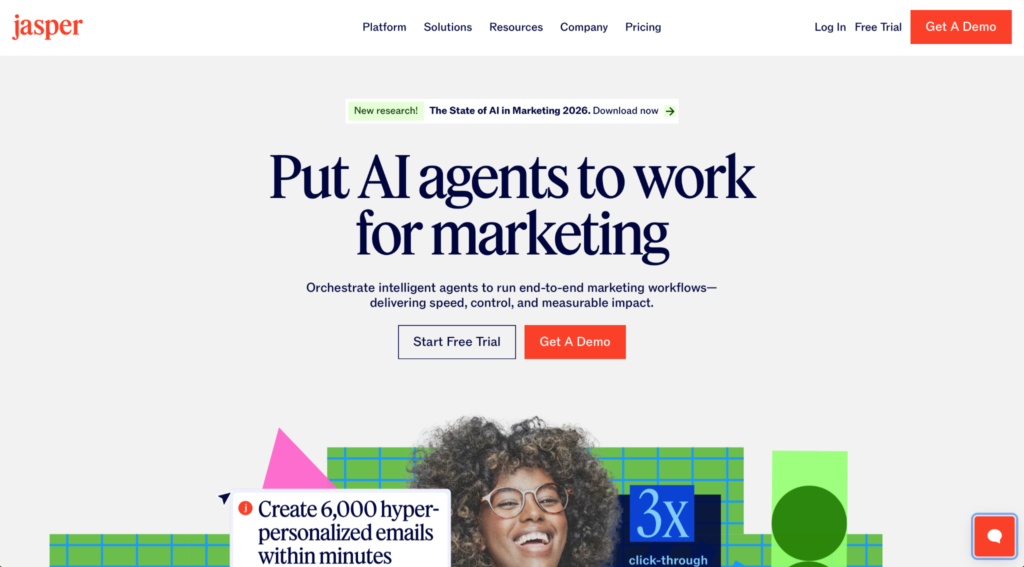
Jasper AI is another Rankability alternative that has evolved significantly from its origins as an AI writing tool. In 2026, it positions itself as a full marketing AI platform with agents, content pipelines, and enterprise governance features. The platform recently added dedicated solutions for SEO, AEO, and GEO.
That said, Jasper is fundamentally a content creation tool, not an SEO analytics platform. It solves a different problem than Rankability.
Key Features:
- AI-powered content creation across blogs, ads, emails, and social media
- Brand IQ system with brand voice, style guides, knowledge bases, and visual guidelines
- AI Agents for research, optimization, and personalization workflows
- Content Pipelines for repeatable, scalable production
- Canvas editor and Grid for team collaboration
Pros:
- Fastest content production speed in this list.
- Deep brand customization ensures output stays on-brand.
- 7-day free trial.
- Strong enterprise features including SSO, governance, and API access.
Cons:
- No AI visibility tracking.
- No SERP analysis or rank monitoring.
- Content optimization is basic compared to dedicated tools.
- User reviews note that output quality depends heavily on how well you prompt it, experienced marketers get far better results.
Pricing:
Pro plan at $69/month ($59/mo annual) per seat. Business plan with custom pricing for larger teams.
Verdict: Jasper doesn’t replace Rankability’s analytics capabilities. But if your bottleneck is content production speed; getting briefs, drafts, and variations out faster; Jasper is excellent at that specific job. Think of it as one piece of a larger stack, not a standalone alternative.
6. Semrush – The Legacy SEO Suite Adding AI Visibility
If you’re looking for a Rankability alternative that also handles backlinks, technical audits, and PPC, basically everything Rankability doesn’t cover, Semrush is the obvious choice. It’s the broadest SEO platform on the market with a 26.4+ billion keyword database and 50+ tools under one roof.
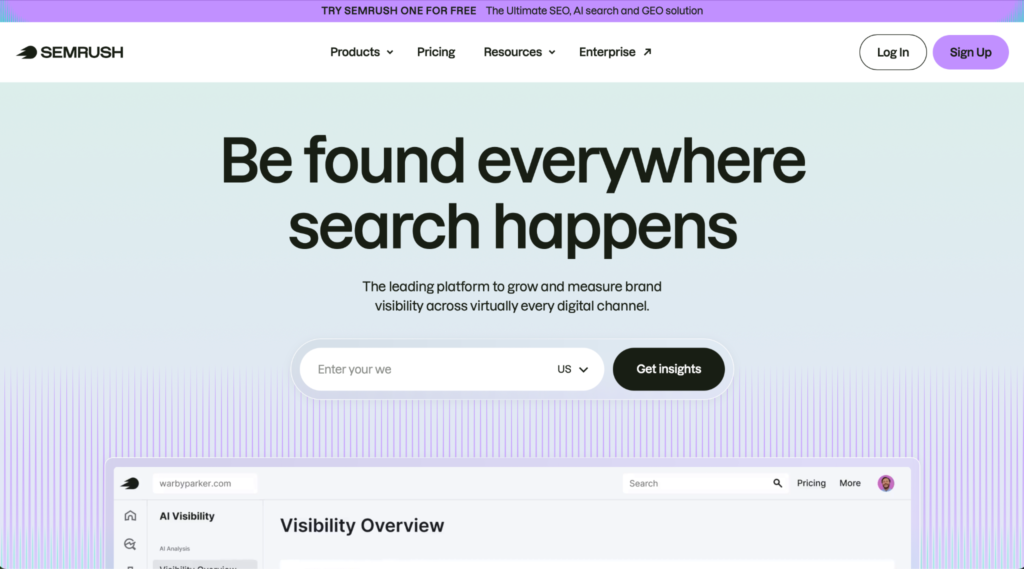
The relevant development for anyone comparing it to Rankability: Semrush launched Semrush One in late 2025, bundling their classic SEO toolkit with an AI Visibility Toolkit that tracks brand presence across ChatGPT, Google AI Overviews, and other AI platforms. On paper, that makes it a direct Rankability alternative, content tools plus AI visibility in one subscription. In practice, it’s more complicated.
Key Features:
- Full SEO suite: keyword research, site audits, backlink analysis, rank tracking, competitive intelligence
- AI Visibility tracking through Semrush One plans
- Content Marketing Toolkit with SEO writing assistant
- Local SEO, PPC, and social media management tools
- 14-day free trial available
Pros:
- The only tool on this list that genuinely covers backlinks, technical SEO, and AI visibility in one subscription.
- If you’re currently running Rankability plus Ahrefs (or similar), Semrush One could theoretically replace both.
Cons:
- The Semrush One Starter plan begins at $199/month, the same entry price as Rankability, but the AI visibility features are noticeably less developed than what dedicated LLM tracking tools offer.
- The content optimization toolkit exists but isn’t as refined as Surfer or Clearscope.
- Additional users cost extra on every plan.
- And the sheer volume of features creates a learning curve that smaller teams often don’t have time for.
Pricing:
SEO Classic: Pro at $139.95/month, Guru at $249.95/month, Business at $499.95/month.
Semrush One: Starter from ~$199/month. Annual billing saves 17%.
Verdict: As a Rankability alternative, Semrush One is the closest thing to a true all-in-one, it fills the backlink and technical SEO gaps that Rankability leaves open. But the AI visibility layer is still a bolt-on to a legacy platform, not something built from the ground up for GEO.
If AI search monitoring is your primary reason for switching from Rankability, a purpose-built tool like Rankshift AI will give you deeper coverage. If you need the full SEO suite and want AI visibility as a bonus, Semrush One is worth evaluating.
7. Ahrefs – Best for Backlink Intelligence + Emerging AI Features
Next on the list of alternatives to Rankability comes Ahrefs.
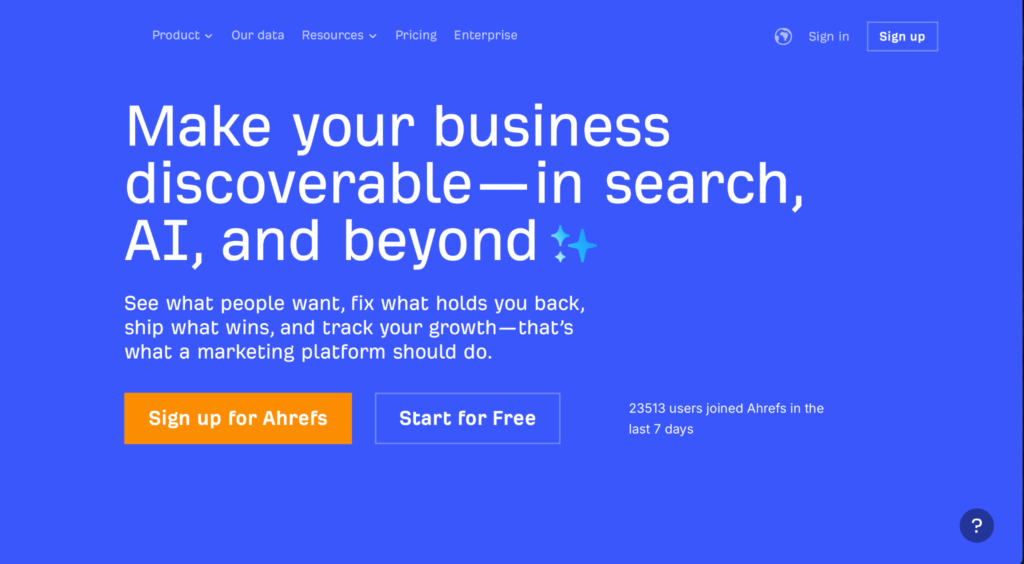
Ahrefs holds the industry’s largest backlink index and remains the tool of choice for competitive research and link analysis.
In 2026, they introduced a $29/month Starter plan and added AI-adjacent features including Brand Radar and AI URL detection through their Project Boost Max add-on.
Key Features:
- Site Explorer with the most comprehensive backlink database available
- Keywords Explorer across 10+ search engines
- Site Audit for technical SEO issues
- Content Explorer for finding top-performing content in any niche
- Brand Radar for brand monitoring (standalone available)
- Ahrefs MCP for integration with ChatGPT, Claude, and other AI assistants
Pros:
- Unmatched backlink data with 15-30 minute refresh cycles.
- The $29 Starter plan genuinely lowers the barrier to entry.
- Ahrefs MCP is a forward-thinking integration.
Cons:
- No native AI visibility tracking in the Rankability sense.
- The credit-based system on lower tiers (Lite at $129/month) creates usage friction, some users report feeling penalized for normal research workflows.
- No free trial.
Pricing:
Starter at $29/month. Lite at $129/month. Standard at $249/month. Advanced at $449/month. Enterprise at $1,499/month. For more, visit their pricing page.
Verdict: If your SEO strategy is anchored in link building, competitive analysis, and keyword research, Ahrefs is irreplaceable. But it doesn’t solve the AI visibility tracking problem. Most teams using Ahrefs for traditional SEO are adding a dedicated GEO monitoring tool alongside it, which is exactly the gap Rankshift AI fills. In short, Ahrefs isn’t a Rankability alternative, it’s a Rankability complement.
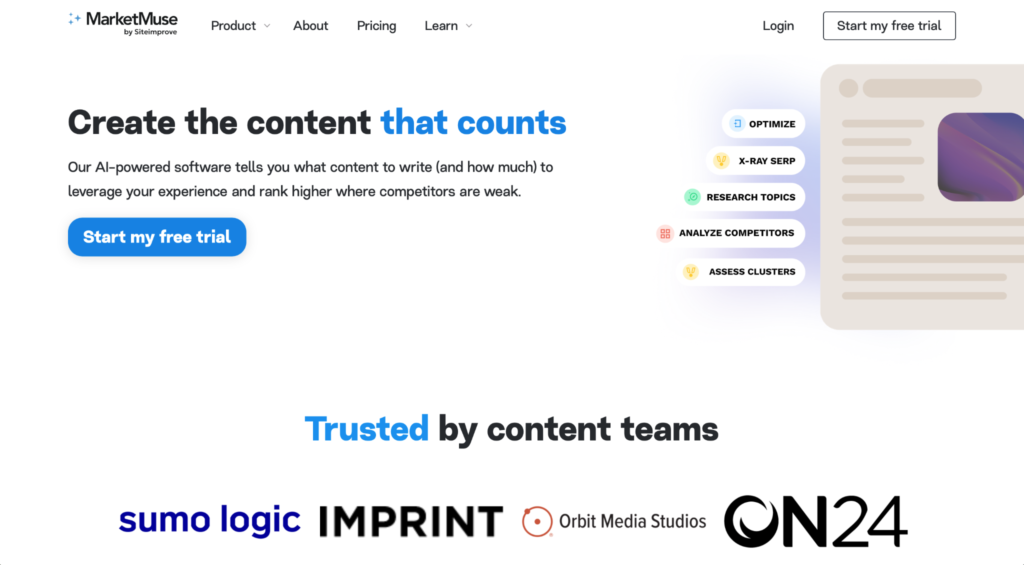
8. MarketMuse – Best for Enterprise Content Intelligence and Topical Authority
MarketMuse competes with the content optimization side of Rankability, not the AI visibility side.
Where Rankability scores individual pages against NLP benchmarks, MarketMuse maps your entire content inventory against a proprietary topic model to surface authority gaps. It’s a different philosophy, strategic planning vs. page-level optimization.
Enterprises use MarketMuse to figure out what to write, not just how to optimize what they’ve already written. If you’re leaving Rankability because you want a deeper content strategy, this is where you’d look.
Key Features:
- Content Inventory that audits your entire published library
- Personalized content scores and difficulty metrics based on your existing authority
- Competitive content analysis with SERP heatmaps
- AI-generated first drafts and structured content briefs
Pros:
- Strategic-level insights that other tools simply don’t provide.
- The personalized difficulty scoring (based on YOUR site’s authority, not generic metrics) is genuinely unique.
- Free tier available for evaluation.
Cons:
- No AI visibility tracking whatsoever.
- Pricing isn’t transparent, paid plans require contacting sales.
- The platform can feel overwhelming initially due to data density.
- No API.
Pricing:
Optimize, Research, and Strategy tiers with contact-sales pricing.
Verdict: MarketMuse is overkill for small teams or individual bloggers. But for enterprise content operations where building topical authority is the strategy, it’s unmatched. Pair it with Rankshift AI for the monitoring layer and you cover both content strategy AND AI visibility.
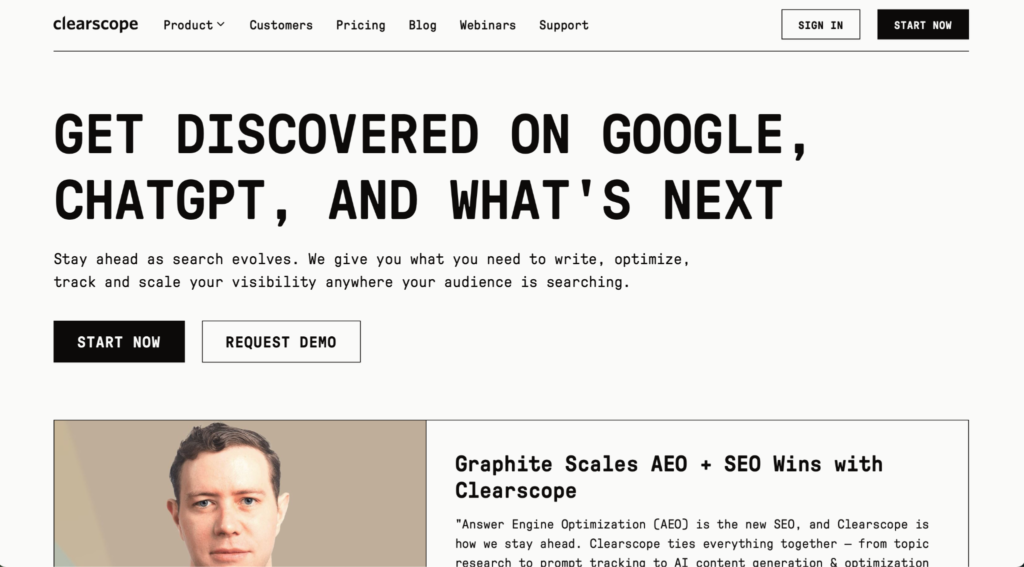
9. Clearscope – Best Writer-Friendly Content Optimization
If the content optimization scoring inside Rankability is what you use most, and you don’t care about the AI writing, keyword research, or AI visibility features, Clearscope is the focused Rankability alternative. It does one thing: helps writers produce content that aligns with search intent and ranks.
Clearscope doesn’t try to be an all-in-one platform. No keyword research tool. No AI writer. No rank tracker. And its AI visibility tracking (AI Tracked Topics) is surface-level compared to dedicated GEO tools.
Key Features:
- AI-powered content reports with semantic keyword recommendations
- Real-time content grading that writers find intuitive
- Draft with AI for faster first drafts
- Content Inventory connecting Google Search Console data to track performance
- Google Docs and WordPress native integrations
- Unlimited users and projects on all plans
Pros:
- Easiest content optimization tool to adopt across a writing team.
- Users report 70-80% faster content brief creation.
- Unlimited seats on every plan.
Cons:
- Starts at $129/month, which is higher than Surfer’s entry tier.
- No API access.
- Not a full SEO suite; no backlinks, no technical audits.
- AI visibility tracking (AI Tracked Topics) exists but isn’t as comprehensive as dedicated tools.
Pricing:
Essentials at $129/month (20 content reports). Business at $399/month. Enterprise with custom pricing. All plans include unlimited users.
Verdict: If your team’s primary need is producing well-optimized content consistently, Clearscope is the smoothest experience available. I’ve watched writing teams adopt it faster than any other SEO tool, the writer-first design philosophy genuinely reduces friction. For AI visibility monitoring, you’ll need to pair it with a dedicated tracker like Rankshift AI.
How to Choose the Right Tool for Your Team
After digging into 9 tools, here’s my honest take: there’s no universal “best Rankability alternative.” The right choice depends on which problem you’re actually solving.
If AI visibility tracking is your top priority, and you want the deepest LLM coverage with the simplest pricing model, Rankshift AI is the clear pick. Unlimited users, UI-based data collection, and support for 8+ AI models across every plan makes it purpose-built for GEO monitoring. I keep coming back to the fact that most competitors charge per LLM or per seat, Rankshift just doesn’t.
If you need content optimization first and AI tracking second, pair Surfer SEO or Clearscope with a dedicated AI visibility tool. This “best of both” approach gives you more depth in each category than any single platform can match.
If you’re an agency that needs everything under one roof, Semrush One gets you closest, but be prepared for the price tag and the reality that its AI visibility features are still maturing.
If budget is a constraint, Otterly AI($29/month for basic AI monitoring) gets you started with the AI visibility part for less than the cost of Rankability’s entry tier.
If you think in content ecosystems and topical authority, MarketMuse for strategy plus Rankshift AI for AI visibility tracking gives you both the planning and measurement layers.
The GEO landscape is still evolving fast. The LLM tracking tools that win long-term will be the ones that help you understand not just where you rank, but where and how you’re being cited in the AI-generated answers that are increasingly how people discover brands.
Bottom Line
The search for Rankability alternatives isn’t really about finding a cheaper version of the same thing. It’s about recognizing that the SEO tool world has fractured into specialized categories, and the best stack for your team probably combines purpose-built tools rather than relying on a single platform to do everything.
Rankability does a lot of things competently. But its $199/month starting price, credit limitations, and integration gaps mean most teams will get better results and better value by mixing and matching tools that excel in their specific domains.
For teams that take AI visibility seriously, Rankshift AI’s combination of comprehensive LLM tracking, unlimited seats, UI-scraped accuracy, and a generous 30-day free trial makes it the strongest dedicated alternative in this space.
Why not give it a try and see the difference?
