Can you track brand mentions in AI search? Yes. Dedicated AI visibility platforms run thousands of prompts across engines like ChatGPT, Google AI Overviews, Perplexity and Gemini, capture responses, extract brand mentions and citations, then compute share‑of‑voice, visibility and sentiment metrics. Manual tracking fails because AI answers vary with each run, rarely cite sources and […]
Log file analysis for AI bots: making sense of AI search
Large language models (LLMs) have shifted how people search for information. In traditional search, optimisers could analyse keywords, page rankings and clicks. AI search is more opaque because conversational assistants sometimes answer questions from their training data and other times retrieve fresh information through retrieval‑augmented generation (RAG). A recent clickstream study covering 80 million ChatGPT […]
Top 11 LLM Tracking Tools To Try in 2026
LLM tracking tools are becoming the new must-have stack for Generative Engine Optimization (GEO). And honestly, that shift is inevitable. We’ve spent years measuring rankings, traffic, impressions, and CTR. But today, when people ask AI for answers, none of those metrics matter if your brand isn’t showing up inside the response. Simply, if ChatGPT, Perplexity, […]
7 Otterly AI Alternatives for Better AI Search Visibility
If you’re here, you’re probably using Otterly AI, or you’ve tested it, and you’re not convinced it’s enough for serious AI visibility tracking. That’s understandable. Users praise Otterly AI for easy setup and intuitive dashboards, but they also call out a steep learning curve, cluttered UI, and difficulty turning visibility data into actionable steps for […]
AI Visibility: What It Actually Is, Why It Matters, and How to Stop Being Invisible to LLMs
Your brand might dominate Google’s first page and still be a ghost inside ChatGPT. Welcome to the new rules of discovery. There’s a revenue leak in most marketing funnels right now, and majority teams are still not paying attention. It works like this: a potential buyer opens ChatGPT (or Perplexity, or Gemini) and asks for […]
Claude AI Tracking: Monitor Your Brand’s Visibility
Generative answer engines such as Claude AI deliver concise conversational answers, often with citations, and many users now rely on them for product research, comparison shopping and general knowledge. In May 2025 Claude.ai recorded around 99.7 million visits with users spending over six minutes per session. Similar research shows that AI‑referred sessions across multiple GA4 properties jumped from 17,076 to 107,100 in […]
How to Track AI Traffic in Google Analytics
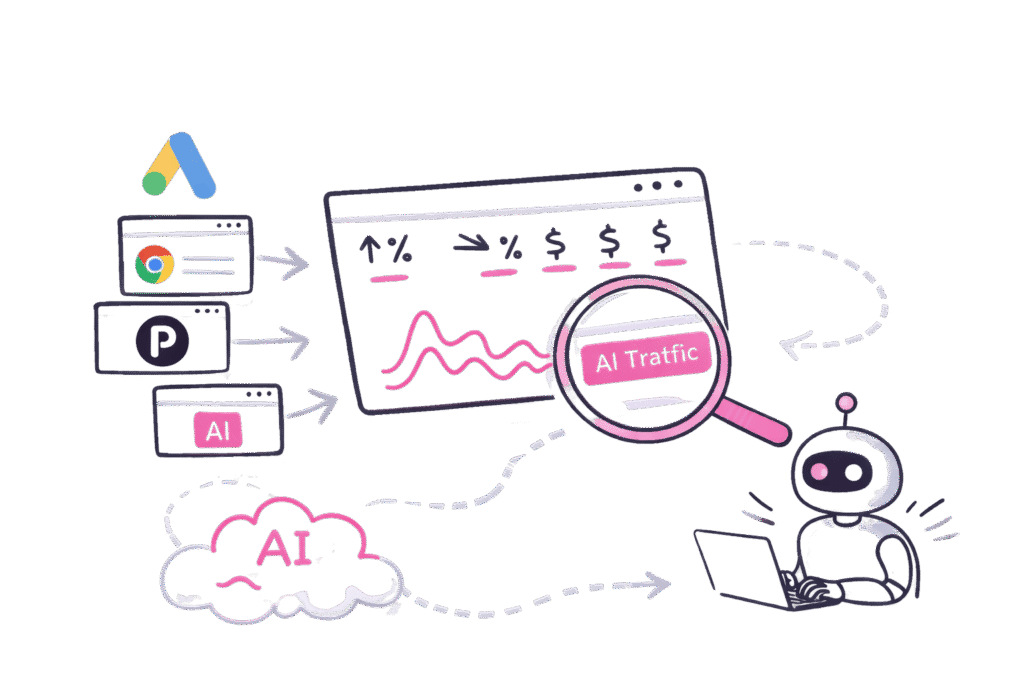
How to Track AI Traffic in Google Analytics AI chatbots are sending visitors to websites, but most marketers have no idea it’s happening. When someone asks ChatGPT or Perplexity a question and clicks through to your site, that traffic often gets buried in your analytics data or shows up as mysterious “direct” visits. Learning how […]
How to Track Perplexity Referrals in GA4 (Google Analytics 4)
Perplexity AI is an AI search engine that answers questions with citations and links back to its sources. When a user clicks one of those links your site receives a referral, and that traffic is often high intent because the user already saw a summary and chose to click through. Understanding how much traffic comes […]
How to Track Claude Referrals in GA4 (Google Analytics 4)
Millions of people ask assistants like Claude for answers, and those agents include links to the sources they trust. When someone clicks or copies one of those citations, they end up on your site. GA4, however, lumps most of those visits into “Direct” or “Referral,” because AI front‑ends often strip referrer data and the default […]
Perplexity AI Tracking: Monitor Your Brand’s Visibility And Mentions
For years SEO professionals optimised content to rank on Google’s blue links. In 2025, search is rapidly shifting toward large language models (LLMs) that answer questions directly. Perplexity AI is part of this shift. It delivers concise, conversational answers and lists the sources it uses, which has made it a trusted alternative to traditional search. […]