
Disclosure: Rankshift is our product, and yes, it appears on this list. We’ve held it to the same criteria as every other tool here like the tracking method, engine coverage, pricing honesty, and what real users say. Where competitors do something better, we’ve said so. We’d encourage you to verify everything through free trials and independent reviews like G2 before committing a budget. That’s how we’d want to be evaluated too.
Sometime in the past months, the way people find products quietly changed.
Buyers began typing their questions into ChatGPT, Perplexity, and Gemini instead, and the tools are now answering with three or four names, confidently, like there was never any doubt.
And, you have no idea if yours is one of them.
That blind spot is getting expensive.
Gartner expects traditional search to shed 25% of its volume by 2026. AI referral traffic grew 693% year over year last holiday season, and it converts 31% better than the traffic you’ve spent a decade chasing.
Out of that shift, a small industry has appeared almost overnight: AEO (Answer Engine Optimization) tools that track whether a brand shows up inside AI answers.
This blog post covers 11 best AEO tools worth knowing. What each one actually does, where it quietly costs more than advertised, and who it’s genuinely built for.
Let’s get started! 😉
First, a Definition Worth Settling
AEO (Answer Engine Optimization) and GEO (Generative Engine Optimization) are, for practical purposes, the same discipline wearing two name tags. Both describe the work of getting your brand mentioned, cited, and recommended inside AI-generated answers.
AEO leans toward the “answer” framing (Perplexity, AI Overviews, voice). GEO leans toward the “generative” framing (ChatGPT, Gemini, Claude).
The tools below don’t meaningfully distinguish between the two, and neither should you. AI visibility is the outcome both are chasing.
For the longer version, read our breakdown of GEO vs AEO.
How We Evaluated These Tools
Every “best of” list is an opinion in a trench coat. Here’s ours, with the criteria laid out so you can disagree where it matters to you:
- Tracking method: Does the tool capture answers from the actual chat interface (what your customer sees, with live retrieval and citations) or from APIs (cheaper to scale, but increasingly drifting from real-world output)? This is the most underrated line in any comparison.
- Engine coverage, and what’s actually included: Tracking ChatGPT is okay. The question is whether Gemini, Claude, AI Mode, Perplexity, and Copilot sit in the base price or get sold back to you as add-ons.
- Pricing honesty: Is the headline number what you’ll pay after a normal month of use? We did the credit math and the per-engine math so you don’t have to.
- The action layer: Does it stop at a dashboard, or does it tell you which page to fix, which source to pitch, and what to write?
- Team economics: Unlimited seats, or per-user fees that tax agencies for growing?
- Proof: What do users say on G2 after 90 days, and what results can the vendor actually name?
Now, let’s move to the tools.
The 11 Best AEO Tracking Tools: Quick Glimpse
| Tool Name | Best For | Starting Price | Engines | Standout |
| Rankshift | Agencies & in-house teams wanting UI-accurate data | $82/mo (annual) | 8+ | Chat-UI capture, unlimited seats & projects |
| Scrunch AI | Enterprise teams with JS-heavy sites | $250/mo (annual) | 7 | Agent Experience Platform (AXP) |
| Peec AI | Mid-market SaaS wanting fast setup | ~$90/mo | 3 base (+add-ons) | Speed-to-insight, MCP |
| Otterly AI | SMBs & solo marketers | $29/mo | 6 (2 as add-ons) | Cheapest serious entry point |
| Athena HQ | Teams that want an action workflow | $295/mo | 8+ | Ask Athena copilot + Action Center |
| Gauge | Teams that want tracking + content done for them | $100/mo | 7 | Data-driven content engine |
| Rankscale AI | Data-savvy agencies on a budget | €20/mo | 17+ | Most engines, lowest entry price |
| Goodie AI | Enterprise & commerce/retail | Demo-gated | 11 | Agentic commerce + AEO writer |
| Evertune AI | Enterprise brands & holding-co agencies | Demo-gated | 9 | Consumer prompt-volume panel + AI ads |
| NIghtwatch | SEO teams unifying rank + AI tracking | €79/mo | 6 | Citation Intelligence (links SERP to AI) |
| GetCito | Teams that want a tool plus a done-for-you team | Free (self-host) | 4-10 by plan | Open-source tool + managed GEO services |
| Am I On AI | SMBs wanting a weekly action plan | $100/mo | 2 | Weekly to-do list + category leaderboards |
| Writesonic | Teams wanting tracking + writing in one stack | $99/month | 7 | Bundles GEO with an AI writer |
1. Rankshift – the UI-accurate tracker built for marketing teams
Best for: Agencies and in-house teams that want ground-truth data and refuse to be charged per seat.
About Rankshift:
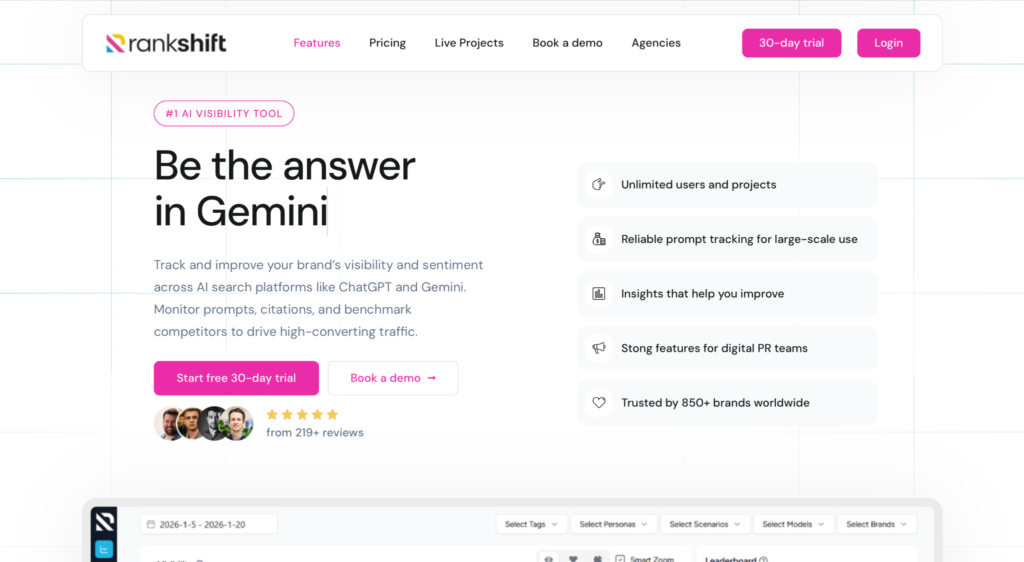
Rankshift is the #1 AEO tracking tool that reads the screen instead of the API, capturing answers from the actual chat interface your customer sees, complete with live retrieval and real citations, rather than the sanitized model output most competitors measure.
The platform helps you track how often your brand shows up across ChatGPT, Gemini, Claude, Perplexity, AI Overviews, and more, then layers on sentiment analysis, citation tracking, and AI crawler logs so you know not just whether you appear, but why.
Built in Belgium and trusted by 850+ brands including Coolblue, Salesflare, and Univé, every plan ships with unlimited projects and users, so the price never climbs when you add a brand.
Key features:
- UI-based prompt tracking across ChatGPT, Gemini, AI Overviews, AI Mode, Claude, Perplexity, Mistral, Copilot and Meta AI, pulled from the real interface, not API endpoints.
- Sentiment analysis that surfaces the themes AI associates with your brand and where perception is drifting.
- Citation analysis showing which sources (Reddit, G2, competitor blogs, your own pages) the engines actually pull from in your niche.
- Built-in AI content writer. Rankshift analyzes LLM responses and your citations, connects key concepts to relevant entities, and drafts optimized content designed to perform in answer engines.
- AI crawler logs that track GPTBot, ClaudeBot, PerplexityBot and friends hitting your site in real time, plus error monitoring.
- Unlimited projects and users on every plan, with Looker Studio, BigQuery, Power BI, and MCP/API access.
Pros:
- UI-accurate data is a real moat
- Flat pricing (no hidden costs)
- Unlimited seats and projects
- Strong fit for digital PR teams.
Cons:
- A slight learning curve at setup, though support moves fast to help.
Pricing: Starter from $82/month (annual, 9,500 credits); Professional $189/month; Business $425/month. It also offers a 30-day free trial.
My Verdict: I keep coming back to the tracking method. The first time I ran the same prompt set through a UI-based tool and an API-based one side by side, the citation lists didn’t match, and the UI version was the one that reflected what I saw when I opened ChatGPT myself. For a marketing or PR team making real budget decisions off this data, that gap is the whole game. Add unlimited projects and seats, and Rankshift AI is the rare tool that gets more cost-effective as your account grows instead of less.
Try it out for yourself and see the difference.
2. Scrunch AI – the enterprise platform for JavaScript-heavy sites
Best for: Enterprise teams whose biggest AEO problem is that AI crawlers can’t read their site.
About Scrunch AI:
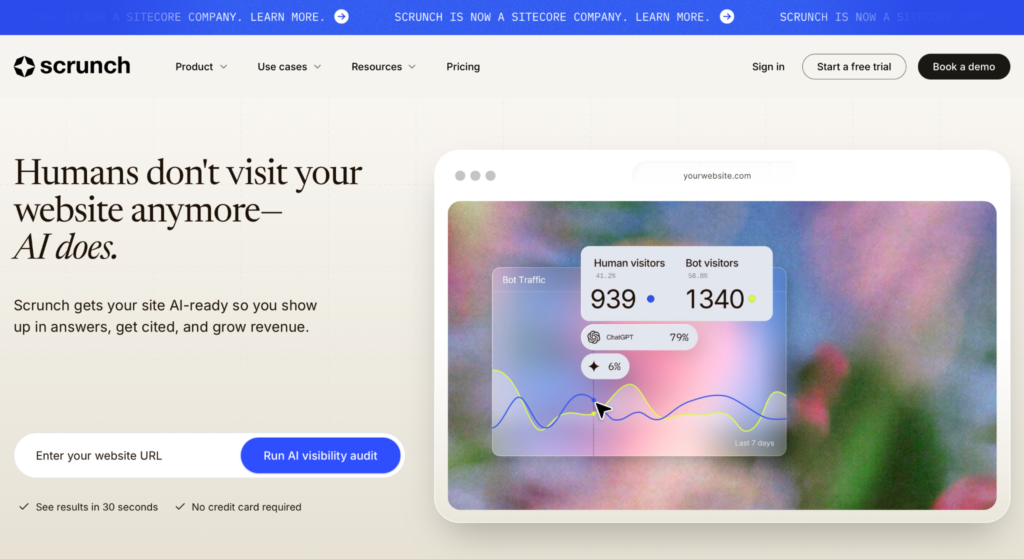
Scrunch AI covers the monitoring basics well, but its genuinely novel piece is the Agent Experience Platform (AXP), which serves a lightweight, machine-readable version of your site to AI agents at the CDN level.
If your problem is “AI can’t render my JavaScript,” that’s a clever fix nobody else does this way.
Key features:
- Prompt and topic monitoring with trends, citations, competitor benchmarking, and persona tracking.
- AXP to deliver compressed, structured pages agents can actually parse.
- Page audits, agent traffic monitoring, and error detection for crawl failures.
- Coverage across ChatGPT, Claude, Gemini, Perplexity, Google AI Mode/Overviews, and Meta.
- SOC 2 Type II, RBAC, and an Enterprise Data API.
Pros:
- AXP is genuinely differentiated
- Clean interface
- Enterprise-grade security
Cons:
- Pricing starts high
- The recommendation layer is thinner than the monitoring layer (a recurring note in reviews)
- Prompt limits count across engines, so they shrink fast
Pricing: Starter $250/month (annual) or $300 month-to-month for 3 users and 350 custom prompts; Growth $417/month (annual); Enterprise custom. Offers a 7-day free trial.
My verdict: Scrunch AI earns its place for AXP specifically. If you run a large, JS-heavy site and you’ve confirmed crawlers are choking on it, that feature alone can justify the price. For everyone else, you’re paying an enterprise entry fee for monitoring that lighter tools do for a fraction of the cost.
Also read: Scrunch AI alternatives
3. Peec AI – the fast-setup favorite for mid-market SaaS
Best for: SaaS teams that want to be looking at real data quality, not next sprint.
About Peec AI:
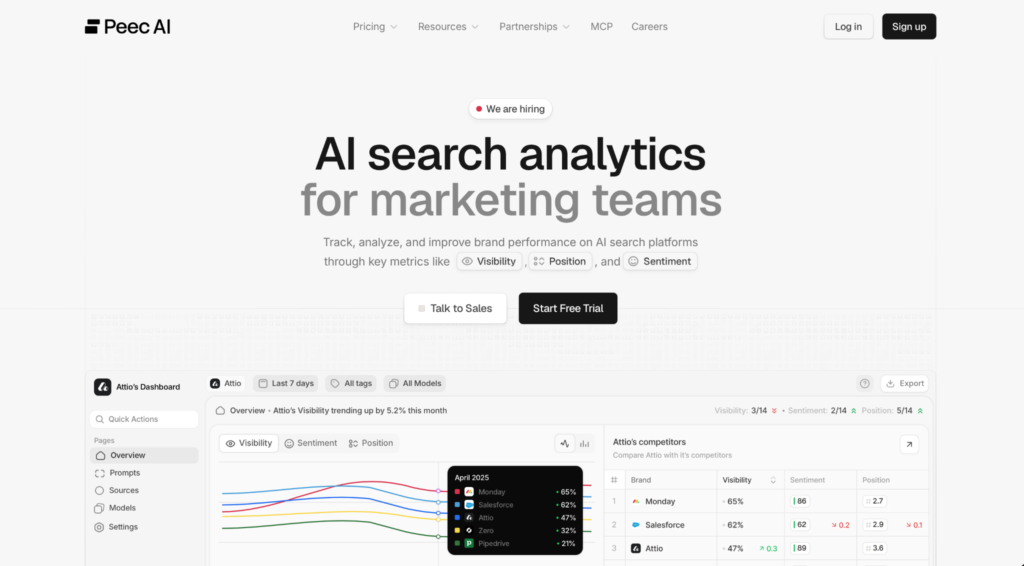
Most AEO tools bury you in metrics. Peec AI bets that you only act on three: Visibility, Position, and Sentiment, and builds the whole dashboard around them.
Peec AI auto-suggests the prompts worth tracking the moment you add your domain, so most users are looking at real data within minutes rather than days.
Moreover, it tracks the major engines on a daily refresh, surfaces which sources AI actually cites in your category, and was among the first tools to ship a Model Context Protocol (MCP) integration, letting you pipe your visibility data straight into Claude, Cursor, or n8n.
Key features:
- Daily-refreshed Visibility, Position, and Sentiment across the major engines.
- Auto-suggested prompts based on your domain and category.
- MCP integration to pipe your data into Claude, Cursor, or n8n.
- Looker Studio connector, CSV export, and API.
- Unlimited seats, with source-level “used vs cited” citation tracking.
Pros:
- Fastest setup in the category
- Clean UI; easy to use
- Unlimited seats
- Composable via MCP
- Founder-level support
Cons:
- The base plan includes only three engines, and adding Claude, DeepSeek, or Grok pushes the real cost well past the headline.
- No content-creation layer
Pricing: Starter around $90/month; higher tiers scale with prompts. Free trial available. Budget for engine add-ons.
My verdict: Peec AI wins on time-to-value, full stop. If your team’s failure mode is “we bought a tool and never finished setting it up,” Peec’s auto-prompts solve that. Just go in with eyes open on the three-engine base; the sticker is for a subset of what you probably want to track.
4. Otterly AI – the most affordable entry point for SMBs and solos
Best for: Solopreneurs and lean teams validating AI search as a channel before committing real budget.
About Otterly AI:
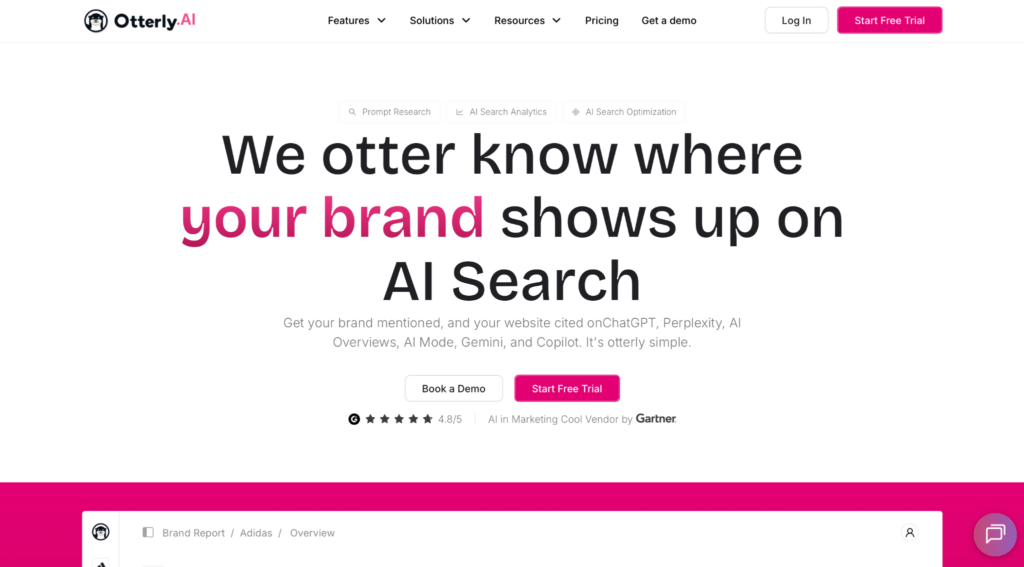
Otterly AI is the most affordable serious tool in the category, with a Lite plan at $29/month.
It tracks brand mentions and citations across ChatGPT, AI Overviews, AI Mode, Gemini, Copilot, and Perplexity, with unusually strong country-level granularity across 50+ markets.
Beyond monitoring, it turns keywords into the prompts your buyers actually use, audits your pages for AI-readiness before you publish, and shows the exact URLs each engine cites. It’s a clean, low-friction way to go from “no idea” to a real visibility baseline.
Key features:
- Coverage across ChatGPT, AI Overviews, AI Mode, Gemini, Copilot, and Perplexity.
- Per-market monitoring across 50+ countries.
- AI prompt research that turns keywords into the prompts buyers actually use.
- Content Audit with predictive AI-readiness scoring and content briefs.
- Link-level citation tracking and brand sentiment.
Pros:
- Lowest price point here; clean UI
- Genuinely useful country-level data
- Real agency workspaces on higher tiers
Cons:
- Gemini and AI Mode are paid add-ons ($9-$149/month), so the “six engines” story only holds after you pay extra.
- Lower tiers refresh weekly, not daily.
- The jump from $29 to the $189 Standard plan is steep.
Pricing: Lite $29/month (~15 prompts); Standard $189/month (100 prompts); Premium $489/month (400 prompts). 14-day free trial.
My verdict: As a first AEO tool, Otterly is hard to beat; low risk, fast setup, clear data. As your only AEO tool, it gets expensive quietly: the headline price covers four engines, and Gemini plus AI Mode cost extra. I’d use it to validate AI search as a channel, then graduate to something flatter-priced once you’re tracking seriously across a team.
Also read: Otterly AI alternatives
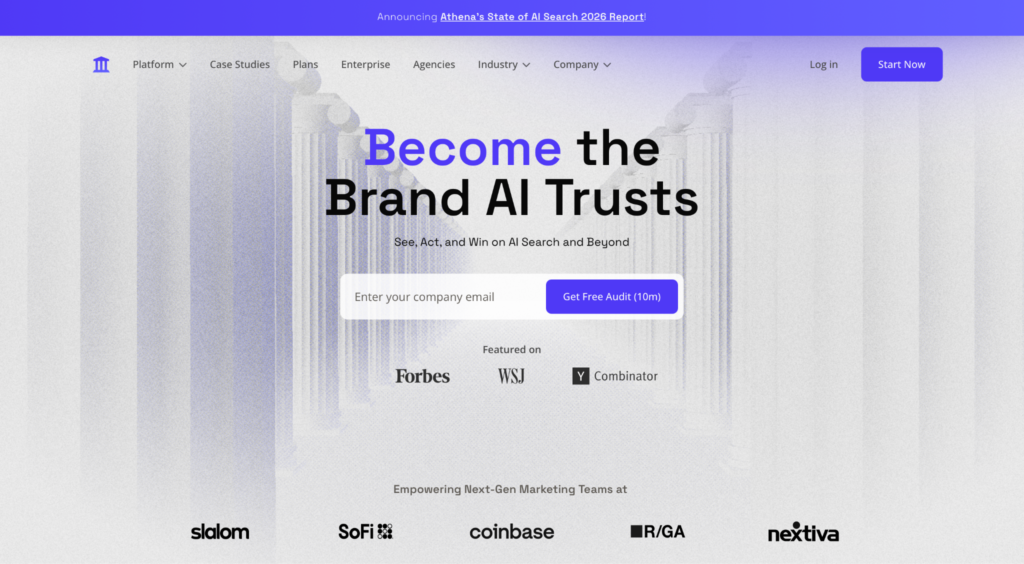
5. Athena HQ – the action-oriented copilot for serious teams
Best for: Teams that are tired of dashboards and want assignable next steps.
About Athena HQ:
Most AEO tools hand you a dashboard and leave the interpretation to you. Athena HQ flips that. Its two standouts both attack the same problem, turning data into action.
Ask Athena is an agentic copilot trained on your account’s real-time data, so instead of squinting at charts to work out why a competitor is suddenly winning on Perplexity, you ask in plain English and get a grounded answer.
The Action Center then converts visibility gaps into assignable, trackable tasks. Native GA4, Shopify, and Webflow integrations tie all of it back to traffic and revenue, which is rare in this category and exactly what a CMO eventually asks for.
Key features:
- Ask Athena copilot grounded in your real-time AEO data.
- Action Center that converts gaps into assignable optimization tasks.
- 8+ engine coverage on every plan, plus hallucination detection.
- GA4 / Shopify / Webflow integrations for revenue attribution.
- ACE Citation Engine (enterprise) and SOC 2 Type 2.
Pros:
- Best action workflow in the category
- Revenue attribution is a real differentiator
- Copilot is genuinely useful
Cons:
- Credit-based pricing means unpredictable monthly spend (3,600 credits burn fast across 8 engines)
- Self-Serve is single-country
- Persona targeting and ACE are enterprise-only
- No free trial
Pricing:
- Self-Serve $295/month (discounted to ~$95 the first month)
- Credit-based
- Enterprise custom
My verdict: If you’ve outgrown “here’s a dashboard” and need a tool that assigns the work and proves it paid off, Athena is built for exactly that, the Action Center plus revenue attribution is a genuine step up. Just budget honestly: it runs on credits, and 3,600 of them disappear fast once you’re tracking daily across eight engines. Great for a funded team with a real GEO mandate; overkill for anyone still validating the channel.
6. Rankscale AI – the credit-flexible favorite for data-savvy agencies
Best for: Technical agencies that want the most engine coverage at the lowest entry price and don’t mind credit math.
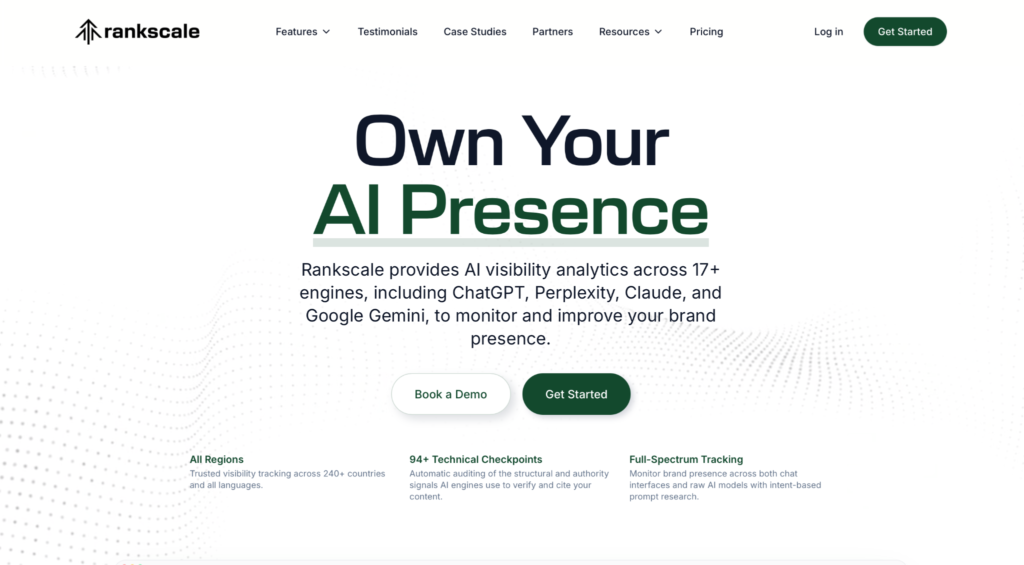
About Rankscale:
Rankscale AI covers 17+ AI engines on every plan (including GPT-5, Gemini, AI Mode, DeepSeek, Grok, and Mistral) with no per-engine upsells, all from a €20/month entry point.
It runs on credits, so you decide how to spread them across prompts, engines, and refresh frequency. It also added a ChatGPT Shopping Analysis feature in early 2026.
Key features:
- 17+ engines included on every tier (each query costs 0.25 credits).
- AI rank tracking, citation analysis, and sentiment with daily-to-hourly frequency.
- Page audits scoring AI-readiness factors per URL.
- ChatGPT Shopping Analysis for e-commerce presence.
- Looker Studio connector and a REST API (launched April 2026).
Pros:
- Most engines for the money
- Flexible credits
- Lowest serious entry price
- Free website audit without signup
Cons:
- Credit math has a real learning curve and burns faster than people expect
- The UI is dense; the “action layer” is guidance-level, not prescriptive
Pricing: Essential €20/month (120 credits); Pro €99/month (1,200 credits); Enterprise €780/month. Offers a 7-day free trial.
My verdict: For a data-literate agency that wants to slice visibility across 17 engines without paying add-on tolls, Rankscale AI is the best raw value here. The flip side is that flexibility is complexity. If your team wants to set it and forget it, the credit model will frustrate you in month one. If your team likes knobs, it’ll love them.
7. Goodie AI – the closed-loop platform for enterprise and commerce
Best for: Enterprise brands (especially retail and commerce) that want research, monitoring, action, and attribution in one loop.
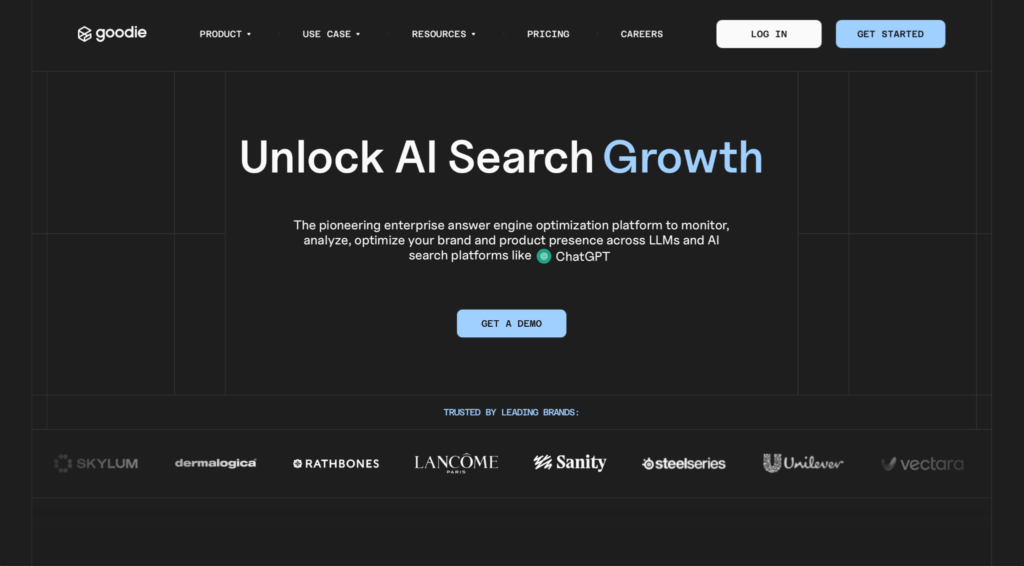
About Goodie AI:
Goodie AI positions itself as an end-to-end AEO platform built around a closed loop: Research, Monitor, Action, Measure.
While most tools track whether AI mentions your brand, Goodie also tracks whether AI recommends your products, through an Agentic Commerce Suite that monitors how your catalog surfaces across ChatGPT, Amazon Rufus, and Perplexity.
Key features:
- Prompt research with search-volume prioritization.
- Visibility monitoring with sentiment and competitive share.
- An AEO Writer that generates AI-optimized content in your brand voice.
- Agentic Commerce Suite for product visibility across ChatGPT, Rufus, and Perplexity.
- Crawler/agent diagnostics and revenue attribution; SOC 2-compliant.
Pros:
- Broadest model coverage
- Genuine commerce/agentic-shopping angle
- Closed-loop workflow with an attribution story
Cons:
- Demo-gated with no transparent pricing (a friction point if you just want to test)
- Aimed squarely at enterprise budgets
Pricing: Custom, demo only.
My verdict: If your products live in AI shopping results, Goodie AI is the most serious tool here. But it’s an enterprise buy through and through: no public pricing, demo-gated, and clearly built for catalogs and budgets at scale. Right fit for a global retail or SaaS brand; wrong one for a team still validating the channel.
8. Evertune AI – the enterprise platform with a consumer data panel
Best for: Enterprise brands and holding-company agencies that need statistical confidence and want to act on AI search as a paid channel too.
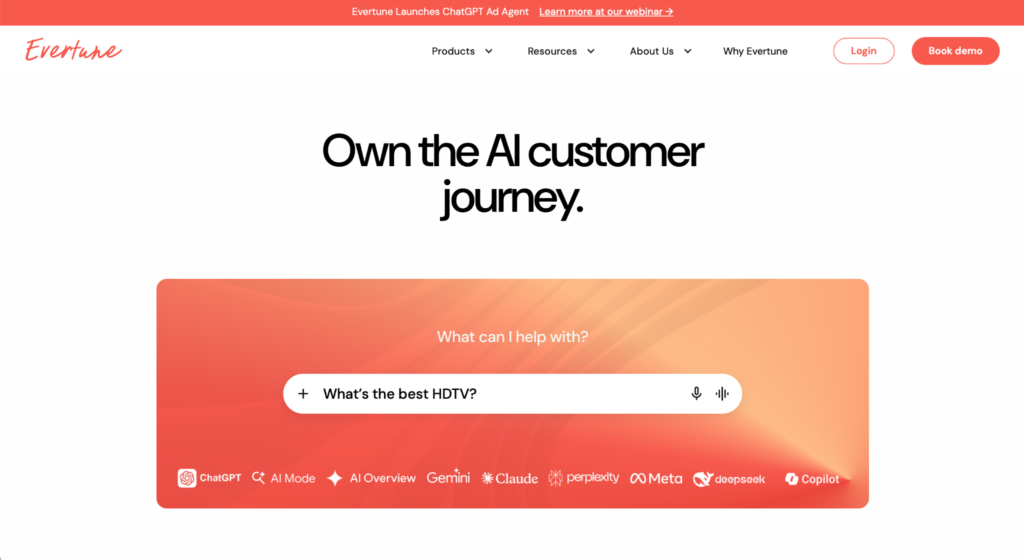
About Evertune:
Evertune is building “the marketing platform for AI search as a channel.” It runs four products: User Insights (powered by EverPanel, a consumer panel spanning 150M+ prompts), GEO monitoring, Content Activation, and an AI Advertising agent.
Most AEO tools tell you whether you appear for a prompt. Evertune tells you how often real people ask that prompt in the first place, the difference between optimizing for vanity queries and optimizing for actual demand.
It monitors brand visibility across nine engines, then extends into content activation and an AI advertising agent, the only tool here treating AI search as a channel you can both earn and buy into.
Key features:
- EverPanel consumer panel showing real prompt volumes and AI usage behavior.
- Statistically significant brand monitoring across 9 engines.
- Content Activation that maps the product attributes and sources driving recommendations.
- Visibility Boost Ad Agent (the first ads agent built directly on visibility data).
- Direct LLM integration plus consumer-app data.
Pros:
- The prompt-volume panel is a real data advantage
- Statistical rigor
- The only tool here is treating AI ads as a first-class product
- Strong enterprise logos
Cons:
- Demo-gated
- Built for enterprise scale and budgets
- The ads layer is overkill for teams that just need monitoring
Pricing: Custom, demo only.
My verdict: Evertune’s edge is the consumer panel. Most tools tell you whether you appear for a prompt; Evertune tries to tell you how often real people ask that prompt in the first place, which is the difference between optimizing for vanity queries and optimizing for demand. If you’re a large brand thinking about AI search as a channel to both earn and buy your way into, this is the most ambitious platform on the list.
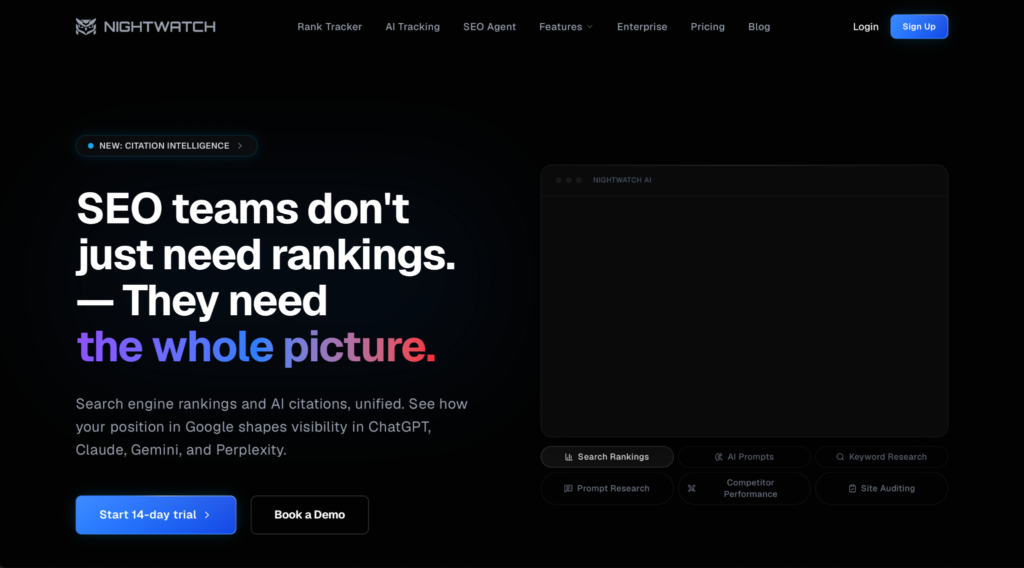
9. Nightwatch – for SEO teams unifying rank tracking and AI
Best for: SEO teams that don’t want a second tool and believe rankings and AI citations are connected (they are).
About Nightwatch:
Most AEO tools were born last year. Nightwatch was a rank tracker for over a decade before it added AI, and that heritage is exactly its argument: AI engines cite what already ranks, so tracking the two in isolation misses the link between them.
Its standout feature, Citation Intelligence, makes that link visible, tracing how a movement in your Google rankings predicts a shift in your AI citations.
Around it sits genuinely deep rank tracking (107,000+ locations, with every check stored as raw HTML for verification) alongside AI visibility across ChatGPT, Claude, Gemini, Perplexity, AI Mode, and AI Overviews. One platform, both sides of search.
Key features:
- Unified rank tracking and AI visibility (ChatGPT, Claude, Gemini, Perplexity, AI Mode, AI Overview).
- Citation Intelligence connecting SERP position to AI citations.
- NightOwl, an automated SEO agent for gap analysis and optimizations.
- Zip-code-level local tracking and a 3-year SERP archive.
- White-label reports and unlimited seats on every paid plan.
Pros:
- One platform for SEO and AEO
- Verifiable accuracy
- Unlimited seats
- Genuinely useful for agencies running both
Cons: AI prompt limits are modest on lower tiers; it’s an SEO tool that grew into AEO, so the AI layer is less deep than purpose-built monitors.
Pricing: Starter €79/month; Professional €159/month; Agency €399/month; Enterprise custom. 14-day free trial, no card.
My verdict: Nightwatch’s thesis (AI cites what ranks, so track both) is correct and underrated. For an SEO team that’s been asked to “also do the AI thing,” consolidating into one tool with shared data beats running two dashboards that never talk to each other. If AEO is your whole job, a specialist will go deeper, but for hybrid teams this is a smart, honest buy.
10. Am I on AI – the to-do-list approach for SMBs
Best for: Small teams that don’t want analytics, they want a weekly list of things to do.
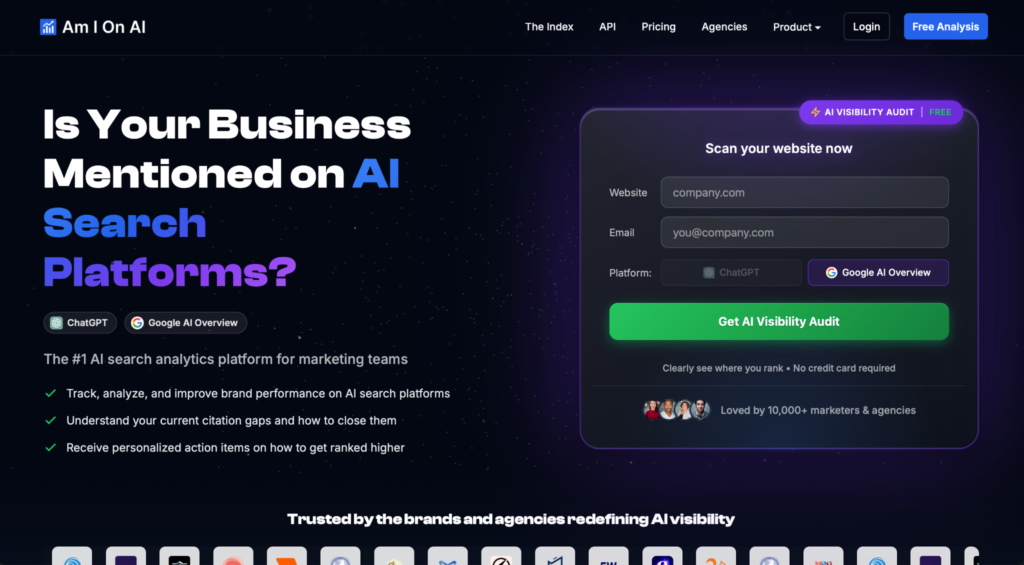
About Am I on AI:
The trouble with most of AEO tools isn’t that they lack data, it’s that they leave you staring at it, unsure what to do next. Am I on AI is built for exactly that paralysis.
Rather than another dashboard, it generates a prioritized weekly action plan, concrete tasks like commenting on a specific Reddit thread or publishing a particular article, each mapped to the sources shaping your AI visibility.
It tracks mentions across ChatGPT and Google AI Overview, then measures before-and-after impact so you can prove which moves landed. Its public Index of category leaderboards adds an easy way to see how you rank against competitors.
Key features:
- Brand monitoring across ChatGPT and Google AI Overview.
- Weekly, personalized action items mapped to source domains.
- Before/after impact tracking on actions you’ve taken.
- The Index: category-level AI visibility leaderboards.
- Mindshare API and agency white-label program.
Pros:
- The clearest action layer for non-experts
- Before/after tracking proves what worked
- Affordable for SMBs
Cons:
- Only two engines (no Perplexity, Claude, or Gemini), which is a real gap for a category where buyers care about five
- Less suited to teams that want deep analytics
Pricing: Pro $100/month; Business custom; agency plans available. Offers a 14-day free trial.
My verdict: If you want answers, not analytics, Am I on AI delivers a weekly to-do list beats a dashboard nobody acts on, and the impact tracking keeps you honest about what’s working. But it only covers ChatGPT and Google AI Overview, so if your buyers live in Perplexity or Claude, you’re flying blind on half the channel. Great for a small team that wants direction; too narrow for anyone who needs full-engine coverage.
11. Writesonic – tracking plus content creation in one stack
Best for: Teams whose real bottleneck is producing the content, not just spotting the gap.
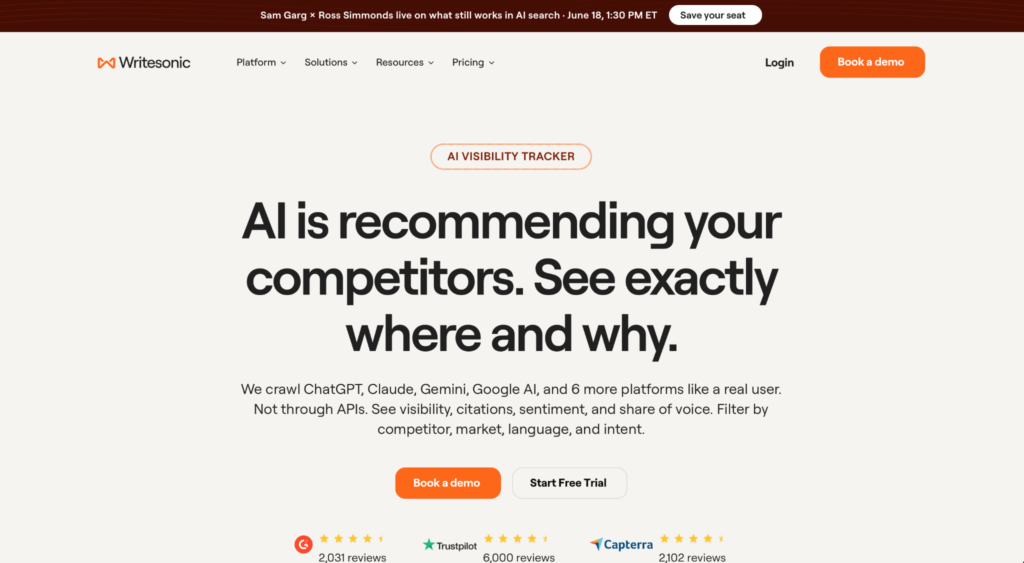
About Writesonic:
Writesonic closes the loop most monitoring tools leave open.
Its Brand Presence Explorer tracks visibility, share of voice, and sentiment across seven engines, while a built-in AI writer and SEO optimizer let you draft and publish the fix without leaving the platform.
Its AI Traffic Analytics product (free) captures AI crawler visits that Google Analytics misses.
Key features:
- Brand Presence Explorer across ChatGPT, Claude, Gemini, AI Overviews, Copilot, Meta AI, and Perplexity.
- AI Traffic Analytics (free) for crawler and AI-referral visibility.
- Citation source intelligence for your category.
- Built-in AI writer and SEO optimizer to act on gaps immediately.
- Recommendations keyed to AI ranking factors, not just classic SEO.
Pros:
- Monitor-then-write in one workflow
- The free AI Traffic Analytics tool is genuinely useful on its own
- Strong multi-engine coverage
Cons:
- If you already have a content workflow, you’re paying for tools you won’t use
- The monitoring is solid but not best-in-class
Pricing: The paid plan starts at $99/month; AI Traffic Analytics is free.
My verdict: Writesonic is the answer to a specific frustration: “the dashboard told us what’s broken but we still have to go write the thing.” If your team is small and content production is your constraint, bundling tracking and writing is a real time-saver. If your content engine already hums elsewhere, buy a sharper monitor and skip the bundle.
How to choose the right AEO tool
Forget the feature checklists for a second. Three questions settle most decisions:
1. What tribe are you actually in?
If you only need to see where you stand, a monitor (Otterly, Peec, Nightwatch) is enough and you shouldn’t overpay. If you need to fix things, you want an action layer (Athena, Am I on AI, Rankshift’s citation analysis). If you need to track, recommend, write, and attribute revenue under one roof, you’re in full-stack territory (Goodie, Evertune, Writesonic).
2. How honest do you need the price to be?
Credit-based and per-engine-add-on models (Athena, Rankscale, Otterly, Peec, SE Ranking) reward teams that enjoy optimizing usage and punish teams that want a predictable invoice. Flat-rate, unlimited-seat models (Rankshift, Nightwatch) reward teams that want to budget once and stop thinking about it. Neither is “better.” They’re built for different temperaments.
3. Do you trust the data?
This is the one most people skip. Ask any vendor a single question: do you capture from the chat UI or the API? UI capture reflects what your customer sees, including live retrieval and citations. API capture is cheaper to scale but increasingly drifts from reality. If you’re making spend decisions off the numbers, fidelity isn’t a nice-to-have.
My honest recommendation: shortlist two tools that fit your tribe, run them in parallel for 14 days on the same prompt set, and let the data pick the winner. This category moves too fast to commit on vibes, and most of these tools have free trials precisely so you can do this.
Choose the #1 AEO Tool – Rankshift
Somewhere in the time it took to read this, a buyer asked an AI engine to recommend a tool in your category, and it answered without hesitation. The only variable you control is whether your brand is in that answer next month, and you can’t move a number you can’t see.
That’s the entire case for tracking, and it’s why fourteen tools now compete to do it. The category has converged enough that the marketing copy won’t help you choose. What will: knowing your tribe, doing the credit-and-add-on math before you sign, and asking every vendor whether they capture from the chat UI or the API.
Pick two finalists, run them in parallel for 14 days, trust the data.
If you want UI-accurate visibility and pricing that scales with you instead of against you, Rankshift is the one you should definitely try; free for 30 days, unlimited projects and users, no card required.
This is a fast-moving category and a topic many teams are still figuring out. If you’re weighing a tool, start with a free trial before you commit budget, and verify current pricing on each vendor’s site, since these numbers shift quickly.
